Asks Jonathan to institute enquiry
SERAP seeks UN sanction against FG
By IKECHUKWU NNOCHIRI & WOLE MOSADOMI
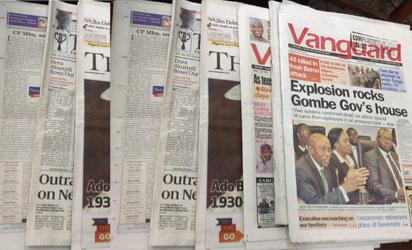
AS the military clampdown on newspapers distribution in the country entered the fourth day yesterday, Nigerian Bar Association, NBA, has urged President Goodluck Jonathan to institute an inquiry into the development.
With the clampdown, which started last Friday, continuing in Minna yesterday, the Socio Economic Rights and Accountability Project, SERAP, called on the United Nations, UN, to sanction the Federal Government.
Condemning the development, NBA, in a statement by its National President, Chief Okey Wali (SAN), described the action of the military as undemocratic.
Wali said: “Clampdown on newspapers distribution is not and cannot be a language in a democracy and we do not understand what the defence spokesman and the Presidency are saying. We expect a clarification from the government. This they must do as soon as possible.
“The Nigerian Bar Association hereby calls on President Jonathan to institute an inquiry into what actually happened on Friday and Saturday June 6 and 7, when it was alleged that there was a clampdown on newspapers distribution in Abuja and other parts of the country.
“Nigerians need to know why such military action must take place in a democracy. It is in the interest of all that we get to the root of this matter. A free press is a cardinal point of any democracy.”
Clampdown continues in Minna
The clampdown on some newspapers by the Military continued in Minna, Niger State, yesterday, as some of national dailies were restricted from being circulated.
For the past four days, the Military check points along Abuja Suleja Minna road has been the seizure point of some of the dailies where drivers and distribution vans are arrested and delayed for hours until the titles being carried for sale become stale.
Some military men were also drafted to the distribution centres where parcels of newspapers were thoroughly searched and cleared before being displayed on the stands.
At the distribution centre, yesterday, the Military allowed Tribune, ThisDay, Union, Sun, The Guardian to sell after searching.
Vanguard, which was seized along with Leadership newspapers was later removed from the van conveying it and was distributed while the Nation and Trust were not allowed to be circulated. The Military later left the distribution centre around 12 noon.
The state chairman of the Vendors Association, Mr. Festus Elisha in an interview with Vanguard, appealed to the appropriate authorities to wade into the ongoing confusion before it degenerates into bigger problems.
He said: “One way or the other, it is affecting the economy, especially vendors. We do not have any other source of income than the sale of these papers and for the past four days, our income has been greatly affected and if allowed to linger on, we will find it difficult to feed.”
Besides the economic implication, “even the presence of fully armed Military in our midst for the past four days is scaring and their presence may even scare readers from stopping to pick their papers. We beg that government should intervene on the issue urgently.”
SERAP
Reacting to the development, SERAP asked the UN Special Rapporteur on the promotion and protection of the right to freedom of opinion and expression, Mr. Frank La Rue, to “issue urgent appeal and measures to stop the government of President Goodluck Jonathan from harassing and intimidating media houses and newspapers.”
SERAP, in a petition yesterday by its Executive Director, Adetokunbo Mumuni, said: “Unless the Special Rapporteur takes action urgently, the effective enjoyment of the right to freedom of expression and media freedom will continue to be under grave threat.
“The seizure and censorship of major newspapers critical of government’s policies amounts to undue and impermissible external interference in the operations of independent media houses.
“This apparently unlawful action has in turn negatively impacted on the citizens’ effective enjoyment of the right to freedom of opinion and expression.”
Specifically, SERAP urged the Special Rapporteur to issue urgent appeal and measures to stop the continuing harassment and intimidation against independent media houses; remind the government of its duty to take immediate remedial measures and actions to eliminate these unjustified restrictions on the right to freedom of expression and the media.
It also wants UN to ask the government to adopt measures necessary to guarantee the protection of journalists and media houses.
Mumuni said SERAP “continues to receive information about continuing threats against, and harassment of, independent media houses solely for exercising their right to freedom of expression and the media.
… demands compensation
“SERAP is seriously concerned about these violations and infringements of the right to freedom of expression and the media. Rather than thoroughly investigating the violations bringing suspected perpetrators to justice, apologising and paying adequate compensation to the media houses concerned, the government has justified them on the flimsy ground that newspaper distribution channels may have been infiltrated by some persons to transport “materials with grave security implications.
“By this action the government is exerting pressure on the media houses. This demonstrates the government’s increasing intolerance for the peaceful exercise of the rights to expression, opinion, information, association and assembly by the citizens.
“This action also contradicts the fundamental principles of pluralism, tolerance and broad-mindedness, without which there can be no democratic society.
“SERAP believes that there can be no freedom unless thought is free and unrestricted; not free thought for those who agree but freedom for the thought others or we dislike.
“It is only from the clash of ideas that truth can emerge, for the best test of truth is the power of thought to get itself accepted in the competition of the market of ideas.
“The right to freedom of opinion and expression is a core right of the International Covenant on Civil and Political Rights and the African Charter on Human and Peoples’ Rights both of which Nigeria has ratified.
Of rights, duties
“This right is important not only for protecting the citizens against undue infringements of the State but also guaranteeing effective participation of individuals and media houses in political life. As such, the right to freedom of expression can be described as an essential test right, the enjoyment of which illustrates the degree of enjoyment of other human rights.
“The respect for this right reflects a country’s standard of fair play, justice and honesty. Freedom of expression is applicable not only to information and ideas that are favourably received or regarded as inoffensive or as a matter of indifference, but also to those that offend, shock or disturb the State or any sector of the population.”
The organisation recalled that “the Security Council resolution 1738 (2006) has condemned deliberate attacks against journalists, media houses, professio-nals and associated personnel even in situations of armed conflict” and called upon all parties to put an end to such practices.
According to this resolution, “all States including Nigeria are to respect the independence of media houses and to comply with the relevant obligations under international law to end impunity and to prosecute those responsible for serious violations of the right to freedom of expression and media freedom.”
Disclaimer
Comments expressed here do not reflect the opinions of Vanguard newspapers or any employee thereof.