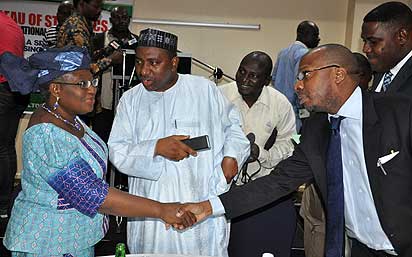
*Briefing on Result of GDP in Nigeria: Minister of Finance and Coordinating Minister of Economy, Dr. Ngozi Okonjo –Iweala chatting with Minister of National Planning Amb. Bashiru Yuguda and Statistician –General of the Federation and CEO of National Bureau of Statistics Dr. Yemi Kale during presentation of Preliminary Results of the Rebased Nominal Gross Domestic Product ( GDP) Estimates from Nigeria 2010 to 2013 held in Abuja. Photo by Gbemiga Olamikan.
The word ‘rebasing’ has been added to the already colourful Nigerian vocabulary, after a team of world class economists reassessed the Nigerian economy and updated Gross Domestic Product (GDP) figures to include new sectors of the economy including the telecommunications value chain , the film industry (Nollywood) amongst others, with the conclusion that Nigeria has now Africa’s largest economy.
Conspicuously absent in the rebasing is the valuation of unpaid women’s work in the home and within the community, particularly rural ones. The economic team has failed to provide us information on the value of women’s work and its contributions- real or potential- to the $510b GDP at the presented, and the projected $600b in 2016.
The unpaid work that women perform for their households and families is absolutely necessary for the functioning of the rest of society. Indeed our monetary economy is dependant on women’s reproductive and care-giving work for the health, well-being and indeed the very existence of the paid work force.
The economy also relies heavily on women to pick up the slack which the paid economy ignores – nursing elderly people, tutoring and child care. Unpaid work is as much a part of the monetary economy as paid work. Yet precisely because it is unpaid, unpaid work has long been overlooked and undermined in economic equations.
Tracking unpaid work will give economists a better measure of all goods and services in the economy. More discerning economies have done this, and in fact evaluating unpaid work was also on the agenda at the Beijing United Nations’ World Conference on Women in 1995. Twenty-two countries including India, South Africa, and Sweden have done time use surveys.
38%
Because unpaid work is unpaid, many women must try to fit in paid work around it creating increasingly stressful lives. One Canadian study showed that 38% of working mothers are severely time stressed, averaging 74 hours of paid and unpaid work each week. The situation for single mothers is particularly difficult as they are unable to rely on another partner to bring in an income.
Because most unpaid work takes place in the home, women who do primarily unpaid work can be isolated and at greater risk of physical, emotional, and/or sexual abuse.
$319b
Women perform 2/3 of unpaid work in Canada worth up to $319 billion to the economy and the equivalent of millions of full-time jobs.
100%
Bangladeshi women work on average 16 hours each day unpaid. This total unpaid 771.2 million hours of yearly work has an estimated value of US$70 to $91 billion, more than 100% of GDP
6-8 hours
In India a typical woman’s day starts by 5 a.m. and ends after 10 p.m. In addition to their unpaid tasks, many women spend six to eight hours daily at paid work. Assigning even a very low wage for women’s unpaid tasks yields an annual figure of US$612.8 billion, or 61% of GDP.
70%
Men and women spend about the same amount of time working, on average seven hours a day, or 49 hours a week. However females spent two hours a day more than males on unpaid work, while males spent two hours a day more than females on paid work. While approximately 60 percent of males’ work is paid, almost 70 percent of females’ work is unpaid.
1.9 hours
Around 95 percent of caregiving time involves caring for children, with the majority of this being for children of pre-school age. Those who spend the most amount of time caregiving are those in the peak child-raising ages of 25 to 44, as Figure 5 shows. Responsibility for this task falls largely to women, with those aged 25 to 34 spending 1.9 hours a day on caregiving compared with men’s 0.6 hours. Women aged 35 to 44 averaged 1.6 hours compared with men’s 0.9 hours. In older age groups, time spent on this activity falls quite markedly and there is little difference in the participation of men and women. In these age groups, caregiving often involves looking after older family members.
Disclaimer
Comments expressed here do not reflect the opinions of Vanguard newspapers or any employee thereof.