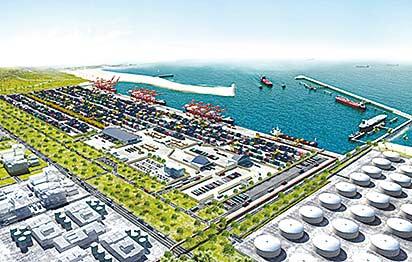
* Lekki model sea port
By Clara Nwachukwu
In the recent times, the Nigerian National Petroleum Corporation, NNPC, has been faced with a legion of issues relating to crude theft and pipeline vandalism, divestments, finance and accountability, products distribution and a host of many others.
Some of these issues particularly those of crude oil theft, finance and accountability has occupied the public discourse and further compounded by the allegedly induced recent fuel shortages.
While these challenges remain daunting, the Corporation said it is resolute in its determination to become a globally competitive national oil company, NOC, of other oil producing countries in the likes of the Saudi Aramco, Venezuela’s PDVSA, or even Algeria’s Sonatrach and many more.
Rather than allow these challenges to weigh it down or distract it from its bigger objective of becoming a world class company, the incumbent leadership of the NNPC, under the watch of the Ministry of Petroleum Resources, has struggled to take them on in its strides.
Fuel scarcity
While still smarting from allegations of financial impropriety levied against it by the Central Bank of Nigeria, CBN, the country was thrown into another round of nationwide fuel scarcity with attendant negative economic impact.
Although fuel marketers attributed the supply shortages to delays in the release of the quarterly import allocations, outstanding subsidy payments and a host of others, but the Ministry and NNPC insisted that the scarcity was artificially induced.
Petroleum Minister, Mrs. Diezani Alison-Madueke, while on a two-day intensive monitoring of fuel depots and retail outlets in Lagos, promised to apply full sanctions against any oil marketer or petroleum product dealer found culpable in the hoarding or diversion of products.
While re-assuring Nigerians of enough products in strategic reserves to meet the demand, she said, “…It appears there are lots of factors militating against efficient delivery of fuel. We learnt for example that some tanker drivers were changing the number plates of their trucks after loading to make it difficult for tracking. This is obviously being done to aid diversion of products from areas that are meant to receive them to other areas.”
Accordingly, she directed the ministry’s relevant agencies including the Department of Petroleum Resources, DPR; Petroleum Products Pricing Regulatory Agency,PPPRA, as well as the marketing arm of the NNPC, Pipelines and Products Marketing Company, PPMC, to arrest the situation.
”I want to establish that there is diversion. If we can establish there is, I want to know when and how this is being done. They need to supply me how these trucks are being tracked because diversion is not easy to do. The perpetrators will be sanctioned and I’m ready to publish names of anybody that may be involved,” she said.
Apart from the ministerial directive,NNPC as the supplier of last resort, in the wake of the scarcity had immediately swung into action by releasing additional 209 million litres of petrol for distribution nationwide, the bulk of which was for the Lagos market.
NNPC’s Group Managing Director, Mr. Andrew Yakubu, also undertook a similar monitoring of products distribution in Abuja the nation’s capital. He disclosed that the Corporation had increased the number of trucks loading for Abuja from 100 to 150 per day, where each truck carries approximately 33,000 litres.
Finance and remittances
Since late last year, the NNPC has battled with allegations by the CBN Governor, Mallam Sanusi Lamido Sanusi over the non-remittance of about $49.8 billion into the Federation Account. It took a Joint Audit Committee made up of the ministries of Finance; Petroleum Resources; Federal Inland Revenue Services, FIRS, the CBN; and NNPC to discover an un-reconciled $10.8billion.
Even at this, the NNPC’s Group Executive Director, Finance, Mr. Ben Otti, clarified that the outstanding sum is not missing. He said some of this could be traced to maintaining a national strategic reserve of 40 million litres for 32 days worth about $0.37 billion; products and crude oil losses, $0.72billion; and pipeline management and repairs of $1.22 billion.
Otti went further to quote that these expenditures were supported under the NNPC Act,Section 7 Sub-section A and B, which states:
The Corporation shall maintain a fund which shall consist of—
(a) suchmonies as may, from time to time, be provided by the Federal
Government for the purposes of this Act by way of grants or loans or otherwise
howsoever; and
(b) Such monies as may be received by the Corporation in the course of its
operations or in relation to the exercise by the Corporation of any of its functions
under this Act, and from such fund there shall be defrayed all expenses incurred by the Corporation.
Transparency and accountability
Perhaps the declaration by the Attorney General of the Federation and Minister of Justice, Mr. Mohammed Bello Adoke, with regard to transfer of interests of some oil mining leases to its subsidiary, the Nigerian Petroleum Development Company,NPDC, underscores NNPC efforts to institute transparency and accountability in the oil industry.
Adoke affirmed thatby virtue of Paragraph 14 to 16 of the First Schedule of the Petroleum Act, CAP.P.10 Laws of the Federation of Nigeria, LFN, 2004 (NNPC Act) and Regulation 4 of the Petroleum (Drilling and Productions) Regulations 1969 as amended, the NNPC can legitimately transfer its participating interest.
Curbing crude oil theft
Alison-Madueke at the Powerlist Conference in London last year, called on world leaders to treat the menace of crude oil theft like that of “blood diamonds”.
According to her, “The grave phenomenon of oil theft and its global support system represents another face of terrorism counteracting our efforts at sustaining the trajectory of our high-growth economy, the stability of our society, and the enhancement and wellbeing of our people.”
The NNPC’s boss, Yakubu, had disclosed that Nigeria loses the equivalent of 150,000 barrels per day, bpd, to pipeline breaks and theft against daily crude production of 2.2 million bpd.
According to the Director General Budget Office, Dr. Bright Okogu, these factors coupled with the discovery of shale oil and gas was responsible for NNPC’s inability to realise the projected 2.5mbpd crude oil production in 2013.
Growing Nigeria’s oil assets
The discovery of shale has made it imperative for Nigeria to grow its oil assets, and the NNPC through its production subsidiary, NPDC, said it is set to increase the nation’s production by at least 300,000bpd over the next two years and 900 million standard cubic feet, mscf, of gas daily by 2018.
The Managing Director of NPDC, Mr. Victor Briggs, said recently that it is currently producing an average of 140,000bpd and supplying 410mscf of gas daily to the domestic market.
Divestment and reinvestment dynamics
Much fear has been expressed over the spate of divestments by the International Oil Companies, IOCs, from some major projects. But the NNPC suspects that these are deliberate efforts go stampede it into not following due process forcontracts awards and execution.
According to the Corporation, “NNPC has an established procedure of contract and project approval which includes conduct of economic analysis to establish project viability and Federal Government’s take from investments in the upstream.”
Disclaimer
Comments expressed here do not reflect the opinions of Vanguard newspapers or any employee thereof.