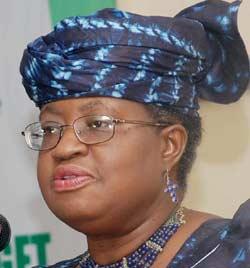
Minister of Finance and Coordinating Minister of the Economy, Dr. Ngozi Okonjo-Iweala
Some states have faulted Finance Minister, Dr. Ngozi Okonjo-Iweala’s claims that the recurrent expenditure is crippling the economy.
Recurrent expenditure is money set aside by government every year to pay salaries, wages, allowances of civil and public servants as well as money used to buy stationery and other office maintenance that constitute overhead cost.
Many Nigerians have argued that the cost of running government is too high leaving very little for use on infrastructure.
Investigations showed that unlike the Federal Government’s rising recurrent expenditure, some states have maintained a balance, keeping the capital ahead of recurrent in the 2014 budget.
Organised labour under the auspices of the Trade Union Congress of Nigeri, TUC, faulted the minister’s claims that the civil service consumes 37 per cent of the recurrent expenditure in the country’s annual federal budget.
In Lagos State, the total recurrent expenditure for 2014 stood at N234.665 billion against the N214 billion it spent in 2013.
The Delta State government ear-marked N159.78 billion or 48.8 per cent of its 2014 budget as recurrent expenditure out of the total budget of N391.51 billion for 2014 fiscal year, while N231.72 billion or 59.1 per cent was allocated for capital expenditures.
Governor Emmanuel Uduaghan in presenting the budget to the State Assembly said: “This budget contains clear proof of our sound financial management as well as evidence of our commitment to good governance for the benefit of Deltans of today, and in the years to come.
Commenting on the budget, Delta State Commissioner for Finance/Economic Planning, Mr. Kenneth Okpara said, “our recurrent cost has been average of 40 per cent from 2011 to the proposed 2014 budget.
“Unlike that of Federal Government that has 70 per cent recurrent. We still believe that the recurrent should be brought down to 30 per cent, so that we can have 70 per cent for capital.”
The state Commissioner for Information, Mr. Chike Ogeah said, “we are doing very well on our budget at the moment. We have a 40 per cent to 60 per cent budget ratio of recurrent to capital.”
Ondo State, a total of N69.681 billion of this year’s N162billion budget had been ear-marked for recurrent expenditure.
Governor Olusegun Mimiko said this is “to keep the structures of governance running.
According to him a recurrent/capital mix of 43 per cent: 57 per cent is adopted for 2014.
On the part of the Federal Government, available records showed that it ear-marked 71.5 per cent of its 2012 budget which amounted to N4.6trillion for recurrent expenditure.
In 2013 67.5 per cent totaling N4.7 trillion was set aside for the same purpose while the current budget of 2014 has 74 per cent or N4.6 trillion of it set aside for recurrent expenditure.
The TUC maintained, “rather than crying wolf where there is none, Okonjo-Iweala and Okogu would do well to tell Nigerians how the foreign reserves of the country got depleted to the present laughable state.”
Disclaimer
Comments expressed here do not reflect the opinions of Vanguard newspapers or any employee thereof.