By Mike C. Obeanu
Jos, the metropolitan capital of Plateau State, is fast recovering from her over two decades of multi-dimensional ethno-religious/political imbroglio. This devastated the city cum state for years leading to massive bloodshed and exodus of non-indigenous residents with the resultant capital flight.
This development, which featured regularly from 2001-2012, made Jos synonymous with crises as the city hardly featured in the news without crises attached to it. It went to the extent that any resident on visiting any city in Nigeria or abroad and on introduction as a Jos resident is looked upon as an ‘insane’ person living in a crises-ridden city. The person would be immediately admonished to relocate to a safer state if he wished to still have his head attached to his body.
But since late 2012 when the last bomb blast was recorded in Jos, the city has recorded relative peace except for some mischievous attacks/clashes in the neighboring local government areas between Fulani herdsmen and the natives.
This relative peace in the city has encouraged the return of many ‘exodees’ who have subsequently gone back to their former businesses. Jos is also one of the major recipients of victims of the Boko Haram onslaught in Borno, Yobe and Adamawa States where many relocated and established their businesses.
From this scenario, it is obvious that the greater percentage of the population in Jos metropolis had been traumatized by either loss of human life, property or source of livelihood occasioned by crises or the monumental fire incident that gutted the magnificent Jos ultra modern main market in 2002.
The population, barely struggling to pick up the pieces of the city, are currently being oppressed by the new government policy of PARK AND PAY.
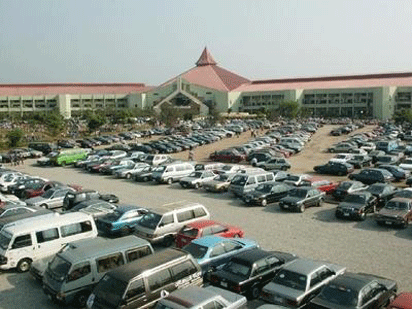
Park and pay is a policy in practice in designated areas of Abuja and Lagos where car owners are made to pay a token on parking in properly built parking lots off the shoulders of city roads or in well fenced and secure car parks.
This was copied by Plateau State government and introduced in mid-2013 in some roads in Jos. The roads namely Ahmadu Bello Way /Beach Road,Rwang Pam Street, Tafawa Balewa and Bukuru Park area were built in the 1970s by the late J.D. Gomwalk administration. With the exception of Ahmadu Bello Way/Beach Road ,which has been dualized, others are lacking in maintenance withdilapidated deep shoulders which often cut car tyres, damage bumpers and exhaust pots while trying to wriggle out of it. Yet, car owners are made to pay N100 for daring to park there.
The other aspect is that the law does not exempt property owners (landlords), tenants, shop/office owners who live or run businesses in the areas. As soon as one is navigating to park along any of the roads, one is rudely rushed by the energetic youths engaged in this unholy task of extorting money from people in the name of PARK AND PAY.
The interesting aspect of this policy is that it is being implemented only in the Christian dominated areas where most of the victims of Jos crises and returnees from Borno, Yobe and Adamawa States are relocated and struggling to re-establish themselves without government assistance. Worst hit are those who survived the deadly onslaught and displacement in Dilimi, Sarki and Ayeni Streets and are managing to find their feet along Tafawa Balewa and Rwang Pam streets. Their businesses are seriously being affected as their customers who cannot afford the daily N100 park and pay fee now look elsewhere.
One of the outcomes of the various crises in Jos is the division of residential and business areas along religious lines. The Moslem businesses are located on the major streets of Bauchi Road, Murtala Mohammed Way, DilimiStreet, Masalaclin Juma’a and Enugu Road. None of these roads is affected by the government’s policy of park and pay, yet they command high traffic flow andharbour high profile businesses.
Similarly, other government laws in revenue collection, registration of business premises, sundry taxes, ban on commercial motor cycles, etc are affective only in Christian dominated areas.
The same goes for the road patrols and frequent checks of vehicle particulars by theVehicle Inspection Officers (VIOs), Nigeria Police, Federal Road Safety Corps and Nigeria Security and Civil Defence Corps. They concentrate their activities in the Christian area, causing unnecessary traffic jams at peak movement periods.
The questions that inevitably arise are:
1. Why is this lopsidedness in policy implementation?
2. Why collecting money for parking on road shoulders where no value has been added since 1970s?
3. Why are there no VIO road blocks, police stop and search and Road Safety checks along Bauchi Road, Dilimi, Murtala Way, Masalachin Juma’a, Enugu Road and Rikkos area?
Let it not be seen as if some people are untouchable while others are subjugated, trampled upon and over burdened with all forms of taxes deserved and non-deserved.
Park and pay is good. It could provide a good source of revenue for government. But the road and shoulders should be properly built and demarcated for easy parking by motorists. The youths engaged in the service should also be properly orientated as some of them lack manners of approach which unfortunately claimed the life of a motorist along Rwang Pam Street late last year while in a hot exchange of words with an attendant.
Disclaimer
Comments expressed here do not reflect the opinions of Vanguard newspapers or any employee thereof.