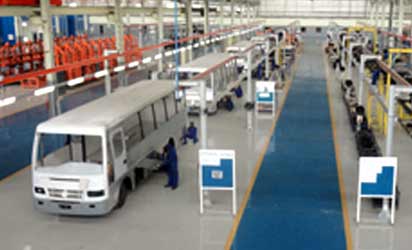
Vehicle assembling plant
By THEODORE OPARA
THE news that plans have been concluded by the Federal Government to commence the implementation of measures to develop the Nigerian Automotive Industry, NAI, is generating excitement in the auto industry. The enthusiasm stems from the fact that Nigeria is at the verge of joining the league of auto-producing countries. The Minister of Industry, Trade and Investment, Mr. Olusegun Aganga disclosed that “with our current population and economy, our potential vehicle market is about a million vehicles a year.”
This figure, he noted, “is more than sufficient to support an automotive industry. We are the seventh most populous economy in the world with a growing middle class (38 million), and a potential vehicle market of one million vehicles annually.”
He posited that the “automotive industry will create significant, good quality employment and a wide range of technologically advanced manufacturing opportunities,” adding, “This industrial base can then form the foundation for other modern advanced manufacturing activities. For example, commercial vehicle production will lead to the manufacture of agricultural, mining and railway equipment, military hardware and transport”.
Regardless of this assurance, some are still skeptical about the workability of the National Automotive Policy,NAP, given that policies like that which appeared promising from inception, ended up unimplemented.
Periodic reviews
Mr. Sheun Bamkefa, an engineer, told Vanguard Features,VF, “It will be good if the government allows for full implementation of the policy, but experience has shown that good policies are usually abandoned midway. You know we had a booming auto industry in the past but that is history now.”
The fears of Bamkefa and others were, however, dismissed by the Director-General National Automotive Council, Mr. Aminu Jalal, also an engineer. He stated that the plan would be subjected to periodic reviews to enable the industry achieve its potential for the economy. As far as Jalal is concerned, the policy would revitalise and boost the existing Nigerian automotive industry. While puncturing the assumption in most quarters that NAP is banning the importation of vehicles into Nigeria, he stressed that the policy would focus on promoting investments in affordable made-in Nigeria vehicles that will minimise the importation of vehicles.
He disclosed that some international automotive manufacturers, in particular, Toyota, Nissan, Renault and GM, have indicated interest to invest in the country, against the backdrop of the automotive development plan. Jalal added, “Nissan, Toyota and others are now conducting a feasibility study on vehicle assembly in Nigeria, believing that a comprehensive automotive development plan will be in place. Accordingly, a holistic, comprehensive and long-term automotive development plan was therefore developed and implementation has commenced.”
On the country’s potential capacity, he said, “At full capacity, the Nigerian automotive industry has the potential to create 70,000 skilled and semi-skilled jobs along with 210,000 indirect jobs in the SMEs that will supply the assembly plants. 490,000 other jobs will also be created in the raw materials supply industries.”
Further checks by VF on the acceptability of the policy showed that the House of Representatives Committee on Industry is also excited about the development. Speaking during an oversight visit to the Ministry of Industry, Trade and Investment, Chairman, House Committee on Industry, Mohammed Onawo, hailed the implementation of the new measures.
He said it would attract new investments into the sector, protect local automotive manufacturers and create employment. Onawo noted, “I was pleased to hear about the new measures by the Ministry of Industry Trade and Investment to transform the automotive sector. Of particular interest to me is how to use tariff to protect local manufacturers. One of the major challenges facing those that are manufacturing cars in Nigeria is the multiple taxation they pay vis-a –vis what somebody pays when he imports a complete car.
“If somebody who is importing a complete car is paying less than somebody who is manufacturing, then you are not encouraging the person who is manufacturing. With the new measures being put in place by the Ministry of Industry, Trade and Investment, I am sure it will protect those investors who are willing to come to Nigeria and invest by assembling or manufacture vehicles here.”
Chief Innocent Chukwuma is another person who is enthusiastic about the development.
Motor vehicle manufacturing
Chukwuma, who is the founder of Nigeria’s first indigenous motor vehicle manufacturing firm, Innoson Vehicle Manufacturing Company Limited, IVM, is certain that the country will rule Africa’s motor market if the policy is implemented to the letter. He said, “We have been in this business for more than seven years, driven solely by faith in our country.
It has been tough. But I can assure you that when this policy takes root, and the industrial clusters begin to develop in our region, Enugu and Anambra, many more allied industries that will feed factories like ours will develop and that is even more jobs, more capital injection, more hands-on training and development for the industry and more research that can afford us the truly Nigerian cars, like the ones we are building at the moment. I bet you, Nigeria is in pole position to rule the African motor vehicles market if this policy is followed to the letter.”
Meanwhile, it was gathered that auto giant, Nissan and Stallion Group, have concluded plans to jointly launch a vehicle assembly plant in Nigeria. The agreement by the two organisations would see Nissan become the first major international manufacturer to launch vehicle assembly in the country. Chairman of Stallion Group, Sunil Vaswani, said, “The new automotive policy spearheaded by President Goodluck Jonathan and the Minister of Industry, Trade and Investment, Mr. Olusegun Aganga, is a laudable government initiative aimed at making Nigeria the regional leader in the industry.’’
Lending his voice to this, President of Nissan, Carlos Ghosn, said: “We welcome the proactive measures being taken by the Government of Nigeria to encourage inward investment and job creation driven by local auto manufacturing. Together with our local partner, Nissan is preparing to make Nigeria a significant manufacturing hub in Africa. As the first-mover in Nigeria, we are positioned for the long-term growth of this market and across the broader continent.”
Disclaimer
Comments expressed here do not reflect the opinions of Vanguard newspapers or any employee thereof.