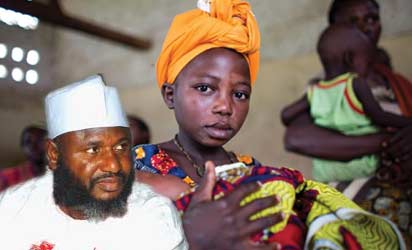
Senator Ahmed Yerima
After witnessing events on the floor of the Senate over the proposal to remove age limitation on marriage as provided in the 1999 Federal Constitution, the International Federation of Women Lawyers, FIDA, Nigeria, has not rested on its oars. Prior to the proposed amendment, interpretation of Section 29 (4) (a) and (b) was that “a woman shall not be qualified for marriage until she attains 18 years of age.”
The contentious resolution of the Senate to delete the sub-section (a) of the Section 29 (4) which defines “full age” as the age of 18 years and above, and the Senate’s decision to retain the sub section (b) – which states that “any woman who is married shall be deemed to be of full age” – quickly drew the ire of FIDA Nigeria’s President, Hauwa Victoria Shekarau, In an encounter with SOLA OGUNDIPE, the charismatic firebrand lawyer and human rights activist, opens up on the lingering child marriage issue: Excerpts:
IN the gallery: We were there in the gallery when it happened. We were privy to all the discussions that happened on the floor of the Senate. As an organization we are meeting. We are discussing our next steps and will be taking measures if the Senate does not do anything about this issue. We are also monitoring what is happening at the House of Representatives and have agreed that when the harmonized position on the Constitution goes to the State Houses of Assembly, our members in the States will be alerted. We are already mobilizing our states branches to also rise to the occasion to ensure that some of those issues on gender and women’s rights issues can be professionally taken up.
Position: Anyone who has not come in contact with child marriage or under-age marriage may not appreciate the magnitude of the problem. There are so many issues involved and for us in FIDA, we cannot wait. We speak for the voiceless. These are issues we come in contact with regularly and we’ve taken position on them. They are issues that come to us because of our line of work. They affect women and children.

Senator Ahmed Yerima
Beyond religion: The issue of the girl-child marriage is more predominant in the northern part of the country. They keep talking religion, religion, but don’t we have people of diverse religion even in the South? Why is it that early child marriage is not a problem in the southern part of the country? Why is it that we see it more in the northern part of the country? Some of these people talking about religion, none of them can give out their daughters in marriage at an early age, That is because they are affluent, they are elitist and they are empowered, but the people who really suffer the most are those in the lower rung of society; people who live below $1 per day. For them, their main focus is finding food to put on the table for their families. So the issues are a lot deeper than we may think or feel.
Clarification: People tend to misunderstand that section of the Constitution. It doesn’t really talk about the age of marriage. That section talks more about the capacity of renunciation of citizenship. It says that only people who are 18 years and above have capacity of renunciation of citizenship. But an exception was created – the Section 29 (b) – which states that a woman who is married is deemed to be an adult even if she is not up to 18 years, she is deemed to be an adult and thus has capacity of renunciation. So even though the Constitution doesn’t come out clearly to say it approves underage marriage, it actually legitimizes underage marriage. But the point is if you are not up to 18 years, you are not up to 18 years. It doesn’t matter whether you are married or not.
The Nigerian Constitution is the alpha and omega in Nigeria and any law that is contrary to it is null and void. So if you put that kind of position into the Constitution, what it means is that you have legitimized underage marriage and people would go ahead to do what they want to do on the argument that even the Constitution allows it.
Smuggled in: If you check the previous Nigerian Constitution before the one of 1999, the contentious sub-Section isn’t there. It was smuggled in when the 1999 Constitution was put together and we are saying it shouldn’t be there. If you recall, the 1999 Constitution was the handiwork of a few people who just came together and drafted it. That was during the military era.
It is steeped in controversy. It was based on criticisms of this Constitution that the National Assembly, for the first time, decided to consult their Constituency that they decided to go round the entire Nigerians, so that they could get legitimacy for whatever constitutional review they wanted to do.
Nigerians say no: I need to stress that the collation of the results of the Constituency Consultation showed that Nigerians want that Section of the Constitution deleted. The voice of the people has stated: ‘delete this Section’. Nigerians came out to say the Section should be deleted. Nigerians want it removed. So why would the Senate now refuse to heed what the voice of the generality of Nigerians is saying? Why would they decide to subject the people’s wish to their own personal and selfish inclinations? For me that is the crux of the matter.
Aberration: Nigerians came out clearly to make that statement. Why would the Senate turn around the wish of the people? It is an aberration. A vote was cast and the result showed that the Senate members wanted that Section deleted, only for Yerima to stand up and start talking about religion. The Senate President then called for a second vote. If you asked me, that second vote was unnecessary and is an aberration.
Admonition: My admonition to Nigerians is that this country belongs to all of us. All those people in government, whether at the Executive arm or the Legislature, they are people we elected to serve us. And so they are not supposed to serve their personal interest but the interest of the people. It behooves on us as citizens to hold them accountable to their mandate. We must learn to speak out. We must learn to condemn what is wrong and support what is good. It is counter-productive to say because it doesn’t concern us directly, we will not take action. We must appreciate that this country belongs to us all and that when we get out of this situation, our hope is to have a country that will be better for generations yet unborn.
Disclaimer
Comments expressed here do not reflect the opinions of Vanguard newspapers or any employee thereof.