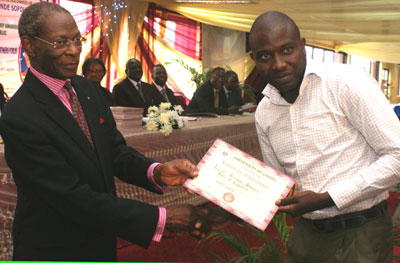
File: Deacon Gamaliel Onosode presenting a certificate to one of the beneficiaries.
THE house is like any other along the street, without any special adornment. We are in the largely middle-class suburb of Surulere in Lagos. But to my pleasant surprise, the street, which I have not visited for several years, has now been turned into a double carriageway.
We get down from the car and enter through a gate leading to a side door. There are flowers along the base of the walls. Past the open garage to the right, where a car is sitting, we climb up a short stairway, and find ourselves in the office, where the neatly dressed Secretary receives us with visible courtesy.
Behind her is a door, and I can hear the man’s voice inside, giving instructions. But we do not wait for long before we are ushered into the inner office to meet him. I look at him again as he hugs my assistant familiarly and shakes my hand. He has not changed in any noticeable way since I saw him last at the Unilag some six months before. He is still dapper and trim, lean and well-kept, with the trademark central parting across his low cut hair. His voice is also the same clear, polished lilt, with its elaborately cultivated diction. As usual his affability is disarming, and his elegance unforced, even in the casual clothes he is wearing.
He leads us on through some doors, past walls that are decorated with paintings, and soon we are back downstairs in his private sitting room. ‘Madam’, whom I still have not met, is not around again today, I learn. The room is filled with mementoes everywhere, on the floor, on the walls, on chairs and tables. Photographs, lovely framed, stare at you, some benignly beckoning, some aggressively posturing, others with some statement that is difficult to decipher at once. Most are of children and grandchildren, in-laws and close relations, and of himself and his wife at obviously memorable moments. The room speaks noisily of the biography of a man who has lived an exceptional life. ‘The children don’t like this room,’ he tells us with a chuckle. ‘They don’t feel at ease here; they say it’s like a museum.’ I am thinking to myself that, if I had a magic wand this moment, I would gather all my songs, all my fables, and weave them into a golden garland, and offer it to him as a birthday present. But sadly, I am no magician. All I can offer are my words of good wishes.
My host accepts them with grace. He is going to be eighty years old in a couple of weeks, this man who has been acknowledged as one the nation’s finest gentlemen. But you would never know this by simply looking at him. He is one of these fortunate beings who are blessed with a frame of Adonic youthfulness. Together with his sprightly gait and clean physique, his body offers a picture that totally belies his age, giving the impression of a much younger man. But it is not because of his looks that I am here today. This is a man who is more or less a living legend, with a curriculum vitae that reads like an intimidating dictionary of select awards and distinctions. He has remained “simply Mister Onosode” by choice and by humility, but it is difficult to think of an important private or public sector business or initiative that he has not chaired at one time or the other in the past fifty years at least. He is a Fellow or Board member of countless business organizations and financial institutions nationally and internationally.
Abundant energy
And in the educational area, to which he seems to have directed much of his abundant energy in recent years, he has been Pro-Chancellor and Chairman of the Governing Council of several of our leading universities, the latest being the University of Lagos, Akoka. I can go on, but how many shall we count of the teeth in the mouth of Adepele? It is not to enumerate his achievements that I have come either. My mission, among other things, is to find out from him the tricks of survival in a cruel age such as the one we live in.
In his biography, published ten years ago, one learns of the rather unfair number of occasions he has been in and out of hospitals and undergone serious surgical operations both here and abroad. Furthermore, he has had to witness the passing away of the people dearest to him, some of his most cherished siblings, leaving him to carry enormous responsibilities even at an early age. How then, with such losses and so many records of near-fatal encounters, has he managed so magnificently to conquer the terror of death, such that the approach of his 80th birthday fills him with no trepidation at all about his mortality? Who, simply, is the man behind the public image? Does he bleed like the rest of us?
I decide to be cautious. I begin by asking him about his background. Coming from what was a lowly rural background, how did he manage to pull himself to such a lofty height in our society and join the ranks of the elite? But he corrects me. Rural, yes, but his roots were not ‘lowly’. “In that community,” he explains, “we saw ourselves and we were perceived as the elite, okay? I remember my father used to ‘import’ a bag of rice from Warri, and when I say ‘import’, I mean that it was like God having come down and brought something. He probably was the only person who had a Raleigh bicycle in town… And we lived in a compound with Zinc roofing, corrugated iron roofing, as opposed to thatch.
Disclaimer
Comments expressed here do not reflect the opinions of Vanguard newspapers or any employee thereof.