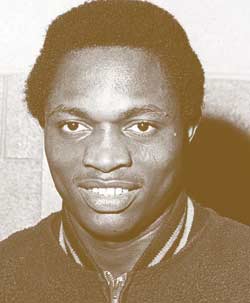
Charlton
I was cutting my teeth in sports journalism when I met Charlton at the National Stadium in Surulere. He had retired from track and field and returned to Nigeria. But shortly after that he went back to the USA. We got in touch again a few months ago through the Face Book.
When Brown Ebewele talks about track and field you are bound to fall in love with the sport. Ebewele, fondly called Juju Man dreams, lives and eats the sport. He once described Charlton Ehizuelen this way: Charlton is a living legend.

Charlton
When I got to America I was amazed at the respect and popularity Charlton commanded. If he stepped into any stadium and his name was announced, the whole stadium stood to cheer him in. And that was a Nigerian. He made us proud and gave us identity.
My dear readers, that is the man who will be writing for us from time to time. Charlton had done a piece but I felt that the younger generation would need to know him more to appreciate this legend of our time.
I pleaded with him to do an introductory piece and he obliged. I present to you Charlton Ehizuelen, the man who the world favoured to win gold at the 1976 Olympic Games but who never had the chance as Nigeria boycotted the games in line with their position against countries that had sporting links with apartheid South Africa. Read Charlton – Onochie Anibeze
By Charlton Ehizuelen
Sports is infectious. It inculcates in one certain attributes and qualities that help shape one’s life. It is a phenomenon that should be accommodated in all communities because, aside it’s competitiveness it helps the body and mind grow positively.
Introduction of sports and play to our children at an early age allows the child to learn about the importance of discipline, respect to rules and regulation, commitment, team work and competition. These are qualities that could also be applied to other areas in life. l was born in Kaduna to Ishan parents.
My father served in the Nigerian police and retired after 28 years as a police officer. His work took him to many places like Kaduna, Kano, Maiduguri, Jos and Ilorin. Therefore, l had the opportunity to live in many cities as a young person. These places had one thing in common, a tradition of sports and play.
The parks, police play ground, and school play grounds, were available to anyone willing to use them. The opportunities encouraged participation in sports.
We had Youth teams in soccer and athletics but lacked organisation. But we had fun. The only qualification to participate was a willing heart and the ability to adhere to the rule of play.
This was the environment in which l grew up, understanding the importance of discipline, team work, respect for self, others and competition.
I attended Holy Trinity Primary school in Maiduguri, where a 30 minute a daily break for play and fun was a part of the school curriculum. This was where the basic skills in sports and play were introduced to the participants.
Formal training in athletics began for me at Anglican Grammar School Evboneka, near Benin-City. The principal, Mr. Idahosa Osifo, understood the importance of athletics and education.
Some form of sporting activity was mandatory for all students. The pool provided the opportunity for
discovery and training. Those selected were placed in athletics programmess, with many privileges that were not available to non-athletes.
It was when I arrived at Edo College Benin-City that my athletics performance began to mature.
I won my first national secondary school championship title in Kaduna, in the long and triple jump events, setting national records in both events. In the same year in 1972, l represented Nigeria for the first time at the Nigeria/Ghana Championships in Ibadan as a junior athlete; there were four junior athletes on the national team that year.
l was third and the best Nigerian for that day, John Okoro was the other Nigerian that competed. Joshua Owusu of Ghana won it.
It was at the Nigeria/Ghana Championships, that an American coach with the Ghanaian team, impressed at my performance approached me, with the idea of going to the USA. He gave me an address to Coach Bob Wright of the University of Illinois and l wrote to him.
Dr Awoture Eleyae was at the University of Illinois as a post graduate student when my letter arrived.
At the end, he played an important role for my departure to the USA.
The 1st national sports festival was held in Lagos in 1973, l won the long and triple events. In my first competition in 1974 at Illinois, I broke Jesse Owens 39 year old record in the long jump, which was set a year before the Berlin Olympics. He went on to win four Olympic gold medals and set an Olympic record.
By the end of 1974 season, I had recorded the best jump in the world in the Triple jump event, and became the first Nigerian to win an NCAA title in the triple jump.
On Jan 1, 1975, l was on the jumps run way in Accra, Ghana, representing Nigeria at the Africa University Games. I won the long and triple jump events, setting my first Nigerian record in the Long jump event. For more than a decade I held both the African and Commonwealth records in the long jump and the triple jump events.
In March of 1975, at the Big 10 conference championships in Bloomington Indiana I was trailing Steve Cobbs of Indiana in the long jump finals, and then it happened.
Track and Field News magazine –Don Kopriva put it this way: “Cobb uncorked a PR 25’11”1/2 on his last jump to take a ¼ lead over Ehizuelen with one attempt left for the confident Illinois jumper.
And then Ehizuelen popped, and the partisan Indiana crowd knew that it had seen track history. Only Bob Beamon (27’2”3/4 in 1968)8.30m has ever surpassed Ehizuelen indoors.
Only three others have ever jumped better than 27 feet indoors, and only 10 have ever jumped over 27 feet period. “That jump was (27’1”1/4,) 8.26m, two inches more would have broken Bob Beamon’s world record. The jump is still the Nigerian Indoor record.
The world renowned Track and Field News magazine featured me on the front page to celebrate my outstanding performances, as the world’s best Long and triple combo jumper. No African Jumper till date has been featured.
I long jumped the best jump in the world in 1975, won my second NCAA title, a silver medal at the Pre-Olympic games in Montreal Canada.
Won a silver and bronze in the long and triple jump events at the Africa / USA/ Germany meet.
In 1976, I made the Nigerian Olympic team. Won the Long jump at the NCAA, my third title, had the best jump in the world. Nigeria boycotted the 1976 Olympic Games.
At the first World Cup in Dusseldorf Germany in 1977, representing Africa l won a Bronze medal in the long jump recorded the third best jump in the world, and a fourth NCAA title in the long Jump. Won two gold medals in the Long and triple jumps at the African championships in Tunis.
NB, That is the track record of the man who will be writing for us from time to time. Stay with us for the best in sports.
Disclaimer
Comments expressed here do not reflect the opinions of Vanguard newspapers or any employee thereof.