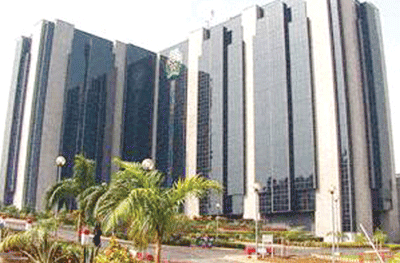
The Central Bank of Nigeria head office in Abuja.
By NKIRUKA NNOROM
About one month ago, the Central Bank of Nigeria published the names of 113 loan defaulters to the Assets Management Corporation of Nigeria, AMCON, which, again, has been generating heated argument among Nigerians. Vanguard sought to understand the rationale behind the use of the approach.
In this interview, the Managing Director of the bad bank, Mustapha Chike-Obi, said that publication of those names has nothing to do with the Corporation’s loan recovery rate. He argued that loan defaulters should not be allowed access to banks’ credit like other developed markets. EXCERPT:
What informed the decision to publish the names of those loan defaulters by AMCON?
I think for that, you really must ask the Central Bank of Nigeria. It is Central Bank’s regulation, but we discussed it with them. We agreed with the policy, but it is the Central Bank’s policy. So all we can do is to give our support and agree with the policy.
That is a decision to make sure that people that almost brought down the banking sector are not given the chance to go back to the banking sector and start borrowing again without people watching and making sure that this doesn’t happen again.
It is a protective measure for the banking system and I think it is something that we all should be happy with. In the United States of America, there is something they call credit call that you can get on the internet on anybody and people who have bad credit record/call.
Such people are not allowed to borrow. Even, they cannot borrow mortgages in the US. So, it is not unusual. Borrowing money from banks is not a constitutional right. People that have abused that privilege in the past should be brought to that level of caution. Again, the timing and decision lies with the CBN, but we at AMCON strongly support the policy.

*CBN Headquarters
Prior to the publication, what effort did AMCON make to ensure that the loans were recovered?
Again, that publication has nothing to do with AMCON recovery record. We have been recovering loans at faster rate than we planned. We have recovered and restructured about one third (1/3) of the loans well ahead of our target; the idea of that policy was not because of AMCON not recovering loans. AMCON was doing good at recovering those loans better than planned, better than expected, but we agreed that it will help us do much better, but that was not the intent of the policy.
You said that you have recovered about one third of the bad loans so far. What was the size of the loan before and how much have you recovered in concrete term?
We have recovered/ restructured or resolved about one trillion worth of loans today. We had about three trillion.
What was the cause of discrepancy between the list AMCON sent to the CBN and the one that came out to the public?
First of all, let me say that on that list were about 113 companies; we think five names should not have been there and we accept responsibility for that error, but people discredited us for five out of 113. In anywhere around the world, that is passing grade; that’s an A.
So, we made a mistake on five names and we have since corrected that error. There was no major discrepancy, each of those five names; there was a reason for it. We thought we are enforcing people who owed us over five million and more, we did not know that the report will be exactly for that purpose, so when the report came out, we saw the names and we have done the correction on that. They should not have been there.
Have the names been struck out from the list?
It is not for AMCON to strike out names from the list. AMCON can only apply to the Central Bank and recommend to the CBN that those names be stuck off the list. For those people, we have recommended and we will keep recommending as event unfold to Central Bank to remove names from the list and Central Bank will then have to agree with our reason before they will strike out any name from the list.
Some believe that the approach of publishing the names of those loan defaulters could be hampering genuine business interests. So, what’s your take on that?
My take on that is very simple. Every debtor in AMCON has not lived up to their obligation, most of them have their loans non-performing for two, three, four, five years and they have not been able to pay. Do you think such people will still be allowed to borrow more money?
Do you? These are bad loans! So, if somebody had borrowed money and is not able to repay after two, three, four years, don’t you think such person should stop, take stock of your business, and see what is going on before they should start borrowing even more money? I don’t know why people are condemning the action.
These are not people whose businesses were running well and all of a sudden they were stopped; these are people that have chronic bad debt for a period of time that almost brought the banking system to its knees. I don’t understand why anybody should be campaigning for them to borrow more money.
In reality, do you think this will serve as deterrent to people borrowing and not paying back their debts?
It will stop them from borrowing more money so that the banking system will not be contaminated in the future. It will certainly act as deterrent to those that borrow; that can pay and refuse to pay, because in Nigeria, they believe that they can get away with anything. So, there might be a small class that it affects, but they are the people who can pay but refused to pay, and hopefully, this will make them realise that they must pay their debts.
So far, what is the response since the publication, have they been responding?
I want to make it clear that the process of restructuring or recovering a loan at AMCON is a long one, averaging between three to six months and this publication that came out some weeks ago will not have an appreciable impact on our recovering or restructuring effort within this period, because if somebody walks in today and wants to repay his loan, there is still a process it will have to go through. However, we now have more approaches, more people have called us wanting to restructure and hopefully, three or six months from now, we can tell you that there will be a beneficial improvement.
For those that are not able to meet their obligations to AMCON in the next six months, what will be the fate of those companies or individuals?
You must understand that we have twelve thousand loans to deal with and we restructure average of five loans a day. So, this list of 113 companies is a very small portion of our loans in terms of numbers and I don’t want you to think that they are in any way special. They are just part of the loans we restructure and we have policies of dealing with people who won’t pay us, who refuses to pay us or who can’t pay, including dispossession, forfeiture, and court action.
So, this is a very small part of our loans and they will not be treated any differently from the other twelve thousand loans we have with us.
I want you to put a figure to what you have recovered between September when those names were published and now
I have told you again that it takes somewhere between three or six months to recover or restructure a loan, and every time we do, we file it in the court as tempt of his judgment. So, there is no impact on that. We cannot see the impact in less than three months.
It doesn’t happen like that; people don’t rush in with bags of money and pay AMCON. We sit down; we make sure the lawyers look at it, the credit people look at it, the court looks at it. So, there will be no impact whatsoever for the next three to six months. After six months, you might see an impact.
What do you think could be done by the CBN to stop the use of single collateral by one individual or company to collect loan from different banks
We are regulated by the CBN; we don’t tell CBN what to do. We are also not a lender, so, it will be more appropriate for CBN and the banks to think of how to solve that problem. We concentrate on our mandates.
Some people strongly believe that the huge loan exposure of the banks points to lax supervisory capacity of the CBN. What can you say about that?
Again, I don’t like to speak for CBN, but I will say this, AMCON came into existence in 2010. We are regulated and supervised by the CBN; we have had about twelve examinations, senior examination and one special examination. We are very thorough, we are very diligent, we are very hardworking, and we do really good examinations. I don’t know what happened before, but I can tell you that today, CBN takes its regulatory job very seriously. I don’t think there is anything like lax supervision in the CBN today.
I gathered that the Union Bank has fully repaid AMCON. So, when is AMCON going to exit from the bank?
Fully repaid CBN, not AMCON; all the banks have fully repaid their loans from the CBN. All the money that CBN loaned the banks, the N620 billion have fully been repaid.
What do you have to say to the alleged secret deal between AMCON and Femi Otedola over the payment of N140.91 billion debt?
I reject it. I reject that term secret. AMCON had a proper and clear process for restructuring loans. It is not secret; all the policies were approved by the board and Femi Otedola’s transaction went through a very rigorous and transparent process that we are very proud of and we can defend anywhere.
I reject the expression of secret and I will say that anybody that thinks it is secret has not asked us any question. We employed two real Estate Surveyors to value his assets. Akin Olawole valued his real estate assets, while FAHL-MT Limited valued two of his tank farms.
We went back and forth before we arrived at the figure. In fact, all the transactions was approved by the board of AMCON, so I don’t know where secrecy comes from. So, when people say we did secret deal, we didn’t, we even fought with him. He had argument with us that we are using low valuation; that we were undervaluing his assets, but we told him that was what we can use.
Disclaimer
Comments expressed here do not reflect the opinions of Vanguard newspapers or any employee thereof.