By Adeola Badru
The National Drug Law Enforcement Agency (NDLEA) has called for a technology-driven and multi-stakeholder approach to tackle Nigeria’s growing drug abuse and illicit trafficking challenge, warning that criminal networks are increasingly exploiting digital platforms and sophisticated methods to expand the illicit drug trade.
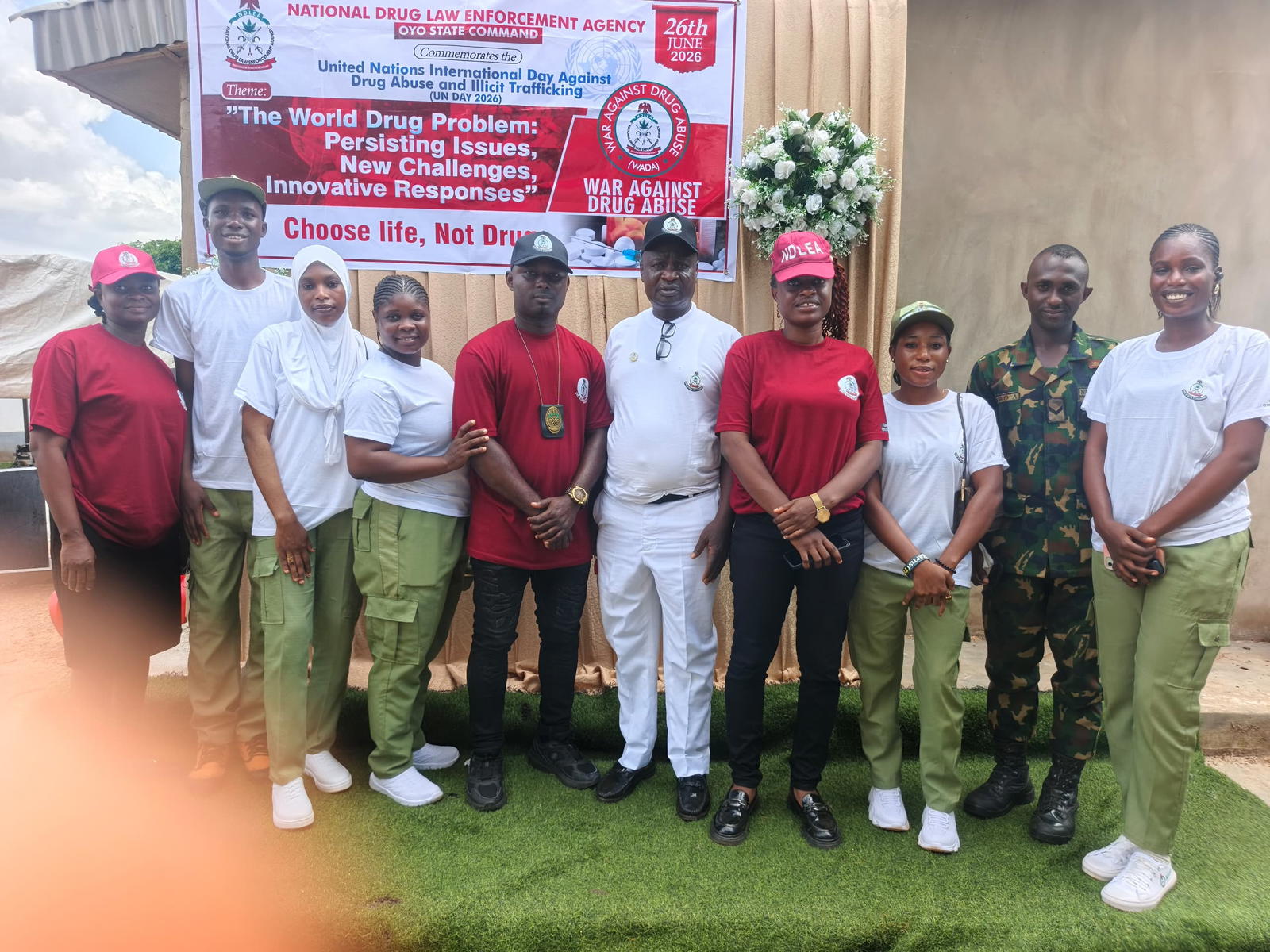
The agency made the call on Friday during the 2026 United Nations International Day Against Drug Abuse and Illicit Trafficking at the NDLEA Oyo State Command headquarters in Onireke, Ibadan.
Speaking on behalf of the Oyo State Commander, Commander Adetula Oluwarotimi Lawal, Deputy Commander, Administration and Logistics, DCN Obiajuru Okoire, said this year’s theme, “The World Drug Problem: Persisting Issues, New Challenges and Innovative Responses,” reflects the realities confronting Nigeria and the global community.
He said although progress has been made in addressing drug-related problems, new challenges continue to emerge.
“Drug trafficking networks continue to evolve, substance abuse remains a major public health concern, and new psychoactive substances and emerging drug trends present fresh threats to our communities,” he said.
Okoire noted that organised criminal groups now exploit technology, social media and transnational routes to facilitate illicit drug trafficking.
He warned that young people remain particularly vulnerable to the consequences of substance abuse, including poor health, family breakdown, crime, violence and reduced productivity.
According to him, governments and stakeholders must adopt innovative strategies that combine prevention, treatment, rehabilitation, community engagement, intelligence-led enforcement, technology-driven interventions and evidence-based policies.
“The fight against drug abuse and illicit trafficking cannot be won by law enforcement agencies alone. It requires the coordinated efforts of government institutions, schools, families, religious bodies, traditional institutions, civil society organisations, the media and every member of society,” he said.
Okoire reaffirmed the NDLEA’s commitment to combining drug supply reduction with demand reduction initiatives through sustained public sensitisation, school outreach programmes, community engagement, treatment and rehabilitation services, as well as strategic enforcement operations.
He urged participants to translate discussions into practical actions that would strengthen Nigeria’s response to the global drug challenge.
Earlier, Deputy Commander, Counselling, Treatment and Rehabilitation, DCN Ajanaku Babatoyin, described substance abuse as an evolving national challenge affecting the country’s health, security and socio-economic development.
He said the drug problem continues to manifest in new forms, requiring fresh thinking and coordinated interventions.
“We see the impact of substance abuse on individuals whose health, education, careers and relationships are affected. We also see families struggling with pain and uncertainty, while communities face increased crime and insecurity linked to drug abuse and trafficking,” he said.
Babatoyin warned that changing trafficking networks and digital platforms have made illicit substances more accessible, especially to young people.
He called for stronger prevention programmes, improved treatment and recovery services, greater youth engagement and wider use of technology and partnerships to reach vulnerable populations.
“The fight against substance abuse is not the responsibility of one agency alone. It requires the collective efforts of parents, teachers, faith leaders, healthcare professionals, community organisations, government institutions and young people themselves,” he said.
He urged Nigerians to recognise the human cost of drug abuse and renew their commitment to raising awareness, reducing stigma, supporting recovery and creating environments that encourage healthy choices.
The event formed part of Nigeria’s observance of the United Nations International Day Against Drug Abuse and Illicit Trafficking, with stakeholders reaffirming their commitment to strengthening prevention, treatment, rehabilitation, intelligence-led enforcement and technology-driven interventions to address the country’s drug challenge.
Disclaimer
Comments expressed here do not reflect the opinions of Vanguard newspapers or any employee thereof.