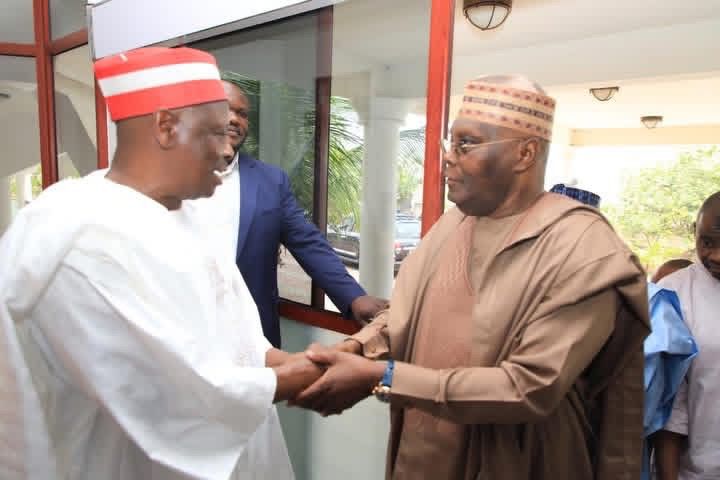
File image.
By Adeola Badru
Last Saturday’s convergence of opposition political figures in Ibadan unfolded less as a spectacle and more as a moment of sober introspection within Nigeria’s evolving democratic experience. It did not announce itself with the theatrics that often accompany political assemblies of such magnitude; rather, it carried the quiet weight of necessity.
Read Also: 2027 Polls: ADC still in trouble, legal hurdles fester beyond Supreme Court’s verdict
Beneath the formalities and the carefully measured cadence of public speech lay a shared, if uneasy, acknowledgement that the country’s political architecture was under strain, and that the opposition, long accustomed to operating in fragments, could no longer afford the indulgence of disunity as the horizon of 2027 drew steadily closer.
The significance of the gathering was rooted not merely in its breadth but in its composition. It brought into the same room individuals whose political trajectories had, over decades, intersected, diverged, and at times collided in ways that reflected the broader story of Nigeria’s democratic journey.
These were figures who had occupied positions of influence within the very system they now sought to interrogate, a paradox that lent both depth and complexity to the deliberations.
Yet that contradiction did not diminish the seriousness of the moment; instead, it sharpened it, underscoring the reality that any meaningful recalibration of opposition politics would have to contend with its own history as much as with the present.
Democracy drifting towards one-party state —Makinde
The summit had been convened under the auspices of Governor Seyi Makinde, whose opening remarks set the intellectual and moral tone for what followed. His intervention was measured, almost reflective, yet unmistakably firm in its intent. Democracies, he had observed, rarely collapsed in dramatic fashion.
More often, they weakened incrementally, through subtle shifts that eroded institutional balance and concentrated power in ways that gradually narrowed the space for genuine political contestation. Nigeria, he suggested, was exhibiting signs of such a trajectory. He had not framed his warning as a partisan critique, nor had he directed it at any individual administration. Instead, he anchored his argument in principle, insisting that the vitality of any democratic system depended on the presence of credible opposition. Without that, the outward form of democracy might persist, but its substance would begin to hollow out. His words carried a quiet urgency: democracy without opposition, he had cautioned, risked becoming little more than a procedural exercise, a slow and almost imperceptible drift towards a one-party state.
Makinde’s remarks provided the philosophical scaffolding upon which the day’s discussions were built. They also introduced the central tension that would run through the summit: the recognition that while the opposition understood the scale of the challenge before it, translating that understanding into coherent collective action remained fraught with difficulty.
From that foundation, the summit’s conversations unfolded across a series of interrelated themes, each revealing a different dimension of the pressures confronting Nigeria’s democracy. What emerged was not a collection of isolated grievances but a layered and interconnected diagnosis, spanning governance, electoral integrity, security, and economic stability.
Judicial independence essential for public confidence in democratic process
—Odinkalu
Chidi Odinkalu drew particular attention to the judiciary and other oversight bodies, arguing that their independence was not merely desirable but essential to maintaining public confidence in the democratic process. Where that independence was compromised, even subtly, the legitimacy of outcomes risked being called into question.
Govt structures must be transparent, accountable to command trust —Bugaje
Usman Bugaje reinforced this position, emphasising that governance structures must not only exist but must operate with transparency and accountability if they were to command trust.
Their interventions resonated with a broader concern that threaded through the summit: that the greatest threat to Nigeria’s democracy might not lie in overt authoritarianism, but in the gradual weakening of institutions. It was not the absence of democratic mechanisms that was most troubling, but their diminishing effectiveness.
Credibility must be demonstrated at every stage of the electoral process
—Igini
If governance provided the conceptual framework for the summit, electoral reform emerged as its operational core. Mike Igini’s contribution was particularly notable for its clarity and precision.
He approached the subject not as an abstract ideal but as a practical challenge rooted in systems and processes. The central question, he argued, was not whether elections would take place, but whether they would be trusted. That distinction, he suggested, lay at the heart of the current crisis. Participation in Nigeria’s electoral processes remained high, yet confidence in their integrity was uneven, and in some cases, fragile.
Igini identified several areas requiring urgent attention: the legal framework governing elections, the administrative capacity of the electoral body, and the deployment of technology in voting and result collation. Each of these, he insisted, had to function with consistency and transparency if the overall system was to inspire confidence.
He was particularly emphatic on the issue of institutional independence, noting that credibility could not be assumed; it had to be demonstrated at every stage of the electoral process. Without such assurance, even legally valid outcomes might struggle to command public acceptance. His argument was not framed as a rejection of existing systems but as a call for their refinement, a recognition that reform must be both comprehensive and continuous. Igini’s intervention went beyond critique, offering a blueprint for rebuilding trust through consistency, accountability, and clarity.
Patterns of insecurity had become deeply embedded in daily life —Adamu
The discussion on security introduced a more immediate and visceral dimension to the proceedings. Kabir Adamu’s assessment of widespread insecurity was both detailed and sobering, presenting a picture of a country grappling with a complex and evolving threat landscape.
From insurgency in the North-East to banditry, kidnapping, and communal violence in other regions, the patterns of insecurity had become deeply embedded in daily life.
Scale of violence outpaces capacity of response —Mark
David Mark’s remarks amplified this sense of urgency. Drawing on both data and experience, he described a nation in which loss had become routine, where the scale of violence had outpaced the capacity of response. His characterisation of Nigeria as a country “constantly in mourning” captured the emotional weight of the crisis, while his critique extended beyond the existence of insecurity to the adequacy of the response.
For Mark, the issue was not simply one of policy but of priority. A state that could not guarantee the safety of its citizens, he argued, risked undermining its own legitimacy. Security, in this context, was not a peripheral concern but a fundamental measure of governance itself. The economic dimension of the summit added further depth to the analysis.
Nigeria’s challenges, not merely cyclical but systemic
—Utomi
Pat Utomi’s intervention was particularly striking for its blend of personal observation and structural critique. His account of the cost of fuel, juxtaposed against the reality of widespread poverty, served as a vivid illustration of the disconnect between policy outcomes and lived experience.
Yet his argument extended far beyond that example. He pointed to rising food prices, the disruption of agricultural production by insecurity, and the continued reliance on oil as indicators of deeper structural imbalance within the economy. Nigeria’s challenges, he suggested, were not merely cyclical but systemic. Central to his critique was the moral dimension of leadership. Economic outcomes, he argued, could not be separated from the values that informed decision-making. Where governance lacked integrity, policy became inconsistent, and public trust eroded. The crisis, in his view, was therefore both economic and ethical, requiring not only technical solutions but a reorientation of principles.
Unity must be anchored in credibility to resonate with the public———Aisha
Civil society voices added a further layer of scrutiny. Aisha Yesufu’s intervention was particularly direct, cautioning that any conversation about unity must be anchored in credibility if it was to resonate with the public. Alliances, she suggested, would be judged not by their breadth but by their sincerity and their capacity to deliver tangible change.
Running through all these discussions was the central question of unity. It was one thing to diagnose the challenges facing the country; it was quite another to build a coalition capable of addressing them.
This tension surfaced repeatedly in the contributions of speakers, reflecting the complexity of the task ahead. Notably, several prominent political figures present at the summit did not take the floor. Their presence nonetheless carried symbolic weight, underscoring the seriousness of the moment and the breadth of interest in the process. The conversations, however, were driven entirely by designated speakers and contributors, whose interventions shaped the tone and substance of the deliberations.
The summit’s communiqué sought to translate these diverse perspectives into a set of concrete commitments. It declared an intention to resist any drift towards a one-party state and affirmed the opposition’s determination to contest the 2027 elections with greater coordination.
Most notably, it signalled an aspiration to present a single presidential candidate, supported across participating parties. The language of the communiqué reflected both ambition and caution. It addressed electoral reform, calling for legislative changes and greater transparency.
It raised concerns about political inclusion and the protection of fundamental rights. Yet even as it projected a sense of unity, it acknowledged, implicitly, the challenges inherent in translating agreement into action.
Those challenges were evident in the dynamics surrounding the summit itself. The absence of certain key figures and the decision of others to remain outside the process underscored the enduring divisions within the opposition space. These fault lines, shaped by history, ideology, and personal ambition, would not be easily bridged.
As the formal proceedings drew to a close, there was no sense of finality. Instead, what remained was a recognition of the work that lay ahead. The summit did not resolve the contradictions it exposed, but it brought them into sharper focus. It forced the opposition to confront its own limitations and to consider the possibility, however difficult, of collective action.
The summit did not offer definitive answers, nor did it claim to do so. What it did was to articulate the questions that would shape the opposition’s trajectory in the years leading to 2027. Whether those questions would be answered in a manner that translated intent into reality remained uncertain. The path ahead would require negotiation, compromise, and a willingness to prioritise collective goals over individual ambitions. It would demand not only strategy but discipline, not only rhetoric but structure.
For now, the summit stood as a moment of intent, defined as much by its possibilities as by its constraints. It served as a reminder that democracy depended not only on those who governed but on those who sought to hold them to account.
Disclaimer
Comments expressed here do not reflect the opinions of Vanguard newspapers or any employee thereof.