By James Ogunnaike, Abeokuta
Environmental experts, in collaboration with the National Environmental Standards and Regulations Enforcement Agency (NESREA), have called for the expansion of waste-recycling capacity and stricter enforcement of Extended Producer Responsibility (EPR) as measures to tackle persistent flooding and erosion in Ogun State.
The stakeholders attributed the environmental challenges largely to industrial pollution and widespread non-compliance with existing environmental regulations.
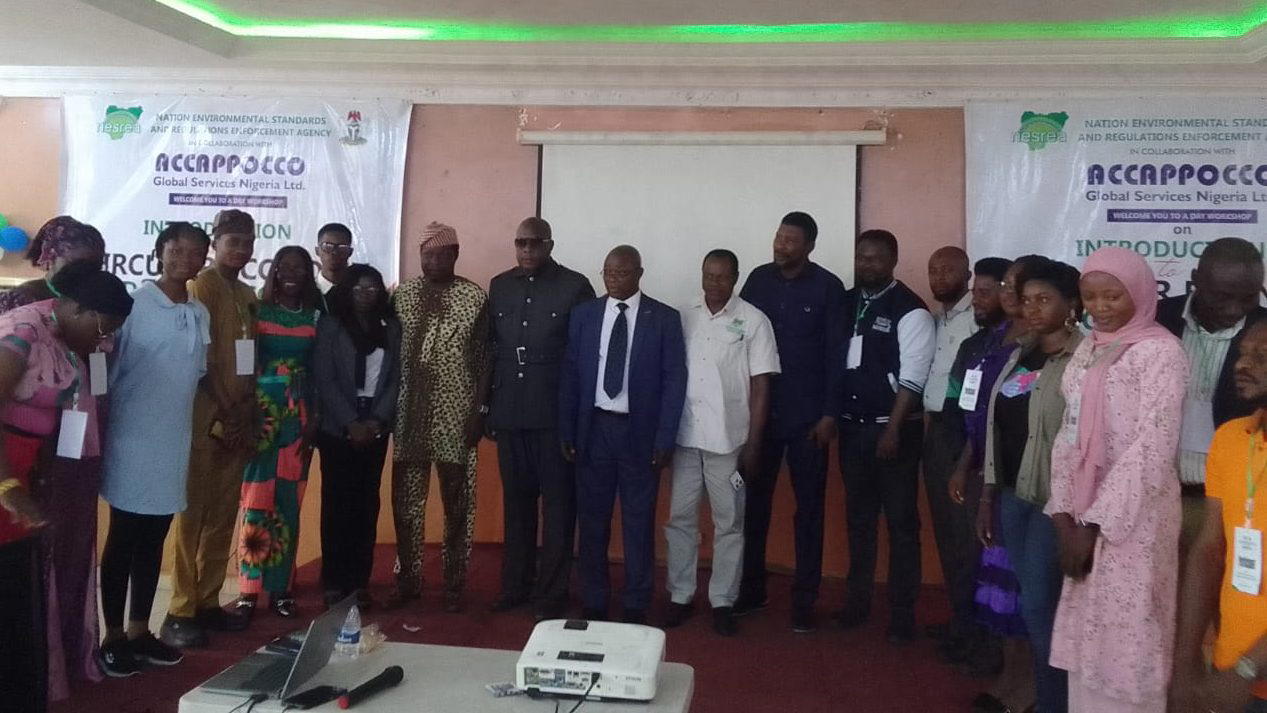
The call was made on Thursday during a workshop organised by NESREA, in partnership with Accappocco Global Services Nigeria Ltd, on the introduction to circular and green economy, held in Abeokuta.
Speakers at the forum disclosed that about 70 per cent of industrial pollution in Nigeria is linked to regulatory non-compliance, stressing that effective enforcement of EPR would compel manufacturers to take responsibility for the entire lifecycle of their products, including waste management and disposal.
In his presentation, Prof. John Oyedele of the Federal University of Agriculture, Abeokuta, underscored the need for Nigeria to transition to a green and circular economy, backed by sustainable financing.
“Linearity has not helped and cannot help any country. It makes you go back to the source to extract, use and discard waste recklessly. The waste keeps creating problems. If care is not taken, in the next 15 years, the generation coming behind us may not find anything,” he warned.
Oyedele further stated: “We need to move decisively in the direction of green and circular economies. Finance houses should also begin to align with this shift. Though, it may have a long gestation period, posterity will judge us kindly for protecting the environment.”
He advised that Nigeria must reduce waste across food, agricultural and manufactured products, while advocating a return to more natural food production methods.
Citing policy successes in Rwanda, he charged the Federal Government to consider banning polythene plastics and bags to curb environmental degradation.
“Indiscriminate waste disposal does nobody any good. Burning fossil fuels and annual bush burning should be reduced. There are many things we must do to make the environment better for all of us,” he added.
Also speaking, Prof. Adewale Taiwo of the Environmental Management and Toxicology Department, FUNAAB, linked recurring flooding and drought in Ogun State to fossil-fuel emissions, calling for an urgent transition to cleaner energy sources.
According to him, Nigeria cannot achieve a circular or green economy without addressing decarbonisation, noting that greenhouse gas emissions are driving climate extremes.
“When fossil fuels are burned, carbon dioxide is emitted, initiating climate change. It triggers drought in some areas and excessive rainfall in others, leading to flooding,” he explained, adding that farmers are the most affected.
Taiwo advocated a deliberate shift from high-carbon to low-carbon energy sources such as solar, wind and biogas derived from organic materials.
Meanwhile, the Managing Director of Accappocco Global Services Nigeria Ltd, Mr Opone Valentine, expressed optimism that a cleaner environment is achievable if industrial pollution and open-system processes are curtailed.
He noted that scaling circular-economy practices nationwide would yield significant public health and environmental benefits.
“There will be a reduction in diseases such as cancer. All these measures will help curb them,” he said.
Valentine identified Persistent Organic Pollutants (POPs) as major environmental and health risks associated with open burning and uncontrolled industrial processes.
“POPs come from open burning and industrial processes that are not in closed systems. If these are curbed and industries are forced into controlled systems, the Nigerian environment will be cleaner,” he added.
The Ogun State Coordinator of NESREA, Mr Jimoh Sa’eed Lanre, urged stakeholders to embrace environmental policies that extend responsibility beyond production to post-consumption waste management.
Disclaimer
Comments expressed here do not reflect the opinions of Vanguard newspapers or any employee thereof.