
Every crypto gambler faces the same question. Is this game actually fair? A provably fair casino gives players a way to check. It doesn’t ask for trust. It offers math instead. And that math runs on something called SHA256 – a hashing algorithm that makes cheating close to impossible.
Not every platform bothers with this level of openness. But the best ones do. BetFury has built its reputation as a trusted casino partly because it publishes verification methods and lets players audit game results on their own. If a crypto casino doesn’t offer that kind of transparency, that’s probably a red flag.
This guide breaks down how to verify provably fair games, step by step. No coding background needed. Just a browser, a copy-paste function, and a few minutes of your time.
What Is a Provably Fair Casino and Why Does It Matter?
A provably fair casino is an online gambling platform that uses cryptographic methods to prove every game result is random and unaltered. The system works before the bet happens. Before you click “spin” or “deal,” the outcome already exists in an encrypted form. You just can’t see it yet.
The casino creates a server seed (its secret input) and gives you a hashed version of it. You also get a client seed – a value you can change. These two seeds, combined with a nonce (a counter that goes up with each bet), produce the result. After the round, the casino reveals the server seed. You then check it yourself.
Why should anyone care? Because traditional online casinos ask you to take their word for it. Provably fair systems remove that need. The crypto casino fairness check is built into the platform’s architecture. It isn’t optional honesty. It’s forced honesty.
How SHA256 Gambling Verification Actually Works
The Role of SHA256 in Game Fairness
SHA256 is a one-way hashing function. It takes any input and turns it into a fixed 64-character string. Change even one letter of the input, and the output looks completely different. And here’s the key part – you can’t reverse it. You can’t take the hash and figure out what the original input was.
So when a casino shows you a hash of the server seed before the game, it’s making a promise. That hash locks in the result. After the round, when the server seed gets revealed, you hash it yourself. If your hash matches, the casino kept its promise. Simple.
Seeds, Nonces, and How They Connect
Three pieces matter here. The server seed comes from the casino. The client seed comes from you (or gets assigned automatically). The nonce counts your bets – first bet is 0 or 1, second is 2, and so on. Together, these three values feed into an algorithm that spits out the game result.
Can a casino cheat this system? Not without getting caught. If they change the server seed after you bet, the hash won’t match. That mismatch is your proof. It’s like a tamper-evident seal on a package.
How to Verify Provably Fair Game Results: Step-by-Step Guide
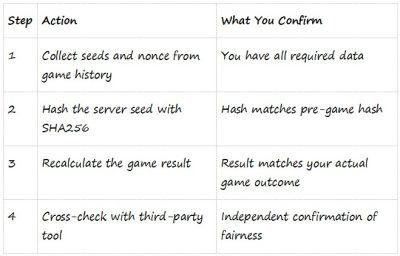
Step 1 – Collect Your Game Data
After any bet, you need four things: the server seed (revealed after the round), the server seed hash (shown before the round), the client seed, and the nonce. Most provably fair platforms show this data in a game history or fairness tab. Look for a small icon or link near your bet history.
Step 2 – Hash the Server Seed With SHA256
Take the revealed server seed and run it through a SHA256 hash tool. You don’t need to install anything. Online tools work fine. A good option is the SHA256 generator at coding tools sites or even open-source verification pages that some casinos provide.
Paste the server seed into the tool. Hit “hash” or “generate.” You’ll get a 64-character string. Compare this string to the server seed hash the casino showed you before the game. Do they match? If yes, the casino didn’t swap the seed. Move to step 3.
Step 3 – Recreate the Game Result
This part varies by game type. Each provably fair casino uses a specific formula to combine the server seed, client seed, and nonce into a result. Dice games might use HMAC-SHA256 to generate a number between 0 and 99.99. Card games might use the combined hash to shuffle a deck.
Many platforms offer a built-in verification tool right on their site. You paste in your seeds and nonce, and it recalculates the result. If the recalculated result matches what you actually saw during the game, you’re good. The round was fair.
Step 4 – Use Third-Party Verification Tools
Don’t want to rely on the casino’s own tool? That’s a smart move. Independent verification sites exist for exactly this reason. They let you input your seeds and nonce, then run the same algorithm separately. If the result matches across multiple tools, there’s basically no room for doubt. A quick search for “provably fair verifier” will bring up several free options.
Quick Reference: Crypto Casino Fairness Check at a Glance
Common Mistakes When Verifying SHA256 Gambling Results
People mess this up more often than you’d think. The most common mistake? Copying the server seed with an extra space at the end. SHA256 is incredibly sensitive. One extra character – even a space you can’t see – produces a totally different hash. Always double-check what you paste.
Another issue: confusing the hashed server seed with the actual server seed. The hash is what you see before the game. The seed is what gets revealed after. They’re related but not the same. Mixing them up leads to mismatches that look like cheating but aren’t.
Some players also forget to check the nonce. If you verify the wrong bet number, the result won’t line up. Keep track of which specific round you’re verifying.
Why Provably Fair Verification Matters for Crypto Gamblers
Here’s the thing – most players never bother to verify. And that’s fine for casual play. But if you’re putting real money on the line (especially larger amounts), knowing how to verify provably fair results gives you an edge that goes beyond luck. It’s about accountability.
Traditional casinos rely on third-party audits from firms like eCOGRA. Those audits happen periodically. Provably fair systems, on the other hand, let you audit every single bet in real time. That’s a big difference.
Does this mean every provably fair casino is safe? Not at all. Verification only confirms game outcomes weren’t rigged. It doesn’t guarantee the platform will pay out, handle your funds properly, or stay online. Always check licensing, reputation, and withdrawal history before depositing anything.
Sha256 Gambling: What the Hash Can and Can’t Tell You
SHA256 verification proves one thing with certainty: the game result wasn’t changed after you placed your bet. It confirms the server seed was locked in before the round started. That’s it. That single piece of proof, though, is powerful enough to keep platforms honest on a per-bet basis.
What it can’t tell you is whether the random number generator that created the server seed was truly random, whether the platform’s payout percentages match their claims over thousands of rounds, or whether your account balance is being tracked correctly. Those questions need different answers – audits, open-source code reviews, and community oversight.
So think of SHA256 as one layer of protection. A good one. Probably the most important one for individual bets. But not the only one you should care about.
Disclaimer
Comments expressed here do not reflect the opinions of Vanguard newspapers or any employee thereof.