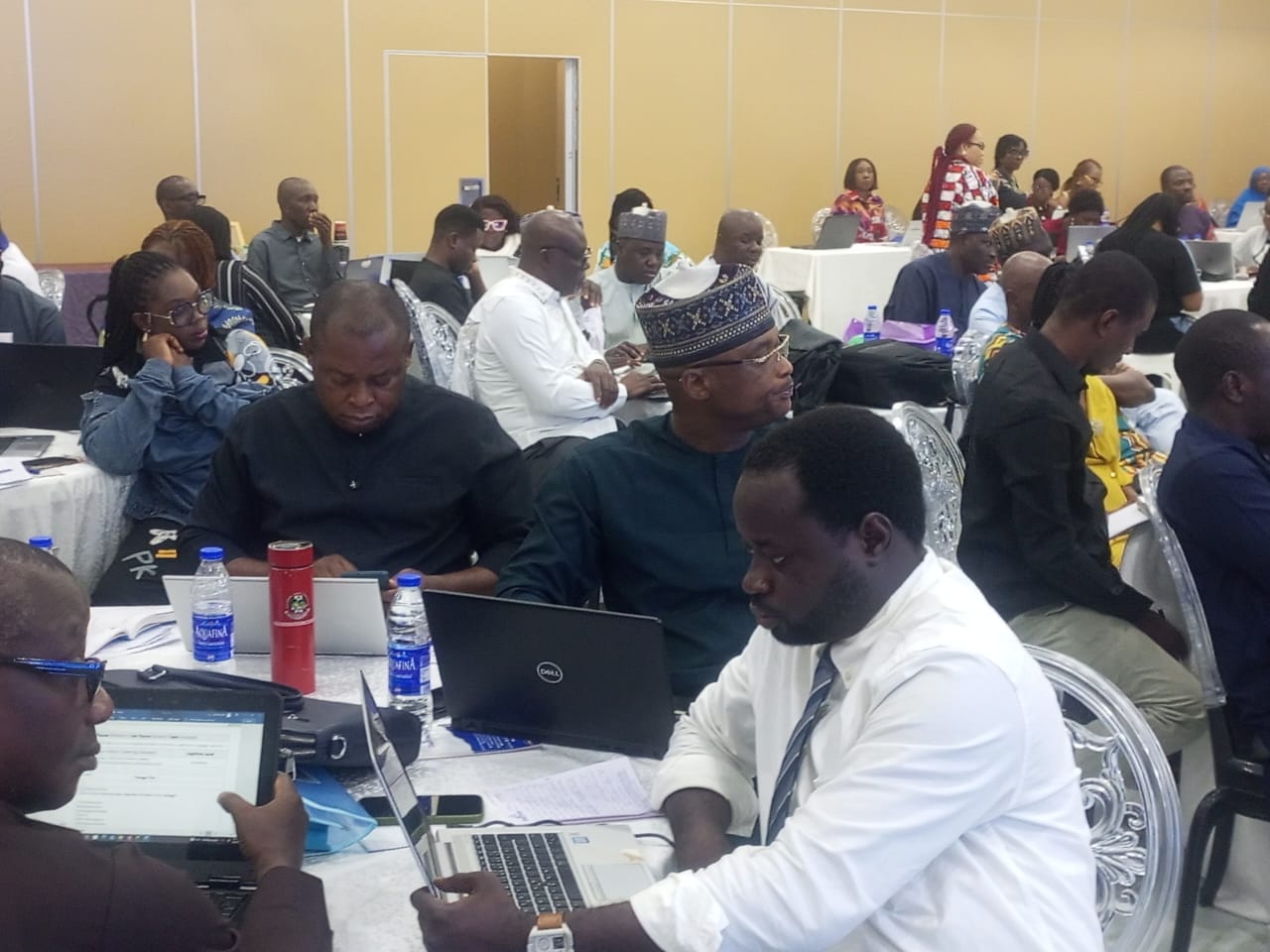
Cross section of participants
By Elizabeth Osayande
The Federal Ministry of Education in partnership with Universal Basic Education Commission, UBEC, has embarked on a transformative 10-day workshop aimed at enhancing Nigeria’s National Learning Assessment (NLA) for 2026.
The event, holding in Ikeja, Lagos, and funded by UNICEF, has assessment specialists, educators, and curriculum experts from across the country converging to reshape the future of educational evaluation.
In a message delivered at the opening ceremony, the Minister of Education, Dr. Tunji Alausa, represented by the Director of Educational Planning, Research and Development in the Federal Ministry of Education, Mrs Obianuju Anigbugu, emphasised the need for standardised learning assessments.
“For too long, we have lacked a unified learning assessment. The Minister’s direction for harmonisation is a significant step toward understanding our students’ learning outcomes at both basic and senior secondary levels,” she explained.
“The workshop aims to produce a robust pool of curriculum-aligned items essential for the upcoming standardised assessments. We want to know the learning outcomes of our children, which will inform decision-making, drive reforms, and improve teaching and learning,” Anigbugu added. “This is a pivotal moment for our education system.”
While some participants are facing this format for the first time, Anigbugu reassured that exposure to this collaborative effort would empower them.
“Though they might come without a solid background, the learning opportunities presented here will equip them well,” she asserted.
“Participants were carefully selected from agencies such as UBEC and the National Educational Research and Development Council (NERDC) based on established criteria. Anigbugu elaborated.
“We have drawn from a well of experts who have previously conducted assessments. Their insights are invaluable to this project.”
Earlier, the Executive Secretary and Chairperson of the NLA, Dr Aisha Garba, opened the workshop with a passionate address, highlighting the significance of high-quality assessment items as the bedrock of effective testing.
“The integrity of our education system relies on robust assessments,” she stated. “A well-defined assessment framework is essential in aligning tests with our educational goals.”
Dr Garba expressed gratitude to key stakeholders including the Minister of Education, Dr Moruf Tunji Alausa, and the Minister of State for Education, Prof. Suwaiba Said Ahmed, for their unwavering support. “Their commitment to equity and quality in education inspires our collective efforts toward improving assessment standards,” she noted.
The workshop promises a comprehensive range of activities designed to develop, review, and validate assessment items using both traditional and digital platforms. A key feature of the workshop is the introduction of “Assessment Gourmet,” a modern digital item banking tool that aims to streamline the testing process while enhancing security and quality assurance measures.
“We are evolving Nigeria’s approach to learning assessment, transitioning from episodic evaluations to a systematic, evidence-based framework,” Dr Garba affirmed.
Giving an overview of the workshop Director of Monitoring and Evaluation, UBEC, Abuja, Mrs Ada Ogwuche, has this to say: “We need the national learning assessment to assess our learners at each level, to see how well they are performing, and if they are not, so that we can change strategy, especially when the curriculum is being used,” Ogwuche said.
According to Ogwuche, the assessment, which is being conducted in collaboration with the Ministry of Education, would cover pupils in Primary 3, Primary 5, Junior Secondary 2, and Senior Secondary School levels.
“This is the first time we are conducting a single national learning assessment for these levels, and it’s a significant milestone in our efforts to improve education standards,” Ogwuche said.
The assessment is being conducted online using the GOMET template, which is designed to prevent any leakage of exam items.
“We’re not generating items using paper and viral. It is strictly online… So talking about any leakage in the item, that will no longer be there because you generate, you don’t even have access to it,” Ogwuche explained.
For the Director of Education, UNICEF, Nigeria, Vanessa Lee, the efforts of FME and UBEC towards having a central NLA are commendable.
“We’re very pleased to be supporting the Federal Ministry of Education and UBEC in providing technical assistance and funding for this important assessment,” said Lee.
Lee, who has been in Nigeria for a while, praised the efforts of the Honourable Minister and Minister for State, saying, “They’re trying very hard, and this National Learning Assessment is a really good step forward in being able to assess students and have a national assessment.”
According to Lee, addressing the issue of out-of-school children in Nigeria has always been a priority for UNICEF. “Are we doing better now? Yes, I hope so. I think everybody is working together, and this is one of the priorities for all of us.”
The assessment is expected to benefit various stakeholders, including children, parents, teachers, and policymakers.
“I expect that children will know how they’re learning, and their parents and communities will know how well the schools are doing,” Lee said.
“The teachers will be able to improve their teaching, and the Federal Ministry of Education and UBEC will be able to make changes to support improvements in the curriculum and teacher professional learning.”
Lee emphasised the importance of collaboration, saying, “When I visit all the states, the commissioners are telling me about all the work that they’re doing to get children back in school. This is a collective effort, and we’re working together to improve education outcomes in Nigeria.”
18 Assessment Experts from higher institutions of learning, 35 subject/curriculum experts from FME, UBEC, NERDC and other educational agencies, 37 classroom teachers in English Studies, Mathematics, Basic Science & Technology and Citizenship and heritage studies from the 37 states and FCT. Directors from Ministry and UBEC are also taking part in the workshop.
Disclaimer
Comments expressed here do not reflect the opinions of Vanguard newspapers or any employee thereof.