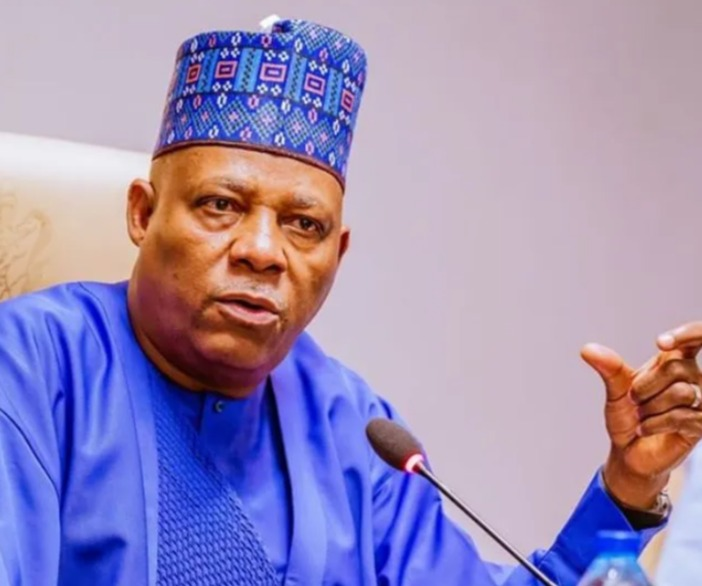
Shettima
…as Egwu calls for governance reforms to address insecurity
By Marie-Therese Nanlong
Jos – Vice President Kashim Shettima has reaffirmed the Federal Government’s confidence in the National Institute for Policy and Strategic Studies (NIPSS), urging graduands of the Senior Executive Course (SEC) 47 to translate knowledge into action and deliver measurable national impact.
This is even as Plateau State Governor, Caleb Mutfwang, the Resident Electoral Commissioner of Benue State, Professor Samuel Egwu, and the Chairman of the NIPSS Governing Board, Ken Nnamani, called for human-centred security, stronger governance reforms and improved utilisation of policy research.
Shettima spoke on Saturday at the graduation ceremony of SEC 47 participants at NIPSS, Kuru, Plateau State. The event attracted senior government officials, traditional rulers, security chiefs, academics and policy leaders from across the country.
Addressing the graduands, the Vice President said Nigeria is rich in talent across its institutions but urgently needs leaders capable of converting ideas into policies and policies into results.
He described the Senior Executive Course as a strategic investment in the country’s future leadership and praised Plateau State for sustaining peace and hospitality that enable NIPSS to function as a national asset.
“You are graduating into a Nigeria that needs leaders who can translate knowledge into policy, policy into action, and action into measurable national progress,” Shettima said, warning that knowledge carries responsibility and must serve the public good with accountability and integrity.
On the course theme, The Blue Economy and Sustainable Development in Nigeria, he said the participants’ research demonstrated strong links between development, security, livelihoods and environmental stewardship.
He disclosed that relevant ministries, departments and agencies had been directed to study and apply the recommendations of the SEC 47 report, describing it as potentially transformative if fully implemented.
In his remarks, Plateau State Governor, Caleb Mutfwang said security conditions in the State had improved compared with the previous year, although challenges remained.
He credited the Federal Government, the military and other security agencies for sustained support, noting that recent security assessments and policy submissions by NIPSS had been useful to the state.
“By the grace of God, the security situation on the Plateau today is better than where we were last year,” the governor said, urging the graduands to deploy their training to deliver solution-driven policy inputs.
He stressed that the true value of the programme would be reflected in the quality of memos, advice and innovations they bring to governance.
Also speaking at the ceremony, the Chairman of the NIPSS Governing Board, Ken Nnamani, criticised the poor engagement of government ministries with policy research, warning that significant public investment in strategic studies risked being wasted if findings were ignored.
He expressed concern over the absence of key ministers and senior officials at policy presentation sessions by SEC participants.
“When reports from NIPSS are left on shelves to gather dust, governance suffers,” Nnamani said, stressing that no foreign consultants understood Nigeria’s realities better than experts within the institute.
He urged the Presidency to ensure that officials assigned to policy engagements were required to provide feedback and act on research findings, and also charged the graduands to serve as worthy ambassadors of NIPSS, noting that the Institute’s
reputation would be judged by their conduct in public service.
In a remark, the Director-General of NIPSS, Professor Ayo Omotayo, said the graduation marked both the end of an academic cycle and a moment of reflection on the Institute’s expanding influence on national policy and governance.
He outlined the Institute’s growing research portfolio, including the SEC 47 flagship study on the blue economy, crisis forecasting initiatives and behavioural approaches to reducing corruption.
Professor Omotayo also unveiled NIPSS’ five-year strategic plan (2026–2030), aimed at positioning the Institute as Nigeria’s leading think tank and a prominent African centre for policy research, leadership development and strategic dialogue.
He appealed for stronger government support, improved funding, digital transformation and the passage of the revised NIPSS Act to enable the Institute to meet its long-term objectives.
Before the graduation ceremony, Professor Samuel Egwu, Resident Electoral Commissioner of the Independent National Electoral Commission (INEC) in Benue State, delivered the Distinguished Annual Lecture titled Strengthening Democratic Governance as a Catalyst for Sustainable National Security in Nigeria.
He argued that Nigeria’s security challenges could not be solved by military means alone, calling for a stronger focus on governance, justice and human security.
Professor Egwu identified weak institutions, corruption, unemployment and poor elite consensus as drivers of insecurity, urging reforms in democratic institutions, the party system and anti-corruption agencies. He also called for a re-examination of Nigeria’s federal system to better manage diversity and strengthen national cohesion.
The ceremony ended with a charge to graduands to serve as agents of change and ambassadors of evidence-based policymaking, united by a national outlook and a commitment to public service.
Disclaimer
Comments expressed here do not reflect the opinions of Vanguard newspapers or any employee thereof.