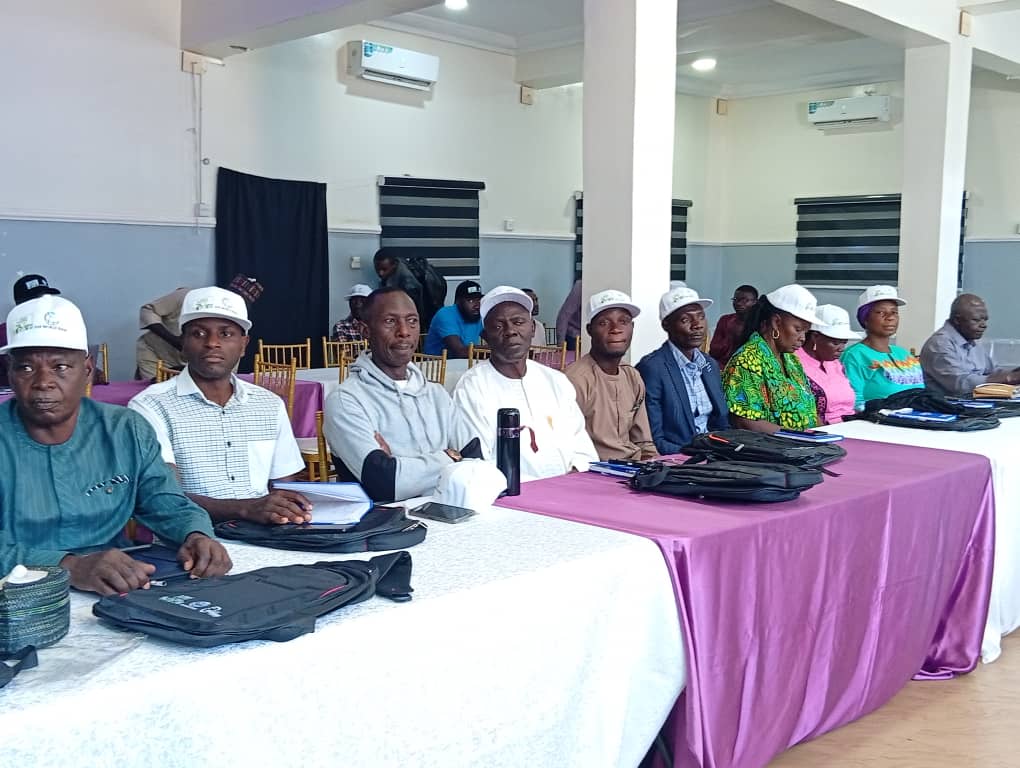
Some of the farmers
By Marie-Therese Nanlong
Jos – Efforts have been renewed to strengthen modern livestock production through improved pasture cultivation with the training of livestock farmers across communities in Plateau State.
The three days capacity building training was organised by Palm Frontiers Ltd, in partnership with the Plateau State Livestock Productivity and Resilience Support, L-PRES, a World Bank supported initiative is targeted at developing practical, saleable business models for pasture production in the State.
The training is to equip L-PRES beneficiaries with the knowledge, tools, and strategies
needed to establish profitable, sustainable, and climate-smart pasture enterprises that enhance livestock productivity and strengthen value chains.
Speaking at the training, the organisation’s Chief Executive, Dr. David Albert, said the initiative was designed to correct long-standing gaps in agricultural knowledge that continue to limit Africa’s productivity despite abundant land and favourable climate.
Dr. Albert explained that livestock won’t progress without quality feed, and pasture development which is central in modern livestock production must be seen as a productive business hence the initiative by Palm Frontiers to equip farmers with the skills, technology and practical guidance to increase yields, ensure proper nutrition for humans and animals, and make farming more profitable.
“Africa is not behind because of the lack of land or weather. We are behind because the know-how has been missing. Our goal is to change that by showing farmers what to do, how to do it right, and when to do it,” he said.
With 54 farmers and 27 members of the Project Implementation Unit participating, Dr. Albert said the focus is on teaching methods of growing high-quality pasture, selecting suitable planting materials, restoring degraded soils, and adopting cost-effective fertiliser alternatives amid rising input prices.
Animal Husbandry Officer with L-PRES Plateau, Emmanuel Nandokol, stressed that livestock production in Nigeria has long been constrained by feed shortages and the lack of structured pasture businesses.
He said, “This training is significant because feed is the biggest challenge in livestock production. We are teaching pasture not just for consumption but as a business model,” and urged participants to begin immediate implementation to support the State’s livestock goals.
Also speaking, Associate Professor Hosea Finangwai, a livestock expert pointed out that opportunities abound in pasture development, hence the training is not an academic exercise but to lay a foundation for a sustainable and productive business.
Speaking on the topic Building sustainable and profitable pasture enterprises in Nigeria: Foundation, global perspectives, and strategic pathways, he insisted that adopting pasture as business can help correct the anomaly in the relationship between farmers and herders.
Finangwai clarified misconceptions about the National Livestock Transformation Programme (NLTP) in Wase, insisting the project was not a failure but faced early resistance and required extensive sensitisation.
He said widespread acceptance of modern livestock systems across States has now contributed to initiatives like LPRES and the current training to enhance pasture production.
He demonstrated the successful cultivation of alfalfa and other forage crops in Plateau through research grants, encouraged farmers to form clusters to access funding, acquire machinery and obtain exotic seeds as according to him, Plateau’s temperate climate provides strong comparative advantage for forage production.
“If livestock development must succeed, we must return to the basics, and the basics begin with pasture,” he noted.
Disclaimer
Comments expressed here do not reflect the opinions of Vanguard newspapers or any employee thereof.