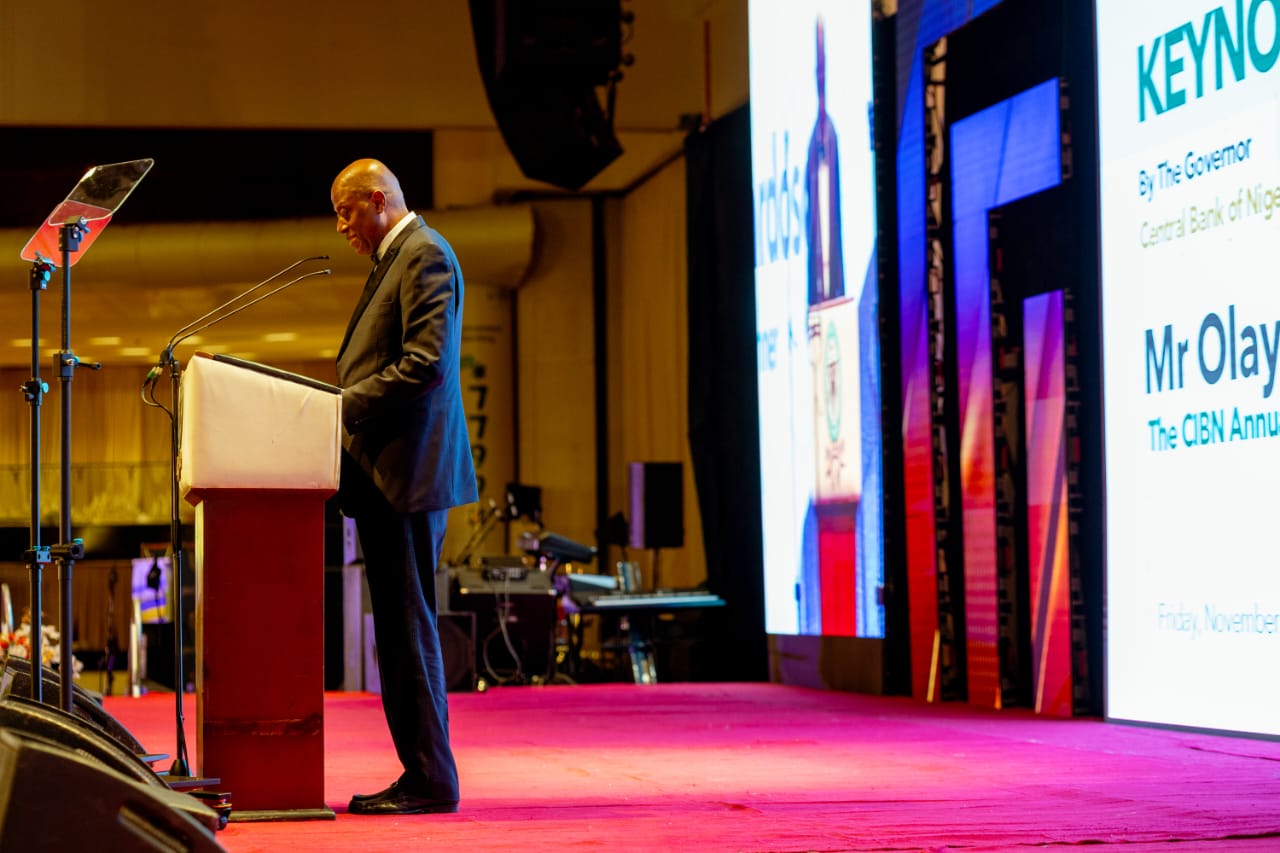
Central Bank Governor Olayemi Cardoso used the stage of the CIBN Annual Bankers’ Dinner on Friday night to send a deliberate signal to the financial community: Nigeria’s economy, he said, has moved into a “new phase of restored stability,” and the country is no longer defined by the crisis it inherited two years ago.
Addressing the hall of bankers, policy leaders and regulators, Cardoso framed the moment as “a defining one” for the nation. He reminded the audience that the reforms of the past two years required what he called courage, sacrifice and clarity of purpose, and argued that Nigeria was beginning to see the payoff. He repeatedly returned to the theme of credibility, saying the Bank had set out clear intentions from the start and followed through. In his words, the CBN had “said what it would do, and has done it, transparently and consistently.”
At several points, Cardoso contrasted the present with what his administration met in 2024. He described the economy of that period as one that had not merely been “at the edge of a macroeconomic precipice,” but one that had “already gone over the cliff.” In his telling, the reforms of the last year can only be understood against that backdrop, not for drama, he said, but for context.
Throughout the evening, Cardoso underlined the seriousness of the moment. At the start of his speech, he jokingly warned the crowd that the “punishment” of standing throughout was his alone, a light remark that underscored the gravity of what he was about to deliver: a sweeping narrative of reform, recovery and recalibration.
He reported that inflation, once seen as the clearest indicator of Nigeria’s economic distress, had more than halved within a year, falling from 34.6% in November 2024 to 16.05% in October 2025. Food inflation, he said, had eased even more sharply. He attributed the progress to tighter policy discipline, better data analytics and the Bank’s return to orthodox monetary practice.
Governor Cardoso described the foreign-exchange market as the clearest symbol of Nigeria’s deteriorated credibility when his leadership team arrived. He said the Bank had taken the politically difficult step of clearing the more than US$7 billion FX backlog a move he portrayed not just as a financial action but as a moral and institutional reset. Clearing that backlog, he suggested, restored a basic truth that had been lost: that Nigeria honours its obligations.
He added that unifying exchange-rate windows, enforcing the new FX Market Conduct Code and mandating EFEMS trading had created a market that is now transparent, rules-based and respected. The gap between the official and parallel market rates, which once exceeded 60%, had narrowed to below 2%. Capital inflows have risen sharply, topping US$20.98 billion in the first 10 months of the year, a turnaround he described as “a clear resurgence of investor trust.”
The Governor said the rebuilding of reserves to US$46.7 billion, the highest level in nearly seven years, reflected an “organic” strengthening driven by improved market functioning, non-oil exports and renewed confidence among Nigerians abroad.
Cardoso described the ongoing banking recapitalisation as another “strategic reset,” aimed at creating a banking system capable of supporting an economy that aspires to scale. He said several banks had already surpassed the new thresholds and insisted there would be no return to the regulatory forbearance that once weakened the sector. Stress tests, he noted, show a system that “remains fundamentally strong.”
He also pointed to Nigeria’s exit from the FATF grey list, saying it removed a barrier that had cost the country billions in potential capital inflows and had quietly constrained Nigerian institutions’ access to global finance.
Turning to digital finance, the Governor said the rapid adoption of contactless payments, strengthened last-mile agent monitoring and deeper fintech integration showed that Nigeria remained one of Africa’s most advanced digital-payment markets, but cautioned that innovation would be matched with stronger consumer protection and cybersecurity protocols.
Cardoso referenced recent credit-rating agency actions, upgrades from Fitch and Moody’s and a positive outlook from S&P, as independent confirmation that Nigeria’s reforms were delivering measurable macroeconomic gains.
As he looked to 2026, the Governor laid out priorities centered on stronger supervision, refined inflation-targeting tools, improved payment systems, responsible fintech development and deeper collaboration with regulators and global partners.
He ended the night by returning to the theme that defined his entire address: that Nigeria’s progress rests on discipline and consistency, not shortcuts. He argued that the country is now more resilient to external shocks than at any point in recent history, crediting a flexible FX regime and a diversified external sector.
Cardoso closed with a reminder that the reforms were not just technocratic adjustments but a rebuilding of trust, trust in institutions, in policy direction and in the idea that Nigeria can chart a stable path forward when it commits fully to doing so.
Disclaimer
Comments expressed here do not reflect the opinions of Vanguard newspapers or any employee thereof.