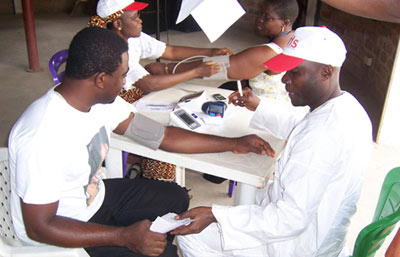
As the world yesterday marked 2012 World Hypertension Day, a new report has shown that a 25 per cent increase in high blood pressure screening in 19 developing countries would reduce the number of cardiovascular disease, CVD, events and deaths that occur each year by up to 3 per cent in these countries.
The preliminary data presented during the World Congress of Cardiology organised by the World Heart Federation recently in Dubai is the first findings from a new report from Harvard that will be published later this year.
The study found that around 900 million people in developing countries have high blood pressure” but that only one-third are aware of their disease.

Moreover, only 100 million of these people receive treatment, while only 5 per cent of the totals are controlled.
Against this backdrop, the study was designed to assess the cost-effectiveness of an intervention to increase screening by 25 per cent in developing countries using a non-lab screening tool to treat those with a systolic blood pressure of greater than 140 mmHg and CVD risk of greater than 20 per cent.
The study found that screening an additional 25 per cent of the population would lead to an increase of more than 10 per cent in the rate of appropriate treatment of hypertension in high-risk individuals. The intervention would lead to about a 1-3 per cent reduction in CVD events and deaths. Furthermore, the incremental cost -effectiveness ratios of these screening programmes were found to be well below one times GDP per capita in the 19 developing countries assessed.
Assistant Professor, Harvard School of Medicine, Dr. Thomas Gaziano said: “Strategies to increase the screening for hypertension could lead to significant reductions in CVD deaths, at costs that are considered to be acceptable according to WHO recommendations,”, CVD is the world’s biggest killer, claiming 17.3 million lives each year.1 More than 80 per cent of CVD deaths occur in low-and middle-income countries. Projections suggest that CVD will remain the single leading cause of death, and by 2030 will be responsible for 23.6 million deaths each year.
Hypertension also known as High Blood Pressure is one of the major preventable risk factors for premature death from CVD worldwide.
High blood pressure contributes to around half of all CVD and the risk of developing CVD doubles for every 1 O-point increase in diastolic blood pressure. High blood pressure that is left untreated can greatly increase a person’s risk of developing CVD. Treating raised blood pressure has been associated with a 35-40 per cent reduction in the risk of stroke and at least a 16 per cent reduction in the risk- of myocardial infarction.
Disclaimer
Comments expressed here do not reflect the opinions of Vanguard newspapers or any employee thereof.