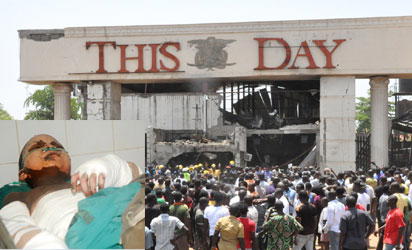
The scene at the ThisDay office after the bomb attack Inset: A young victim of the attack.
By Adisa Adeleye
In a week dominated by bomb attacks on the offices of Nigerian Newspapers – Thisday, Sun and others and the political reactions to the statement credited to the Nigerian Security Adviser, it is tempting to conclude that the future of the country is in serious jeopardy.
While the bombs of Boko Haram had been less discriminating in terms of its effect in the past, the recent massacre of Christian dons at the Bayero University Kano (BUK) has pointed out ethnic and religious factors as motives. The attacks on the media houses and higher educational institutions portend greater danger to the stability of the country.
Unfortunately, Nigeria is now witnessing an attempt by a deadly sect to suppress information and voice of dissent on national affairs and also the pursuits of Western education. The danger is that the insurgency of the Boko Haram sect, although localized to some northern states, might fly into other areas of the country on the wings of the religious bigotry and ethnic irresponsibility – actions and reactions.
While the dastardly actions of Boko Haram sect that aroused public outcry, the other heinous crimes of armed robberies, kidnapping and petty stealing abound all over the country with little control.
The state of insecurity in the country calls for serious examination of the present methods of controlling crimes. First is the adequacy of the right equipment, quality and quantity of the security outfits in the face of growing menace of the activities of the criminal gangs within the community.
This calls to mind the advice in certain quarters that the Police Force should be decentralized for more effective operation as it is being done in many countries which practice federalism. Even in Britain; Police is a decentralized affair like it is in USA. Those who are afraid of a state police are those who prefer dogma to political reality and the requirement for adequate security in the face of rising incidences of crime.
The average Nigerians all over the country are to be pitied for living in a country akin to the Hobbes‘ State of Nature ‘where life is nasty, short, and brutish‘. The appalling difference in the Nigerian situation is that the bombing incidence seems localized at the moment while the other lesser nefarious activities continue unabated.

The scene at the ThisDay office after the bomb attack Inset: A young victim of the attack.
For example, the menace of bad roads causes deadly accidents while unhygienic living conditions are surer ways to death. On top of these hazards to life is the epileptic supply of electricity to many homes which makes lives intolerable to many homes.
In the midst of many complexities in the living conditions in Nigeria and the absence of political and economic stability that makes the future looks uncertain, the thoughts on the mind of every Nigerian are how to survive.
Nigerians have been addicted to suffering over the decades without any resort to avoid or conquer the incidence of suffering. Often, spontaneous reactions of sufferers in form of mass demonstrations have been brutally suppressed, especially under the military rule.
Of recent, strikes and demonstrations on the removal of subsidy and agitation of payment of N18, 000 minimum salaries of lowly paid workers have not been favorably viewed in official quarters. It looks at times as if the present Nigerian leaders lack innovative minds or they are wicked. In some respects, they appear dull and wicked.
There are many options open to Nigerians in tackling the complexity of problems that make up Nigeria – their country. Some past Nigerian leaders have reminded us of the existence of ‘The Other Party‘ in clearing the mess and providing solution and ensure prosperity.
Unfortunately, military rules in this country have failed either to ensure political stability or economic prosperity; rather, the military itself did become at a time the part of the Nigerian problems. Their enduring legacy seems to be in the famous phrase ‘with immediate effect‘ which has now become a famous jargon of the present day rulers when enforcing some changes, even if trivial.
A more reasonable proposal is the adoption of a representational voting system which could lead to the emergence of a government of all people. For instance, if President Jonathan of the PDP has scored 22 million votes to win, the opposition parties which scored about 18 million would have had a say in the composition of the Federal Government, but under the present system of the first – to the tape, President Jonathan could choose all members of his cabinet from his winning party.
Thus, a good National Government could emerge under a representational system of voting and people and Nigerians would think and believe that they are represented in such a government. For example, a Boko Haram problem will not be PDP or Jonathan‘s baby.
Many analysts do suggests that political parties should be abolished in Nigeria and representation to political offices and elections to legislative houses should be from communities and enlightened provisional groups. They argue, and wisely too, that the huge amount of money wasted by political parties in running for elections and political posts could be judiciously utilized to fix the dilapidated infrastructures of the economy.
Also, the bitterness of political debates and the destruction of life and properties associated with electioneering campaigns would be eliminated. They think that afterall, the Greeks who originated the concept of democracy did not recommend party politics.
The other suggestion is the emergence of one single party made up of all parties to confront the ranging political and economic problems of the country. In that case, all aspects of political and social problems would be agreed by all parties, and each party agreeing to give up its sovereignty or identity.
Supporters of this idea think that the best from all parties would be the reliable team to rule. When Asiwaju Bola Tinubu of the ACN asked President Jonathan to seek help in solving the current security, political and economic problems of the country, he might have had a sort of political cooperation of all parties in mind. Sadly, he was misunderstood.
A Nigerian who does not want to ‘check out‘ from the country would want to stay, not as a passive onlooker, but a believer in internal solutions to the ranging country‘s problems through innovative leadership and disciplined citizenry.
It does not look as bravery for a leader in times of crisis to believe that he or his party possesses the wisdom required to solve the nascent complex problems of the country.
The terrible news of the week came from the Minister of Power said that the new IPP PROJECT had problems because of gas supply to the Plants. And this is in a country which is one of the largest suppliers of oil and gas in the world Sms only 07059197616
Disclaimer
Comments expressed here do not reflect the opinions of Vanguard newspapers or any employee thereof.