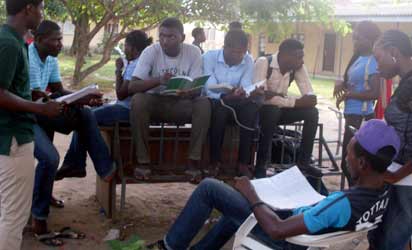
…last minutes revision
BY IKENNA ASOMBA
Nature has had it from the very beginning that there is time for everything. A tour of various tertiary institutions across the country reveals tension on the campuses as students prepare for their end of semester examination.
Semester examinations in tertiary institutions take place after about 10 to 12 weeks of lectures. While some schools are set for or already in their 2011/2012 or 1st semester exams, some others have just commenced or in the middle of their 2nd semester academic session.
The first semester exams at Lagos State University (LASU) are billed to be conducted between April 30 and May 18, 2012. At the Yaba College of Technology (YABATECH), Akoka, first semester exams will have been postponed from May 7, to May 14, 2012. This development has led to mixed reactions among students.
Some perceive it as an advantage to adequately prepare themselves for the exams, while others are not excited about the delay.
Similarly, a circular dated 16th day of April, 2012, at the Federal University of Technology, Owerri (FUTO) stated that dates for the commencement of its1st semester examination for 2011/2012 academic session for older students (200L to 500L), commences on Monday, 30th April 2012 while freshmen (100L) will begin on 14th May, 2012.
At the Ebonyi State University and Anambra State University, the 2011/2012 1st semester exams have been billed for May 7 and 21 respectively.
Be it the 1st or 2nd semester exams, some common scenes to behold in these institutions are students falling ill, which Ngozi Okonjo, a 300L student of Business Administration, Lagos State University, calls “psychological exam fever and tension.”

...last minutes revision
Also, as some students referred to as the ácadas’ aggressively storm the school libraries in their last minute preparations for exams, others are seen running helter-skelter to make photocopies of course materials, all in a bid to pass the exams.
Surprisingly, during this period, some students are forging new friendship with their more serious colleagues, for the purpose of being carried along during the exams.
To some other students, this is the best period to get ready their arms and ammunition- micro-chips, which has been termed ngbo, ‘ómokirikiri, amongst other names given it by students. These students, instead of studying, perpetrate examination malpractice by bringing into the exam hall, illegal materials hidden in unimaginable parts of the body.
Tied to this, some students (male and female) use these last days as the best time to Nicodemusly (secretly) storm the offices of some lecturers to secure passes by all means, who in the bid to satisfy their selfish desires, aid and abet all forms of exam malpractice. This act has been termed by students as ‘sorting.’
Amidst these last minute preparations, another trend that has also crept into our higher institutions is the ‘read and pour syndrome.’ It is a recurring situation where students memorize for the singular purpose of making good grades in examinations.
Commenting on the read and pour culture, Emeka Iwu, 300L student, University of Jos (UNIJOS), refers to this set of students as partially prepared for exams.
“From my findings, they seem not to believe in examination malpractice, but in the carrying capacity of their brains to assimilate whatever must have been read, even few hours to the examination. However, give them some hours after the exams, and ask them same questions, they will be found wanting,” held Iwu.
For Muiz Ojulari, 300L Mass Communication student of the Lagos State University (LASU), lecturers must be blamed for this read and pour culture adopted by students. “You can imagine a lecturer who does not give his best in class, expecting a student to cover virtually all areas of the bulky course outline.
In other situation, these lecturers expect students to give them back word for word of what they have taught them. As failure awaits students who do not comply with this shallow expectation, students have no other option, but to adapt to the culture,” Ojulari submitted.
Similarly, Lara Omole, another 300L student of Lagos State University (LASU), attributed the read and pour culture to late preparations for exams.
“How do you expect a student to record outstanding performances that can be defended, in the face of the work-load of courses they offer, coupled with bulky assignments from lecturers and the non-conducive learning environment they are meant to study under?”
However, Osita Obi, 100L student of Yaba College of Technology (YABATECH), holds a contrary view. For Obi, students’ academic laziness is the major cause of their indulgence in all forms of examination malpractice and the read and pour culture.
“At the beginning of every academic semester, outlines or areas of concentration for each course offered, are made available to students by lecturers to study ahead of the class. So students should not complain of insufficient time to prepare.”
Disclaimer
Comments expressed here do not reflect the opinions of Vanguard newspapers or any employee thereof.