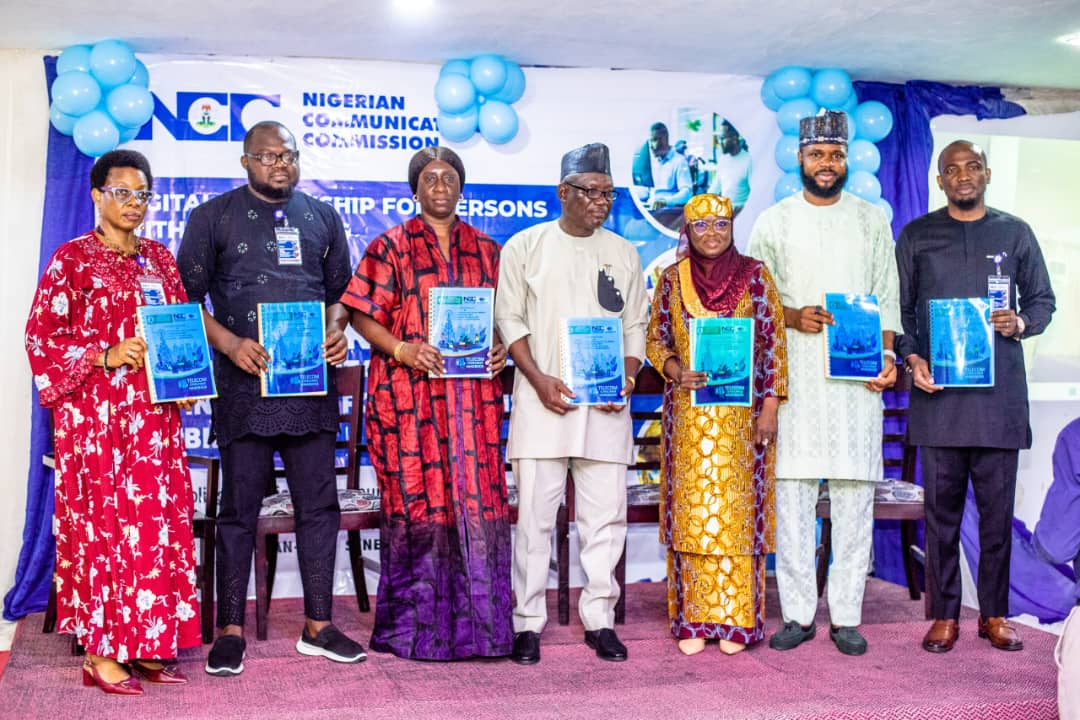
The President/CEO, DBI, Mr. David Daser (second from the left), and other participants, holding books on digital citizenship for persons with disabilities, at a sensitization workshop on: Digital Citizenship for Persons with Disability, organized by the NCC in Abuja.
By Victor Ahiuma-Young
ABUJA — The Digital Bridge Institute, DBI, has called for the immediate development of a comprehensive policy framework to dismantle all barriers preventing over 27 million Nigerians with disabilities from accessing digital education and securing quality employment.
The President and CEO of DBI Mr. David Daser who made the call on yesterday in Abuja while speaking at a sensitisation workshop themed “Digital Citizenship for Persons with Disability,” stressed that persons with disabilities (PWDs) must not be left behind in Nigeria’s digital transformation journey.
A statement by DBI’s Manager, Public Affairs, Soji-Ezekiel Fagbemi, informed that the workshop, organised by the Nigerian Communications Commission, NCC
“It is very imperative that no one is left behind, especially the over 27 million Nigerians with disabilities, as we shape Nigeria’s digital future,” Daser said.
In his goodwill message titled “Empowering All: Advancing Digital Citizenship and Inclusion for Persons with Disabilities,” Daser advocated for the urgent removal of all structural and systemic barriers to the full participation of PWDs.
He called for a disability-aware policy framework and inclusive initiatives to promote equal digital opportunities.
Commending the NCC for convening the critical sensitisation workshop, Daser praised the Commission for its consistent human-centered and forward-thinking regulatory approach.
He noted that as the founding institution behind DBI, the NCC continues to demonstrate commitment to national development beyond its regulatory duties.According to him, “Empowering PWDs in the digital space means not only providing access to technology but also ensuring they have the skills, support systems, and confidence to thrive as equal digital citizens.
“Whether it’s through accessible user interfaces, screen readers, inclusive content design, or enabling policy frameworks, we must remove all barriers to full participation. This is not charity. It is not a favour. It is justice. Inclusion is a shared responsibility. Regulators, educators, the private sector, and civil society must all lean in.”
Daser highlighted DBI’s efforts in promoting disability inclusion, particularly through its partnership with organisations like Sightsavers, saying “the institute has integrated inclusive practices into its digital skills training programmes and has witnessed how adaptive technologies and inclusive designs can transform lives.
“At DBI, we are not merely a training institution. We are a bridge to inclusion. Our partnership with Sightsavers has enabled us to develop and deliver digital skills programmes tailored to persons with disabilities. From inclusive content to accessibility-focused environments, we’ve seen what is possible when intention meets expertise.”
He added that DBI stands as one of Nigeria’s leading institutions in implementing inclusive digital training and sensitisation programmes, with a proven track record and the capacity to scale.“Empowering all means leveraging the best tools and institutions available,” Daser stated.
“DBI is ready and well-positioned to serve as a hub for innovation, inclusion, and human capital development in the digital age.”
In her remarks, the NCC Director of Economic Analysis, Mrs. Olatokunbo Oyeleye, said the workshop was an opportunity for genuine engagement and learning. She urged participants to apply the knowledge gained to positively impact people living around them.
“Digital skills are required in every facet of life and human endeavor,” she noted.
“We must go beyond talk to real impact.”
The NCC also donated 100 copies of books on digital citizenship to the National Commission for Persons with Disabilities during the event.
Speaking on behalf of the Commission, its Executive Secretary, Mr. Ayuba Burkin Gufwan, lauded the NCC’s leadership for its forward-thinking initiative aimed at closing the digital divide and enhancing the active participation of PWDs in the digital ecosystem.
However, Gufwan expressed concern over the non-inclusion of blind participants in the workshop by the consultants, stating that the blind are now able to use computers effectively and should be fully represented in such initiatives.
Disclaimer
Comments expressed here do not reflect the opinions of Vanguard newspapers or any employee thereof.