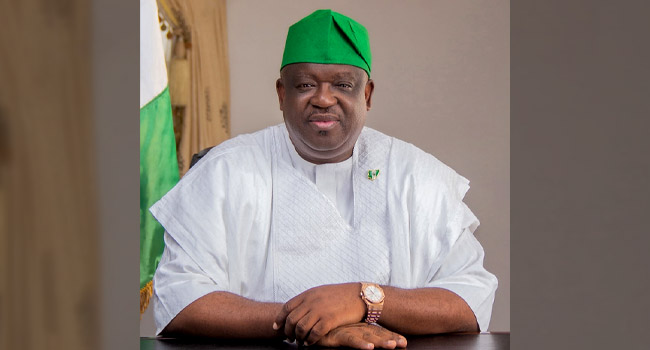
Calab Muftwang
By Marie-Therese Nanlong
At a small, dimly lit Primary Health Care Centre in rural Pangkai, Mikang local government area, 62-year-old Mama Ladi sits on a wooden bench, waiting for the only nurse on duty to arrive. Her grandson, Joel burning with fever, clutches her wrapper.
The building with dilapidated walls, broken ceiling, no electricity, mirrors the state of many primary health facilities across Plateau State. And yet, from this quiet despair, a new hope is rising.
Governor Caleb Mutfwang has declared an intention to transform the State’s broken health system from the PHCs to the tertiary hospital into one that can serve not only its own people, but others.
In a move to reverse decades of neglect in the healthcare sector, Governor Mutfwang is charting a path that begins at the grassroots, with a revitalization of the over 1,250 Primary Health Care Centres (PHCs) scattered across Plateau. These centres, often in deplorable conditions, form the first point of contact for many residents, especially in rural communities like Pangkai.
Speaking at a State Engagement on Sector-Wide Approach (SWAp) for Resource Mapping and Mobilization in Jos, the Governor outlined his ambitious vision to not only revive the PHCs, but also construct a world-class teaching hospital that could attract international attention and medical tourism.
“Our dream is to build a Plateau State Teaching Hospital that will not only serve our people but become a global centre of excellence,” Mutfwang told a cross-section of health professionals, development partners, and policymakers.
“We are looking at medical tourism. But to build that, we need at least $100 million. I don’t know where the money will come from, but I trust God we will get it,” he stressed.
But while the teaching hospital is the flagship ambition, it is the governor’s hands-on focus on PHCs that signals a deeper understanding of the State’s immediate healthcare needs. Many of these facilities are shadows of what they should be, lacking electricity, personnel, equipment, and medicines.
In a strategic move, Governor Mutfwang, within the week, appointed traditional rulers across Plateau as Health Ambassadors, giving them an active role in championing primary healthcare in their domains.
At a ceremony in Pankshin, the Governor reminded the royal fathers of their influence, urging them to mobilize their subjects and instil a sense of ownership around community health.
“As respected custodians of our communities and culture, your influence is invaluable. We want you to drive accountability and participation. When people take ownership, development becomes sustainable,” he told them.
To support this effort, all 17 Local Government Chairmen have been directed to include the construction of new PHCs in each district in their 2026 budget proposals, a step toward infrastructure expansion.
Health Commissioner Dr. Nicholas Ba’amlong described the traditional rulers’ involvement as a culturally intelligent intervention. “This is about embedding healthcare in the community fabric,” he said.
The Governor’s actions are being matched with concrete deliverables. To address the manpower deficit, 1,450 healthcare workers have been approved for recruitment. This will help shore up the chronically under-staffed PHCs, many of which struggle with just one or two health workers managing scores of patients daily.
For frontline workers like Nurse Rejoice Dung, the promise of change feels tangible for the first time. “We’ve been working in the dark, literally delivering babies with torchlight. If this plan is implemented, it will change everything,” she shared.
Recognizing that poor electricity is a major setback, the State is now deploying solar energy systems to PHCs in off-grid areas. This innovation aims to ensure uninterrupted services, especially in emergency situations.
During a site visit to Pushit in the Mangu LGA, Governor Mutfwang inspected the renovation of a PHC, expressed satisfaction with the progress, and promised improved staffing, upgraded equipment, and increased allowances for health workers. He also emphasized community oversight, charging residents to report any sabotage or negligence.
“This is your facility, own it, protect it. If you see something, say something,” he admonished.
The Governor’s vision is rooted in a broader view of health as foundational to every other area of development. “Without a healthy body and mind, there is no function we can perform in society,” he noted.
His vision is not without its challenges. He admits to being frustrated by limited resources saying, “The dreams I have for health and education are huge, but I’m frustrated because I don’t have the resources. We are building from the ruins we met. Every resource mobilized will be transparently accounted for.”
With traditional institutions activated, PHCs being rebuilt, health workers recruited, and an ambitious teaching hospital plans on the horizon, Plateau’s health sector may indeed be on the verge of transformation.
And for Mama Ladi and countless others who have waited for years in broken clinics, the promise of a better tomorrow no longer feels out of reach, it is becoming a reality, one health centre at a time.
Disclaimer
Comments expressed here do not reflect the opinions of Vanguard newspapers or any employee thereof.