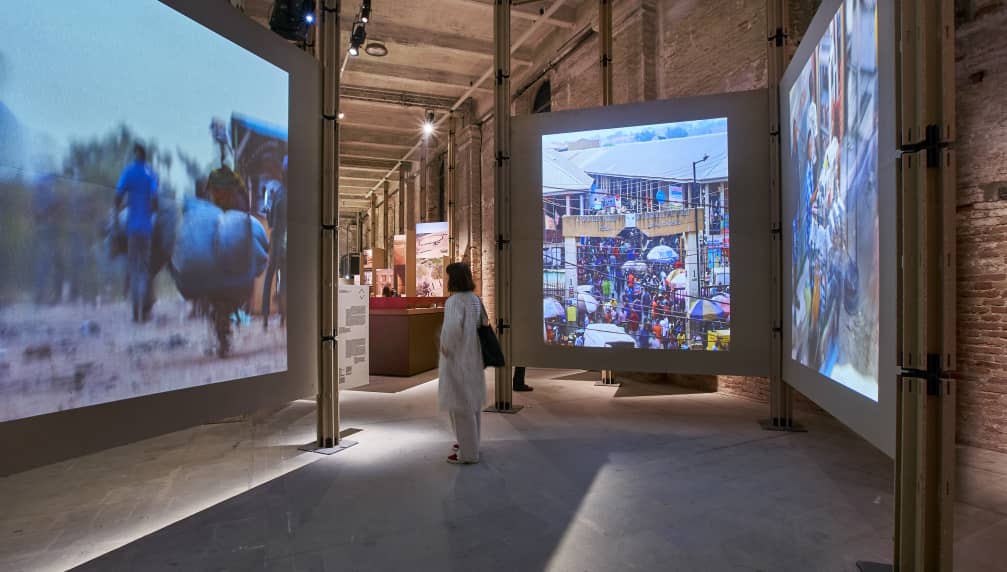
Tosin Oshinowo’s installation ‘Alternative Urbanism: The Self-Organized Markets of Lagos’, on display at 19th International Architecture Exhibition of Venice Bienniale, in Italy. Photo: Paul Raftery.
By Osa Mbonu-Amadi, Arts Editor
In a stunning twist at the 19th International Architecture Exhibition of the Venice Biennale, Lagos has stormed the global stage, not with an official Nigerian Pavilion, but through the raw energy and ingenuity of its informal markets. Architect Tosin Oshinowo’s installation, “Alternative Urbanism: The Self-Organized Markets of Lagos,” has clinched a coveted Special Mention from the Biennale jury, sparking excitement across Nigeria’s creative community.
While Nigeria’s absence from the main pavilion might have raised eyebrows, Oshinowo’s work has seized the spotlight, causing Lagos markets to take centre stage, and boldly celebrating the city’s sprawling market culture. The installation, currently on display at the Corderie, Arsenale in Venice, dives deep into the heart of three iconic Lagos markets—Ladipo, Computer Village, and Katangua.
Each market tells a story of resilience and resourcefulness. Ladipo pulses with the trade of second-hand cars and spare parts. Computer Village, the tech nerve centre of Ikeja, buzzes with gadgets—both new and used. Katangua, in Agege, is a treasure trove of second-hand clothing and shoes. These markets, Oshinowo argues, are not just commercial hubs, but living factories—processing, repairing, and recycling goods from the global north, and giving them new life on the streets of Lagos.
The jury, obviously blown away by circular ingenuity, was quick to recognise the power of Oshinowo’s vision. “Tosin Oshinowo’s Alternative Urbanism offers a glimpse into markets processing the waste of the industrialised economy,” the jury declared. “This documentation is a promising initiative for further research about markets in Africa and their importance as prototypes for innovation. These markets are keynotes in a robust ecosystem that merits study because of its adaptive circularity.”
Oshinowo’s installation is nothing short of immersive design, engendering global inspiration. Towering three-metre-high walls create a dramatic enclosure, their inner surfaces alive with videos capturing the daily hustle of Lagos traders. On the outside, maps crafted from recycled denim—sourced from Katangua itself—trace the intricate flow of people and goods. An accompanying essay pays tribute to Rem Koolhaas, the legendary architect whose research into Lagos markets first inspired Oshinowo as a young student.
This Special Mention is a triumph for Nigerian creativity, as well as a landmark moment for Nigeria at the Venice Biennale. It adds to Oshinowo’s growing international reputation, coming hot on the heels of her role as curator of the 2023 Sharjah Architecture Triennial in the UAE.
In her acceptance speech, Oshinowo revealed how Koolhaas’ early work on Lagos left a lasting mark. “In 2001, as a young architecture student, I came across his Harvard Cities project covering Lagos. It was the first time I saw my city through this lens, and I have remained spellbound ever since,” she said, her voice charged with emotion.
Behind the scenes, Oshinowo Studio’s success is powered by a coalition of supporters, from the A.G. Leventis Foundation to Harvard University’s Loeb Fellowship. Nigerian institutions, private galleries, and passionate individuals all played a part in bringing this vision to life.
It’s indeed, the Lagos spirit going global. With the Venice Biennale running until November 23, Oshinowo’s installation stands as a testament to the spirit of Lagos—restless, inventive, and always ready to turn adversity into opportunity. In a world searching for answers to the climate crisis, Lagos’ markets, as seen through Oshinowo’s eyes, offer a bold blueprint for circularity and collective intelligence.
This is Lagos, unfiltered and unstoppable, taking its rightful place on the world stage—one recycled part at a time.
Disclaimer
Comments expressed here do not reflect the opinions of Vanguard newspapers or any employee thereof.