By Favour Ulebor
A team of African scholars has debunked the widely held belief that China engages in debt-trap diplomacy, describing it as a “misconception lacking credible evidence.”
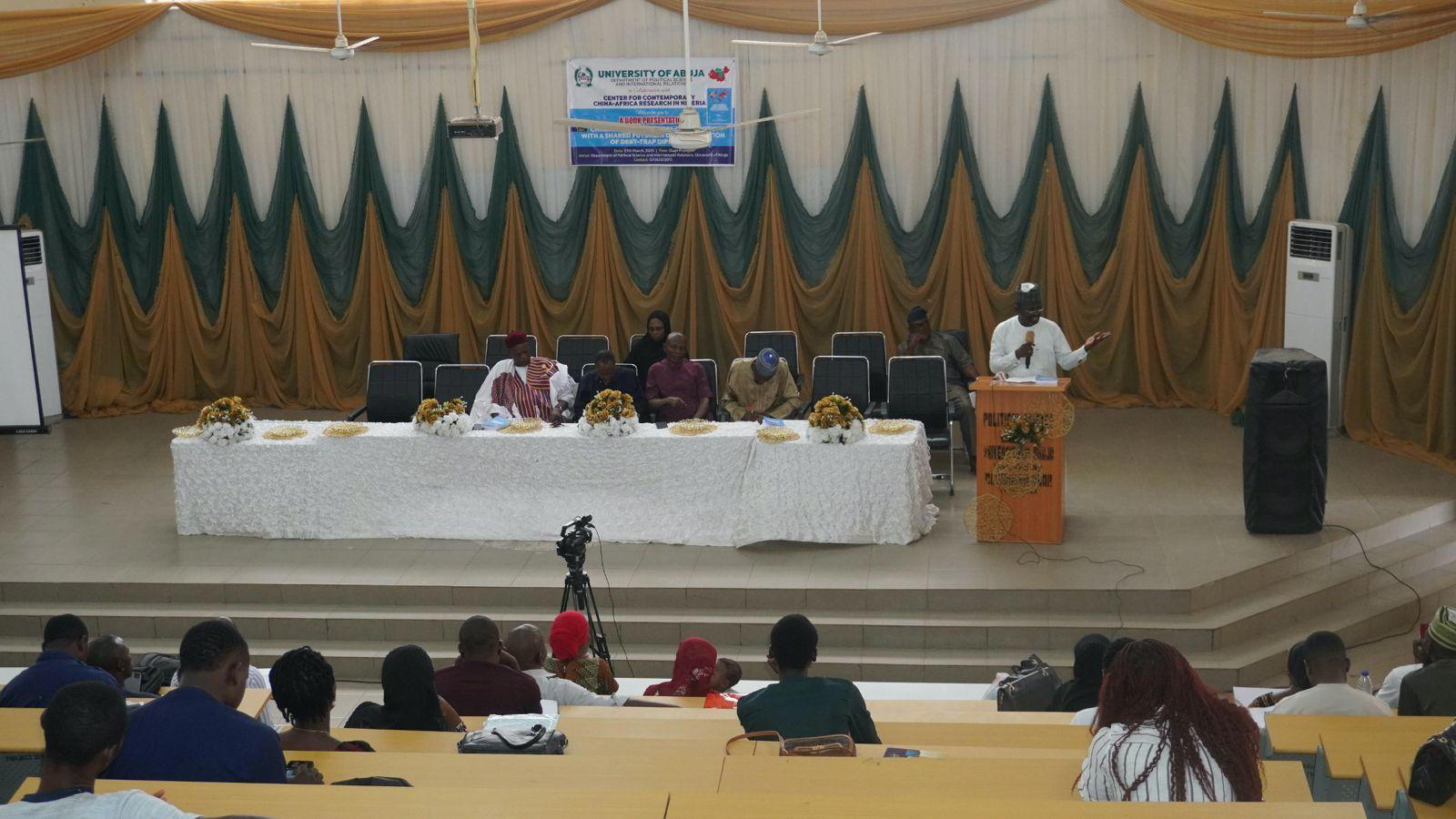
The scholars made this assertion during the unveiling of their new book, China, Building a Global Community With a Shared Future: A Deconstruction of Debt-Trap Diplomacy, at the University of Abuja’s Department of Political Science and International Relations on Thursday.
Professor Sheriff Ghali Ibrahim, Head of the Department and Director of the Center for Contemporary China-Africa Research in Nigeria, who edited the book, refuted claims that China deliberately entraps developing nations with unsustainable debt.
“The claim that China uses debt to manipulate poorer nations is baseless. Instead, China is fostering global development by supporting infrastructure, trade, and human capital growth,” Ghali stated.
He highlighted Nigeria as a major beneficiary of China’s Belt and Road Initiative (BRI), which has contributed significantly to railway and road construction, seaports, energy, agriculture, and technology transfer.
“Through the BRI, Nigeria has witnessed massive infrastructure development, including railways, airports, roads, and bridges. The initiative is here to stay, and Nigeria remains a key beneficiary,” he added.
The 450-page book, reviewed by Professor Saleh Dauda, is organized into 25 chapters. Chapters 1-6 explore China’s contributions to global development and dismantle the debt-trap narrative. Chapters 7-14 focus on China’s investments in Nigerian infrastructure and its efforts to reduce global poverty. Chapters 15-21 examine the China-Nigeria strategic partnership, China’s role in African public infrastructure, and the dynamics of Nigeria-China relations in a multipolar world. The final chapters, 22-25, analyze Sino-Nigerian economic relations, the absence of debt traps in their trade dealings, anti-corruption measures, and a comparative analysis of Nigeria and China.
Prof. Saleh emphasized that “China’s concessional loans do not exhibit debt-trap characteristics, unlike loans from international financial institutions such as the World Bank and the International Monetary Fund (IMF).”
The book presentation drew an audience of foreign policy experts, academics, university lecturers, and students, all eager to discuss the evolving dynamics of China-Africa relations.
Disclaimer
Comments expressed here do not reflect the opinions of Vanguard newspapers or any employee thereof.