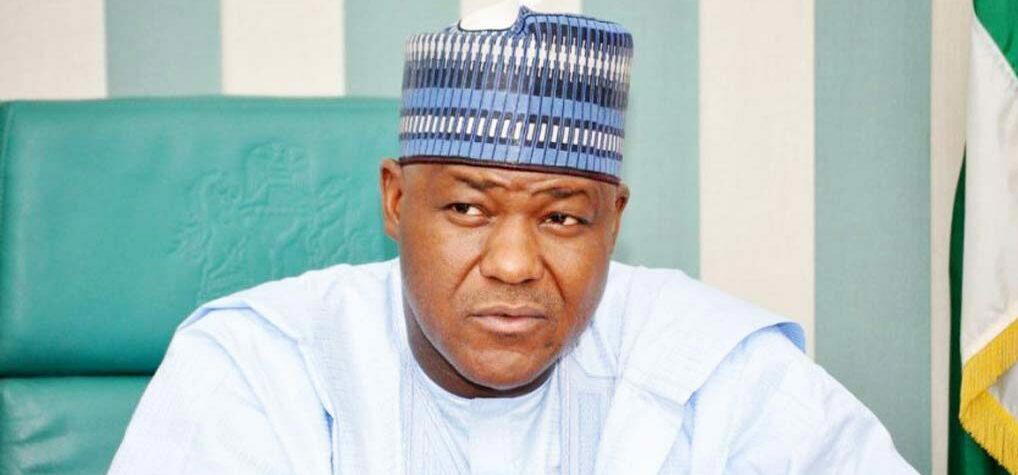
Dogara
Laolu Elijah, Ibadan
FORMER Speaker, House of Representatives, Honourable Yakubu Dogara yesterday said the emergence of Boko Haram could be attributed to a lack of good governance by successive administrations.
He said this in Ibadan while presenting a keynote address at the 2025 World Interfaith Harmony Week conference and awards entitled, “The love of the Good, and the love of the neighbours” which held at the Trenchard Hall, University of Ibadan.
The ex-Speaker who was represented by Timothy Golu lamented that despite the bitter experience that the Civil War left behind, Nigerians are yet to learn from it.
He said, “No society throughout history has ever risen above the level of its leadership. Sadly, when we abdicate our responsibility, all we have left is to cover up our weakness as in the case with us now.”
“For the 12 months preceding December 12, 2024, 10 countries were categorised as extreme-conflict countries. These are – Palestine, Myanmar, Syria, Mexico, Nigeria, Brazil, Lebanon, Sudan, Cameroon and Colombia. It is no surprise that Nigeria occupies the 6th position on the global chart.
“We have had a number of crises since independence, the worst of which was the civil war from 1966 to 1970. Seems we didn’t learn much from that sordid episode, after all.”
“The evidence of our abysmal failure at nation building are right under our noses- the formation or the rise of successionist groups such as the Movement for the Emancipation of the Niger Delta, Niger Delta Frontier Force, Indigenous Peoples of Biafra, Oduduwa People’s Congress among other.
“However, it is in this democratic era that we are now witnessing the worst security challenges in Nigeria.
“The Boko Haram insurgency that broke out in Borno state in 2009 has now metamorphosised into one of the most dangerous international terrorist organisations leading to the deaths of thousands of people and displacement of over five million others”.
Still lamenting the spate of insecurity in the country, he made reference to the perennial farmer-herders crisis noting, “Farmer-Herders crisis has bedeviled Nigeria for some unbroken years now. It has displaced hundreds of thousands of people, damaged local economies, and entrenched ethnic and religious polarization which continue to claim thousands of lives. Successive administrations since 1999 have been unable to tackle this primarily due to ineffective responses.”
“Only the uninformed doubts the fact that, as it is, we have arrived at our moments of national peril. Unfortunately, our history is marked by disturbing anecdotes of series of ethno religious violence that have profoundly stymied nation building.
“I have said before that we cannot lose the fight against violence and still keep our civilization and country. Therefore, if our democracy must deliver on its promises, we must deploy our collective will and energy to root out violence.
“For it is not materialistic things, power or pride that make a nation great and strong, only the willingness of great men and women within it to reach out to each other and work together.
“I presume it is because of lack of leadership and denial of personal responsibility which has become a moral epidemic today.
“Leaders think and talk about solutions and responsibility is at the heart of leadership because the leader is the one who responds to a need. That response may be to God’s call or to the needs they see around them, in this case, the unmitigated violence we witness on daily basis. It is said that, “everything rises and falls on leadership”.
“No society throughout history has ever risen above the level of its leadership. Sadly, when we abdicate our responsibility, all we have left is to cover up our weakness as in the case with us now.
“Assuredly, our lives will begin to change the day we take responsibility for it. The future of peace, development and progress is very possible but only if we take the risk and accept the responsibility of consciously creating it”, he submitted.
Those at the event were former President Olusegun Obasanjo, former Governor of Ogun State, Senator Gbenga Daniel, President of Christian Association of Nigeria (CAN) Rev. Daniel Okoh, former President, CAN, Reverend Supo Ayokunle, Ambassador Yemi Farounbi and several others.
Disclaimer
Comments expressed here do not reflect the opinions of Vanguard newspapers or any employee thereof.