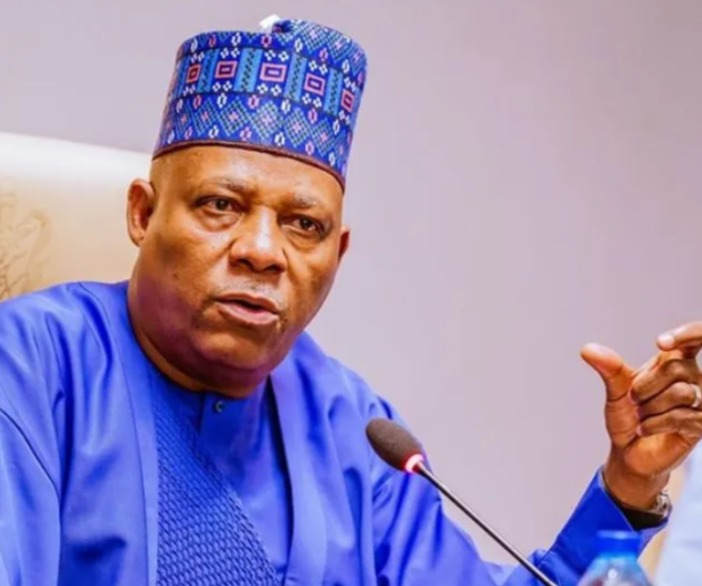
Shettima
By Johnbosco Agbakwuru
Vice President Kashim Shettima has described the number of out-of-school children in northern Nigeria as alarming, emphasizing the need for immediate intervention to address the crisis.
Speaking on Thursday at the inaugural International Conference on Girl Child Education in Nigeria, organized by the Nigerian Governors Forum (NGF), Shettima stressed the importance of prioritizing education, particularly for the girl child, as a solution to this pressing issue.
The NGF, in its remarks, identified early marriage, early childbearing, poverty, illiteracy, gender-based violence, and discrimination as key factors preventing girls from accessing education in Nigeria.
At the conference, held at the Presidential Villa in Abuja, the Vice President—represented by the Deputy Chief of Staff to the President, Senator Ibrahim Hadejia—outlined the challenges of education in northern Nigeria, especially in states like Kebbi, Zamfara, and Bauchi, where more than 60% of primary school-age children are not in school. For example, Kebbi has a staggering 64.8% of out-of-school children. Secondary education figures are equally concerning, with Bauchi at 66.75%, Kebbi at 63.8%, and Jigawa at 62.6%.
Shettima stated, “We cannot ignore these frightening numbers. The consequences are far-reaching, and it is critical to address this as an emergency with region-specific solutions.”
He emphasized that the dignity of the girl child is fundamental to any civilization and called for collective responsibility to prioritize their education. “The latest multiple indicator cluster survey reveals that 25.6% of primary school-age children and 29.6% of secondary school-age children are out of school. Every child abandoned to the streets today is a potential liability tomorrow.”
Shettima highlighted that educating girls is not just a moral obligation but a crucial factor for economic stability. “For every additional year a girl stays in school, her future earning potential increases, infant mortality rates decrease, and poverty levels in communities drop,” he said, adding that the gender parity index now shows that girls have nearly caught up with boys at the primary level and have surpassed boys at the secondary level.
He also spoke about the National Economic Council’s efforts to secure the future of the girl child, focusing on education, health, nutrition, and employability. “We aim to achieve a 0.6 score on the World Bank’s human capital index, which requires increasing years of schooling and improving education quality.”
Addressing education financing, Shettima noted significant increases in education expenditures. “In 2022, states spent N1 trillion on education, representing 12% of their total expenditures. By 2024, states committed N2.4 trillion, while the federal government allocated N2.2 trillion, bringing the combined total to N4.6 trillion. However, we must aim higher, pushing for 15 to 20% of state budgets to be dedicated to education.”
Shettima called for a unified approach, stating that federal, state, and local governments, along with civil society and international partners, must work together to ensure that every Nigerian child receives quality education. He also urged local leaders and traditional and religious figures to play a role in advocating for the education of girls.
In his remarks, NGF Chairman and Kwara State Governor Abdulrahman Abdulrazaq expressed concern over the increasing number of out-of-school children and highlighted the challenges of learning poverty and insufficient teacher capacity. He noted that quality education is key to national development and called for increased funding, improved infrastructure, and enhanced instructional materials.
“Our goals include increasing primary school enrollment, improving learning outcomes, and ensuring smooth transitions from primary to secondary education,” Abdulrazaq said, adding that states are committed to achieving these objectives.
The governor also praised states like Lagos, Enugu, Kaduna, and Ogun for meeting or exceeding the international benchmark of allocating 15% of their budgets to education.
Development partners such as the World Bank, UNICEF, British Council, and UNESCO were also present at the event, signaling their commitment to supporting Nigeria’s efforts to improve girl child education.
Disclaimer
Comments expressed here do not reflect the opinions of Vanguard newspapers or any employee thereof.