BY JAPHET ALAKAM
The Igbos of the South East Nigeria or Ndigbo is one of the three major ethnic groups in Nigeria with distinct culture. In fact, they are seen as one of the most organised group in Nigeria with well established democratic system, culture, law and administration, an action that made the Europeans to describe them as having a democratically organized autonomous communities.
But recent developments reveal that the group is on the verge of loosing her language and culture courtesy of western influence.And if concerted efforts are not put in place now, sadly, the language and culture will in the near future be wiped out. Though various Sate governments in the South East have at one time come out with several measures to stemming the tide of the negative development. Unfortunately, the disturbing situation persists.
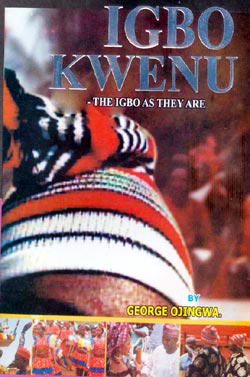
Troubled by this ugly scenario and in a bid to suggest measures that can be employed in addressing the issue, an Igbo son and a retired civil servant, George Ojingwa decided to write a book titled, Igbo Kwenu- The Igbo As They Are.
The beautifully illustrated 163 page book documents those ideal values that are seen and believed to represent Igbo culture. Coming from the stables of Transfiguration Press and Publishing House Owerri, Nigeria, the book is a well researched effort that draws the attention of Ndigbo both at home and in diaspora to the richness, unity and essence of Igbo culture as a way of life and the need to preserve it. 
The book which comes at the right time when the need to redeem the Igbo culture is highly needed is a wonderful compilation of the life and times of Ndigbo during the pre colonial/colonial period up to that point that encounter brought many changes in the traditions of Igbo people.
Divided into six chapters, the first chapter of the book takes an excursion into the history of the Igbo, how they came , the unique features of her people, the language , names and their meaning, mode of religion, farming, rural industry etc.
While Igbo similarity with the Jews is not left out by Ojingwa, he however highlights some of the qualities that distinguish the Igboman from people of other tribes and regrettably laments that most of the youths of these days know nothing about these qualities.
The author in Chapter 2 goes further to talk about Igbo family life. In this chapter, he takes a look on the family life of Ndigbo: how the people conduct their marriages, their aesthetic sensibilities, child bearing and the reception, naming ceremony, classification of children, divorce, birth control, maternal bond, death and burial requirements.
The book also x rays most of the customs and traditions of Ndigbo and how they came about, their importance and why some of them are outlawed. For example the Osu caste, slavery, and the untouchables, Kolanut and its uses, traditional land sharing policy of the people, Age grade system, New yam festival, Masquerade performance, cultural games, adultery, etc. The issue of taboos and superstition are also handled.
The various ways of administration of Ndigbo is equally written about also beautifully by the author, who takes time as well to explain the importance of ofo as an important staff of office among the Igbo.
The book ,Igbo Kwenu, is a very good attempt at documenting a palpably extincting culture and language. The significance of this effort lies in its clarion call on the people of Igbo extraction all over the world on the need to rehabilitating their defining essentials: their language and culture, the cultural signifiers of their existence as a people. This is an important contribution.
Disclaimer
Comments expressed here do not reflect the opinions of Vanguard newspapers or any employee thereof.