By Victor Ecoma
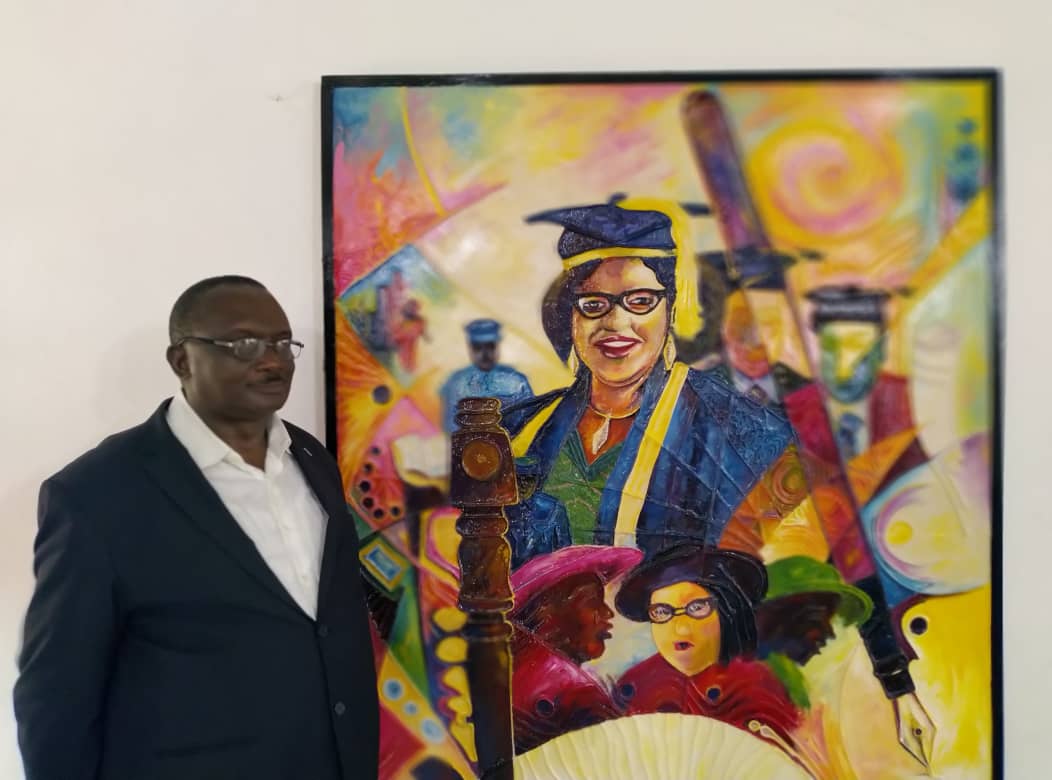
The portrait painting of the Vice Chancellor, University of Calabar entitled “Emergence” size: 221.5cm x 145cm is a mixed-media painting by Prof. Victor Ecoma painted in 2023.
Prof. Ecoma is the Head of the Department of Fine & Applied Arts in the university. The painting is significant as a historical cum narrative painting which illustrates the emergence of Prof. Florence Obi as the first female Vice-Chancellor of the university since its inception in 1975. The painting has become an important part of the history of the university and its very first important art collection.
In all human civilizations portraiture and other forms of artistic expressions constitute a veritable means of illustrating the human conditions either in the expression of human emotions, intellectual achievements, fulfilling societal aspirations or in honouring leadership. Paintings have remained an essential medium of visual documentation which endures and most times outlive the artists, their patrons and audiences, and for the most part continues to speak to future generations.
Works of art by their very nature enable us to see and feel the sensibilities which documents, texts and words are constrained to convey, as human agencies they provide us insights into what the past was like, enable us to evaluate the present as a guide for articulating future aspirations. The painting ‘ “Emergence” is not just a portrait it is portraiture embedded in a narrative painting which can be contextualised, analyzed and valued at several levels.
No doubt it is a historical account of the first female Vice-Chancellor of the University of Calabar. Historically, the painting’s realism and symbolism are essential components of visual literacy as the foundation for 21st century knowledge, visually given by computers, Internet, smart phones, videos, etc., which illustrate the value of art education and art appreciation.
Sociologically, the painting speaks to issues of gender disparity, the place of the girl child education, women empowerment, the radiating enlightenment of university education and the radiating influence of Prof. Obi’s academic leadership. Anthropologically, the painting expresses the hybrid-aesthetics of connecting an intricate balance between African forms of art expressions and those of Western art in a way that not only stimulate intellectual imaginations but provides an understanding of the similarities and differences between the two cultural worlds.
Placing one’s work in a public space for a greater public appreciation is a tribute to an honest art career for which I am grateful to the Vice-Chancellor, Prof. Florence Obi for this opportunity.
Disclaimer
Comments expressed here do not reflect the opinions of Vanguard newspapers or any employee thereof.