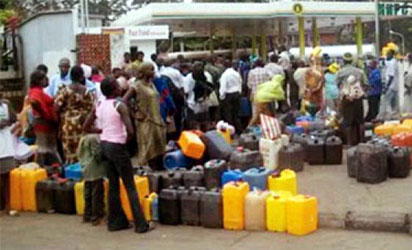
The long queue for expensive and unavailable kerosine…but when will this scarcitystop?
By Ebun Sessou & Anozie Egole
Two weeks ago, Mama Yakoyo, as she is popularly called, bought a litre of kerosene at a nearby filling station for N95 but was shocked when she returned for another purchase last Monday and was told a litre now sells for N200.
Officially, Kerosene is meant to sell at N50 a litre, but it now goes for N200 per litre as black marketers have upped their price by over 100 per cent. They now sell a gallon for N1000 instead of N350. This is the scene in Nigeria today.
From east to the west; north to the south, the endless search for this commodity is virtually affecting all homes, especially the ordinary people who find the use of kerosene stove more affordable. The long queue of consumers waiting endlessly at filling stations has made the situation worse.
Similarly, it was gathered that the price of charcoal has also gone up. Mr. John Oche, a charcoal seller in Sangatedo area of Lekki disclosed that a bag of charcoal which used to sell at N1, 600, now costs between N2,000 and N2,500. Small leather bags of charcoal which used to sell at N50, now costs at N150.
Sources disclosed that the current situation could lead to deforestation, as low income earners who cannot afford kerosene now depend on firewood as alternative energy.
No official reason was given for the scarcity. Some oil marketers who spoke to Saturday Vanguard blamed the scarcity and high cost of kerosene on the pricing and supply of the product.
One of the major oil marketers attributed the problem to non-functioning of local refineries to full capacity, forcing government to import in order to meet local consumption. The marketers also accused the federal government of delay in settling their reimbursement claims.
The managing director of Aaso filling station in Egbeda-Isheri road of Lagos, Mr. Suleiman said that the problem will be best solved by the government if the the people responsible for this scarcity can be brought to book. “Nigerian National Petroleum Cooperation [NNPC] as the major distributor should properly handle petroleum and its equivalent in the country very importantly.”

The long queue for expensive and unavailable kerosine...but when will this scarcitystop?
He said that for more than 10 years now, the NNPC Ejigbo satellite deport has not had Kerosene while other filling stations go to Apapa depot to buy from individual refineries and the refineries sell to them at any price they wish. For this, they will now add their own money in order to cover both the money they used in purchasing the goods and the money for transportation
Experts however, advanced other reasons for the scarcity of the product. According to them, kerosene is now being used as additive in diesel to prevent waxing and gelling in cold weather. The product is also used for heating oil; as solvent for insecticide sprays and as fuel in aviation industry to reduce the risk of jet fuel explosion. This according to them makes kerosene a priceless commodity, leading to scarcity.
Because of the scarcity of the product, many unemployed youths have resorted to hawking to make fast money. A black marketer who claimed anonymity told Saturday Vanguard that he sells more than 50 litres of kerosene a day, depending on the availability of the product.
He further disclosed that the business is lucrative as a result of high demand. Although kerosene is sold at N50 a litre at NNPC mega stations, consumers however, complained of the difficulty in getting the product.
A kerosene retailer said it takes between four to five hours to get kerosene in the station. It was gathered that the black marketers usually bribe the filling station attendants in order to get the product.
The product is also adulterated, which at times results in explosions with great loss to lives and property.
Scores of Nigerians have lost their lives to kerosene explosion, as a result of kerosene adulteration. Nigerians who spoke blamed the government for its inability to monitor the distribution of the product.

Diezani Allison-Madueke, Petro Minister
Most homes that cannot afford the commodity are now forced to make do with other cooking alternatives, including firewood and charcoal, despite the inconvenience associated with materials.
Saturday Vanguard gathers that the scarcity is made worsened by the refusal of the Petroleum Products Pricing Regulatory Agency (PPPRA) to pay subsidy on the product previously imported by the NNPC. To worsen the situation, no reprieve seems to be coming from the federal government to combat the problem as the effects of kerosene scarcity bite harder.
In February, the Petroleum Product Marketing Company (PPMC), while speaking through its spokesman, Ralph Ugwu on the scarcity of kerosene, said the agency had supplied enough products to satisfy national demand.
According to him, it is surprising that despite PPMC’s effort to saturate the market with kerosene, there is still widespread scarcity. In the face of this defence, Saturday Vanguard discovered that kerosene couldn’t even be obtained at the NNPC mega stations in Lagos.
On days when it is available, the demand outweighs the supply. The product, it was learnt, is being rationed in Lagos, thus, making it difficult to reach other parts of the country where the situation is really biting harder.
With perennial kerosene scarcity continually posing a nightmare, Nigerians are angry that despite being blessed with crude oil from which the Dual Purpose Kerosene (DPK) is produced, they still suffer in the midst of plenty.
According to reports, the national daily demand of DKP is estimated to be between eight and 10million litres. This quantity obviously cannot be made available by dysfunctional refineries scattered across the country.
Nigeria’s refineries have been meeting only 35 percent local consumption, while the remaining 65 percent is sourced abroad. Hence, the country relies on importation of the product to meet high demand.
The absence of refineries to produce kerosene as well as other petroleum products have been said to be responsible for the untold hardship inflicted on Nigerians, especially now that kerosene imports have reportedly declined with only few refineries producing it worldwide.
The scarcity is also taking its toll on the economic life of the country, especially in Lagos, where most restaurants rely on kerosene for business. Even their reliance on coal pots and firewood is still hinged on kerosene, as they still rely on it to start a spark.
Most restaurant owners in Lagos complained about staying on long queues for days in order to buy kerosene to run their businesses. They decried the level of suffering meted out to them, noting that they now rely on black marketers who sell at exorbitant prices to sustain their business. The brunt of this cost, no doubt, will be transferred to customers through increased food price.
With no visible action taken to control the twisting cost of kerosene or make the product readily available, consumers who go through the torturous experiences of queuing up in the scorching sun to buy the essential commodity are looking up to the federal government.
They are pleading with the authorities to save them from avoidable suffering obviously inflicted on them by some greedy fellows in the petroleum industry.
This sudden increase in kerosene price has also affected the suppliers as some managers of filling stations are complaining bitterly about the challenges they are facing as a result of the change in price. Some said as a result of the price increase, they have not been able to purchase the commodity because nobody is ready to pay such amount of money for a litre of kerosene.
For many Nigerians, buying kerosene across the nation is like a carmel passing through the proverbial eye of a needle. The product is not available in many filling stations. Where it is available, it sells the product at exorbitant prices. A litre of kerosene at filing station ranges between N200 and N250 depending on the station.
At the black market, the product sells for N350. This has brought pressure on firewood as many housewives have resorted to firewood or sawdust for cooking.
In Lagos and its environs, the price of kerosene has jumped by more than 100 per cent which has resulted in long queues at Nigerian National Petroleum Corporation, NNPC, mega stations.
Mrs. Abiola Odukoya, a restaurant owner in Governor’s road of Ikotun area of Lagos State, said that this increase in prices of kerosene is grossly unfair.
According to her, “Government wakes up and takes decisions without considering the feelings of the common man on the street. This government has no better plans for the poor masses. The only way they are compensating the people that voted them into power is bringing out policies that impose hardship to the masses.
“There is no adequate electricity supply and right now, we have been faced with scarcity of kerosene. This government is making life miserable for the society.”
Ruth Joseph , a school certificate holder, narrated how the increment in prices of commodies including kerosene has made her resort to selling recharge cards to make ends meet.
Disclaimer
Comments expressed here do not reflect the opinions of Vanguard newspapers or any employee thereof.