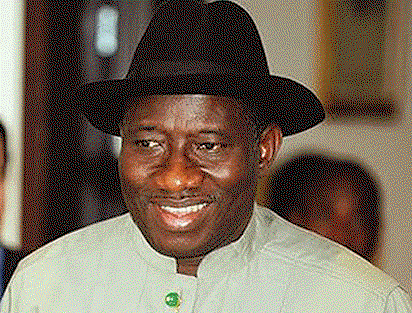
President Goodluck Jonathan
By SUNDAY AKANNO
The relegation of agriculture to the background at the onset of the oil boom during the 1970s occurred side by side with what has been described in some quarters as the epoch of implantation of corruption in the country.
Then it was the stock-in-trade for public officials to misappropriate public funds and walk away. The official response during this ugly era perhaps explains why most citizens still have little respect for the nation’s leaders.
Despite this, Nigeria became recognized as a nation with rich potentials in human and natural resources. This recognition contributed in strengthening the popular title which Nigeria earned -Giant of Africa.

President Goodluck Jonathan
This notwithstanding, people still marvel at the paradox of Nigeria not being able to surmount some of its challenges after five decades of independence.
Many wondered why the resources at the nation’s disposal have not been deployed by the leaders for improved national development.
Both local and foreign experts have consistently blamed the trend on two issues: poor governance and weak institutional structures.
However, there were a few exceptional people who believed the negative system ought not to continue indefinitely. One of such persons was Mrs Oby Ezekwesili, who currently serves as World Bank’s Vice President for Africa Region.
At a recent forum on public procurement, held in Port Harcourt and jointly organized by the Rivers State government, the United Nations Development Programme (UNDP) and the Norwegian Embassy, Ezekwesili and other stakeholders, who converged to appraise the scope of reforms in Nigeria’s public procurement system, bared their minds on some critical issues affecting the sector.
Some, who gave thought provoking suggestions and recommendations at various sessions of the conference, adjudged procurement system in the country as having performed moderately.
Historically, the initial attempts to correct some of the developmental ills of Nigeria, which later resulted in the establishment of the Budget Monitoring and Price Intelligence Unit {BMPIU}, could be readily traced to former President Olusegun Obasanjo.
As critical as Nigerians could be, Obasanjo still enjoys accolade as a leader who established the anti- graft agencies in the country, which was seen as the first bold step to tackle corruption in the nation. He also articulated discussions which led to a robust reform process in the nation’s public procurement system.
Prior to this move, however, public procurement practices were largely unprofessional, inefficient and ineffective; it was based on Treasury Circulars of 1958, which provided only guidelines on public expenditure management.
These scanty guidelines for procurement was governed by what was known as financial instructions, later it became financial regulations, which only specified how government workers could procure services, goods and works.
As experts in the field of contemporary public procurement system grew, they began to see these guidelines as grossly inadequate and that it created room for malpractices and high level corruption in contract management.
Then the country was known for its notoriety of public officials and contracting firms busying themselves bloating contract costs and ripping the Nigeria economy off in many instances.
The event afforded Ezekwesili an opportunity to appraise the sector, particularly against the backdrop that she once headed the BMPIU when the reforms were being mulled.
While presenting a paper with the theme: “Strengthening Public Procurement Management at the Sub-National Level in Nigeria”, she bemoaned the nation’s low developmental index even after a decade of democratization.
She heaped a larger part of the blames on a few state governments which she said have failed in their ability to articulate core priority needs of the people they govern.
While it is now common knowledge that the Public Procurement Act was officially signed into law in 2007, her appraisal saw her flaying most state governments for lacking the political will to institute procurement laws in their states as had been the case at the federal level in the last five years.
This, she attributed to ploy by some state governors to resist the anti graft agencies when their tenure of office expires.
Governor Chibuike Rotimi Amaechi also barred his thoughts at the occasion. Although he shared most of the views of Ezekwesili he had some reservations.
He said as laudable as the Public Procurement Act seems, it sometimes tend to slow down the pace of performance of government.
He said most governors are faced with the challenge where the citizens want to see immediate impact or what is now termed “dividends of democracy” from the public wealth.
Another resource person, Director General, Bureau of Public Procurement, Abuja, Engr Emeka Ezeh, who gave a presentation, re-echoed some of the values and guiding principle in contemporary public procurement dealings.
He said accountability, ethics, impartiality, professionalism and transparency are necessary ingredients for a procurement bureau to cause the ripple effect of good governance which citizens expect in most cases.
Similarly, Director General, Rivers State Bureau of Public Procurement (RSBoPP), Franklyn Nlerum who was also on hand to give insights to the discussions, underscored the need for information technology in modern management of public funds.
Beyond their comments and observations, others who made presentations on the first day of the programme were of the opinion that public procurement policies in Nigeria are very laudable and apt since it has been able to reflect real change or institutionalized process from government to at least curb some of the sharp practices which previously characterized public spending.
The BPP, as the sole regulator of public procurement practice in the country, has been scrutinizing the activities and performances of the Ministries Department and Agencies (MDAs) of government under its public procurement review mechanism to ensure transparency, accountability, value for money, timeliness, among other essential duties.
Records have it that the BPP saved the country N216.6 billion during the 2010 appropriation year from its review of contract processes before the issuance of Certificate of No Objection.
In Rivers State also, Rev. Precious Omuku, who presides as chairman of the Rivers State Bureau on Public Procurement, revealed that the agency has been able to save the state N12.79 billion as at October, 2011.
He disclosed that through fiscal prudence, N13.5 billion was salvaged in 2010, while N19.3 billion was saved in 2009.
At the federal level, this whole reform, especially in terms of institutionalizing public procurement processes has made it become a standard practice for MDAs to base their annual procurement budgets on verifiable need assessment.
Besides, before the commencement of the yearly procurement, the MDAs now have to prepare and present to the bureau, their public procurement plan to substantiate their readiness and strategies for the year’s procurement.
*Akanno is a public affairs analyst based in Abuja.
Disclaimer
Comments expressed here do not reflect the opinions of Vanguard newspapers or any employee thereof.