By Onyeka Ezike
The rich culture and history of the Yoruba Kingdom can be traced to the epoch preceding the advent of the British Colonial administration, which has continued to thrive within and beyond the borders of Nigeria.
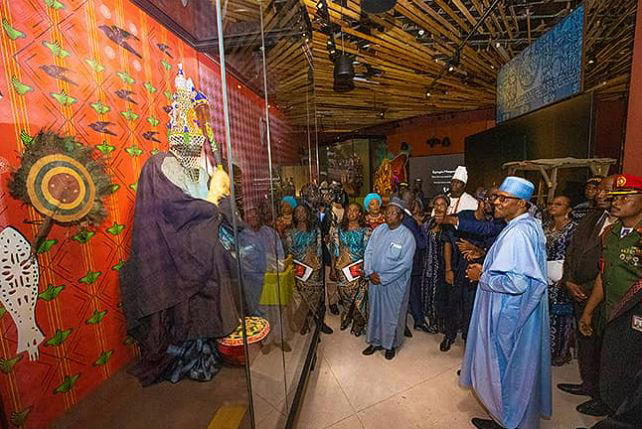
To further boost its popularity alongside showcasing the treasured heritage, President Muhammadu Buhari, accompanied by the Lagos State Governor, Babajide Sanwo-Olu, and other dignitaries recently Commissioned the J Randle Centre for Yoruba Culture and History at Onikan, Lagos.
The iconic architectural edifice was built by Kaiser Construction Company. The center was remodeled into a recreation and tourism spot for the preservation of Yoruba Culture, and a museum to enhance the understanding of the people’s culture.
The museum represents a ground-breaking cultural attraction that will reveal to visitors the story of the Yoruba culture and her history to the younger generation.
The unique F-shaped building was named after the physician, John Randle. He was a prominent Lagosian who built a public swimming pool in 1928 at King George V Park, which later became the Love Garden – a much-loved recreational area.
This grand gesture was inspired by the refusal of the British Colonial Office to build a swimming pool for Lagosians to learn how to swim. The J. Randle Centre is aimed at engaging the public with the richness of Yoruba culture and history, its impact through art, music, religion, and language.
Speaking at the event, Lagos State commissioner for Tourism, Arts, and Culture, Mrs. Uzamat Akinbile-Yussuf said “Lagos State Government aims to provide opportunities for the younger generation and other scholars to dive deep into the mystery of Yoruba heritage, history and ancestry. It is a place where we can have the younger generation understand the value and importance of our culture.”
According to the Lagos State Commissioner for Information and Strategy, Mr. Gbenga Omotoso, “it is a very bold attempt to sell and revive our culture, and tap from tourism in the area of the economy.”
A section of the museum shows the Yoruba creation god, Obatala. It describes the genealogy of the Yoruba race through the Orisha of Yoruba mythology, who was given the task to create the earth.
Another notable sculpture in the museum is the image of the Oba of Lagos. Placed at a very strategic location directly opposite the entrance, the image depicts royalty and respect. Visitors are expected to pay homage to the Oba’s image.
The Yoruba culture has a rich masquerade heritage, and it acts as a catalyst for tourism destinations. This can be seen in the exhibitions of the different Eyo masquerade on Lagos Island such as Adimu (Eyo Orisha), Eyo Alaketepupo, Eyo Oniko, Eyo Olegede, and the Eyo Agere.
The media section contains the details of Nigeria Yoruba musician, bandleader, political activist, pan-Africanist, and the pioneer of Afrobeat, Fela Anikulapo-Kuti. Some of his hit albums include “Gentleman” (1973), “Open and Close” (1971), “Beats of No Nation” (1989), “Zombie” (1977), and “Roforofo fight” (1972). Other media materials visible at the museum are Baba Sala and Orun Moorun.
There are also artifacts in the building such as the ancient colonial telephone used by the colonial administrators for communication, the ancient radio used by the colonial masters, and some ancient boxes for file keeping.
The image of Samuel Ajayi Crowther, the Yoruba linguist, clergyman, and the first African Anglican Bishop of West Africa, among other artifacts, are also found at the historical museum.
Disclaimer
Comments expressed here do not reflect the opinions of Vanguard newspapers or any employee thereof.