By Awa Kalu,SAN
In the annals of the history of the legal profession in Nigeria, no temptation ‘heavier’ than the Salami vs. Katsina-Alu saga has been chronicled and none has been so fiercely debated.
There is hardly any Nigerian, including groundnut sellers, who have not expressed an opinion on the rampaging judicial Tsunami that has refused to be tamed.
While blames have been traded evenly and openly, the truth has not been unearthed unequivocally. The result is that all members of the legal profession have been tarred with one infamous brush.
I resisted every attempt from different quarters (including from anonymous callers who identified themselves as stakeholders) to comment on this matter earlier than now.
It was indeed my decision to refrain from joining in the debate on either side of the divide. However, having regard to the fact that the issues are very fundamental I decided, rather hesitantly, to weigh in from a different angle.

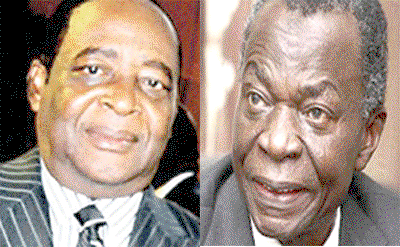
•Katsina-Alu & •Ayo Salami
All those who are familiar with Jonathan swift’s fabled 18th Century satire, Gulliver’s Travels, will remember the land of Lilliput. Having read the book as a secondary school student, I will not attempt any summary of its purport but would rely on an introduction to the woodsworth edition written by Doreen Roberts.
Of the Lilliputians, Doreen notes that ‘Physical size apart, they would be thoroughly at home in Brussels. They are urbanized, bureaucratically top-heavy and preoccupied with formalistic niceties and law jargon.
They seem to share the legalistic obsession of Defoe’s protagonists with documents, contracts, written schedules, inventories, formal permissions and articles of agreement.
Gulliver himself has to besiege the Lilliputian Emperor with written memorials and petitions for his release, which is made contingent on his swearing to eight articles according to the prescribed forms of both England and Lilliput.
In the introduction, it is noted that “(in Lilliput, a person swears a formal oath by holding the right foot in the left hand, placing the middle finger of the right hand on the crown of the hand, and the thumb on top of the right ear.)” Doreen Roberts then notes further that ‘the Lilliputians are riddled with parties, camps factions and pressure-groups, but these, apparently, do not represent serious differences of principle-simply rival power-alignment of place-seekers.
Again the implication is that such a world is perversely, grotesquely over-complicated. It is so obvious that what we ought to be doing. We have known all the moral laws all along, and they do not change.
There is no need to turn politics into a science, administration into a mystery, law into an adversarial battle of wits and a gigantic system of obfuscation, why cannot we all mean the same things by the same words?”
According to the publishers, Gulliver’s Travels is “a parody travel-mem oir’ which ‘reports on extraordinary lands and societies, whose names have entered the English language; notably the minute inhabitants of Lilliput, the giants of Brobdingnag, and the yahoos in Houyhnhmmland, where talking horses are the dominant species.”
I am not in a position to determine whether we are dwarfs in Lilliput or giants in Brobdingnag nor can I venture to say that we as members of a very learned profession are yahoos in Houyhnhmmland.
Yet, I will give you an opportunity to identify with one or all of these far-away peoples by refreshing your memory with the story of the great Lord Denning’s humiliating retirement.
The story is told by Lord Denning himself in The Closing Chapter-one of a formidable array of books, written by the Rt. Hon. Lord Denning, erstwhile Master of the Rolls.
In the interest of those who have never read the book and other big judicial officers who are yet to retire, a few excerpts will be made from Lord Denning’s rather instructive story.
In his words, “On 23 January, 1982 I was asked, ‘when are you going to retire?’ I deliberately kept my options open. I always replied, ‘I shall go on as long as I can do the job’. Next question, ‘who will be the Judge of that’? ‘I will be, myself.’ In my heart of hearts, I knew that I could not go on much longer.
One of my friends in a high place dropped hint: ‘You are at the peak of your fame now. Do not go on too long! Joan said so lovingly as well. I told her, ‘I would like to go on till the book is published’. That would be in May.
I had in my mind that I would retire at the end of the summer term. I knew that the old enemy, Time, was turning against me: The enemy increaseth every day, we, at the height, are ready to decline.
There is a tide in the affairs of man, which taken at the flood, leads on to fortune; Omitted, all the voyage of their life is bound in shallows, and in miseries. (Shakespeare, Julius Caesar, Act, iv.Sc.3.)
On the basis of the introduction, Denning used very many subtitles to narrate the calamity that befell him while waiting to retire. In a nutshell, the publication of his celebrated book titled What Next in the Law proved decisive in the events that spelt disaster for his career.
Denning calls some of the passages in the book his ‘Achilles’ heel’. Every famous person has an Achilles’ heel. Denning recalls that ‘it is from Greek mythology, when Achilles was a baby, his mother sought to make him invulnerable. So he plunged him into the river Styx – every bit of his body – except his heel by which she held him.
He became a great warrior and slew Hector, the champion of Troy. But he carried his boldness too far. He solicited the hand of a lady in the Temple of Athens. As he did so Paris wounded him in the heel and he died’.
As already noted, Denning’s Achilles heel was an offending passage in his book “What Next in the Law in which he suggested that some of those who came to the shores of England from overseas might not be suitable to serve on juries: and that there should be a new way of selecting jurors.
There was yet another passage in which Lord Denning suggested that some accused persons were using the ‘peremptory challenge’ so as to pack the jury-box with jurors who were sympathetic to their side.
In Lord Denning’s words, “I took as an instance a trial at Bristol about same trials which had taken place there. I suggested that the accused used their peremptory challenges so as to secure as many coloured people on the jury as possible. I am very sorry that I made that suggestion. I did it on the basis of a letter that I had received.
But I have since been shown the transcript. It shows that the challenges were used quite properly. They were used at the invitation of the Judge so as to secure a representative jury. So I had made a mistake of fact. It was to cost me dear. No comment is fair if it is based on a mistake of fact”.
To cut a long story short, comments in the press taken together with a threat recounted to sue Lord Denning in a libel action from two black jurors in the Bristol case hastened Lord Denning’s departure from his exalted seat of Master of the Rolls.
Denning recounted how ‘sorely troubled’ he was as a result of which he was in correspondence with the Lord Chancellor concerning his proposed date of retirement. As it eventually turned out, neither Denning nor the Lord Chancellor could stem the tide and he retired ahead of schedule.
For our present purpose, it would indeed be nice to sum up Denning’s exit in his own words. He said: “so there it is. All over in a forthnight. The book launched on Thursday 20 May Retirement announced on Friday 28 May.
Apology on Tuesday 1 June. Sadly I recalled the fate of those whose career has ended in disgrace or failure. It is a long list: Thomas Wosley, Francis Bacon, Warren Hastings, Ceal Rhodes and many other Never so well put as in the soliloquy of Thomas Wosley as recorded by Shakespeare?
Farewell, a long farewell, to all my greatness! This is the state of man; today he puts forth
The tender leaves of hope, tomorrow blossoms, And bears his blushing honours thick upon him: The third day, comes a frost, a killing frost; And, – when he thinks, good easy man, full surely.
His greatness is a ripening, – nips his root, And then he falls, as I do I have ventured, Like little want on boys that swim on bladders, This many summers in a sea of glory; But far beyond my depth: my high-blown pride.
At length broke under me; and now has left me, Weary and old with service, to the mercy. Of a rude steam, that must for ever hide me”
The saga of Denning’s retirement is concluded by his recounting a story that appeared in The Sunday Times of 30 May 1982 titled ‘who will take his place?! He records that the story anchored by one Hugo Young who took the view that: when Lord Chancellor Hailsham considers the field of successors, it is safe to say he will choose no one like Denning. There is no such beast on the bench of Judges.
When all the raucus headlines have been forgotten, and the last regrettable calamity has passed insignificantly into the dustbin, Denning’s great works will endure forever. To anyone who believes the law should liberate, not enslave, he is a beacon”.
Well, in the Nigeria situation of the two major dramatis personae, one has departed and the other is suspended. We have no right to speculate about their successors.
We had no such right but we have a right to weigh Doreen Robert’s portrayal of the land of Lilliput and the road traveled by Lord Denning when his reputation was threatened which do you prefer? Good Luck.
Disclaimer
Comments expressed here do not reflect the opinions of Vanguard newspapers or any employee thereof.