BMW
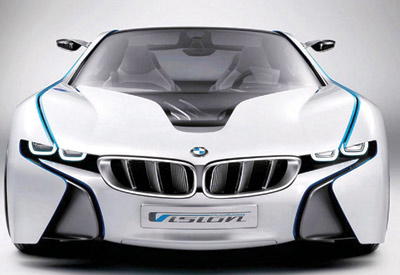
BMW’s i8 Concept, an innovative and sporty plug-in hybrid, will be showcased at the Johanesburg motor show in South Africa next month. It is one of two electrically-assisted vehicles, along with the i3 Concept, to be presented by the world’s best-selling luxury car brand this year.
Visitors to the 2011 Johannesburg International Motor Show will be able to see this beauty up close on BMW’s stand at the Expo Centre, Nasrec, from October 6-16.

BMW
Unlike the Vision concept, which utilises a diesel engine and an electric motor, the i8 Concept is powered by a turbocharged petrol engine and an electric motor. The 1.5-litre three—cylinder forced-induction petrol engine produces an astonishing 164kW and 300Nm of torque, and is ably assisted by a 96kW/250Nm electric motor, which draws power from a lithium-ion battery positioned between the front and rear axles.
With a combined maximum power output of 260kW and 550Nm, the i8 Concept is capable of accelerating from 0—100km/h in just 4.6 seconds (80-120km/h in 4.0 seconds) and will go on to an electronically limited top speed of 250km/h.
Besides being a high performance car, it can also be driven in fully electric zero-emissions mode for up to 35 km from a standard power socket takes approximately 105 minutes. Even more impressive is the i8 Concept’s fuel consumption of 2,7 l/100km in the combined European driving cycle.
Despite its frugality, the i8 promises a very sporty drive — by positioning the petrol engine over the rear axle and the electric motor over the front axle, with the battery positioned between the two _ the i8 boasts perfect 50:50 weight distribution and a low centre of gravity. But it’s not all about high-performance, dynamic driving — the 2+2 i8 is versatile too, and can be driven in silent, front-wheel drive electric form, rear-wheel drive or even in all-wheel drive mode, depending on your requirement.
The exterior features BMW’s new i design language, with the body incorporating carbon fibre-reinforced plastic in white, high-gloss black and stream blue, while vast expanses of glass make up the roof section.
Aerodynamics was a major influence in the overall construction, which has been optimised to cut through the air as efficiently as possible. The overlapping, layered surfaces contribute to this, and give the i8 Concept a dynamic, three-dimensional appearance.
This flowing design continues inside the cabin, with the central screen and console directed towards the driver, while a smaller instrument panel sits behind the steering wheel to provide further information. Interior surfaces are a combination of leather, metals and high_gloss piano black plastics.
The i8 concept also introduces Last Mile Navigation and Intermodal Route Planning. The former sends navigation information to your Smartphone to help you locate your final destination on foot, while the latter analyses public transport options to complete the journey. The navigation system also calculates the best way to manage energy consumption for the trip to ensure that it operates at peak performance and optimal efficiency when required. A production version of the BMW i8 Concept is expected to go on sale in 2014
Mercedes-Benz unveils new climatic wind tunnels
Mercedes-Benz has unveiled two new climatic wind tunnels at its Sindelfingen site, designed to bring extreme weather conditions indoors. Temperatures ranging from minus 40 to plus 60 degrees Celsius, hurricanes with wind speeds of up to 265 km/h, tropical rainfall and heavy snowstorms are all parts of the standard repertoire available here to the test engineers. If needs be, they can even provide a realistic simulation of a mercilessly hot sun.
The new climatic wind tunnels make it possible for the engineers to optimise new vehicles or components for all possible weather conditions at a very early stage of the development process. So in future, real-life road tests, in arctic cold or the blazing heat of the desert, will only take place with prototypes that have already reached an advanced stage of development by being thoroughly tried and tested under the most extreme climatic influences.
This enables Mercedes-Benz to achieve the highest possible quality. The clear ambition to do so has been a key element in the philosophy of the world’s oldest automotive manufacturer for the last 125 years.
Cars these days first take shape on the computer. The initial crash tests, aerodynamic studies or suspension testing, too, are undertaken as electronic simulations in a virtual world, long before the first prototype is built. Simulations like this can never, however, replace the use of test rigs or real-life tests. In order to close further the gap between simulation and real-life testing, Mercedes-Benz has now taken two new state-of-the-art climatic wind tunnels at its Sindelfingen site into operation, following two years of construction work.
This marks the completion to schedule of the next stage of expansion for the Mercedes-Benz Technology Centre. Research, development, design, planning and production teams work together at the Sindelfingen location in a close network that is unmatched by any other automotive manufacturer in the world.
One of the two new climatic wind tunnels is designed as a cold tunnel, with a temperature range of minus 40 to plus 40 degrees Celsius. The new hot tunnel, on the other hand, offers a temperature range of minus 10 to plus 60 degrees.
Each tunnel is equipped with an integrated twin-axle roller dynamometer that allows speeds of up to 265 km/h – and thus with sufficient reserves for even sports cars to be tested on the rig here.
The new climatic wind tunnels replace the cold tunnel that has been used until now, in which temperatures down to minus 20 degrees Celsius and speeds of up to 64 km/h are possible, as well as a hot tunnel in which the maximum limits are plus 40 degrees Celsius and a top speed of 100 km/h.
Disclaimer
Comments expressed here do not reflect the opinions of Vanguard newspapers or any employee thereof.