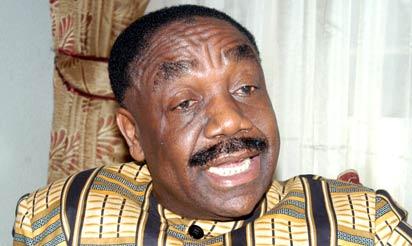
Prof. Dew Mayson.
*We will unite our people once again
*How we plan to develop Liberia
Presidential candidate of the National Democratic Coalition, NDC, of Liberia, Professor Ambassador Dew Tuan Wreh Mayson, stands accused of being too committed to the Liberian cause. He should.
As one of those who worked for the victory of the incumbent, President Ellen Sirleaf-Johnson, he expresses disappointment at the turn of events in his country. Prof. Mayson today is the presidential candidate of the opposition coalition comprising eight political parties and the figures continue to swell. Whereas it is early days yet, regarding the weight the opposition is capable of pulling in its bid to unseat Johnson, Prof. Mayson and the opposition politicians believe that “What would keep the coalition together is exactly what brought it together – the need to come together in order to win and the need to stay together in order to help raise the standard of living of our people. In our manifesto, these things are stated clearly and the points refer to some of the basic things our people need and it binds us together. Yes, there are varying ideologies in the parties but there is one consuming ideology and which is to see a better Liberia for our people by voting out this government”. He insists that October’s presidential election in the country would be a golden opportunity for the people to define a new path to greatness and unity.
Professor Mayson has also stated that an administration led by him would ensure that Nigeria begins to reap the dividends of her contribution to the enthronement of peace and stability in Liberia.
“The present administration led by President Ellen Sirleaf-Johnson promised so much in words but delivered so little to the people of Liberia in the area of reconciliation and unity”, Professor Mayson explained, stressing that the regime of disillusionment that is being foisted on the innocent people of Liberia “is the driving spirit behind the massive angst and rejection of the President and her Unity Party”.
The opposition is also promising a national conference. Mayson says this has become very important because our people need to be united in order to focus on the work of development.
EXCERPTS:
By Jide Ajani, Deputy Editor
What led to the opposition coalition in Liberia?
It’s very simple. We’re running against an incumbent. We in the opposition posed two questions: The first question was, do you want to win? And invariably they’ll say yes we want to win. The second question was, do you think you can win alone? And they said no. So, if you want to win since you can not win alone, the strength of the logic is that we must come together and defeat this incumbent.
Some political parties are not involved in the coalition against the incumbent; don’t you think the opposition against the incumbent may likely suffer a discount on account of this, since they, too, would win some votes?
Well, every day we get new additions to the coalition. It is an unwritten agreement that the opposition parties are going to support one another and there is an unwritten agreement. If there is the need for a second round, all the opposition parties will support the opposition candidate.
The average observer would want to find out why the other political parties are ganging up against the incumbent?
It is because the incumbent has not delivered on most of its promises.
Like?
The present government came in as a government of reconciliation and the major problem in our country is the disunity which led us to 14 years of civil strife. We said to ourselves that the policies of this administration can not lead us to the reconciliation that we seek.
Reconciliation is more in words than in deed and we’ve decided that if we are to avoid another civil war, we need a government that would pursue the reconciliation of our people as a priority.
There’s one thing I’ve always told our people. We went to war not because we didn’t have roads in Liberia; in fact we had more roads before the war than we have now.
We went to war not because we didn’t have good schools; in fact the schools we had then were more and better than what we have today. We went to war because the fundamental problem since 1821 has been the division between those who came in to settle down and the inhabitants of the land.
Every country suffers from one form of division or the other. What is the peculiar nature of the division in Liberia?
Can you imagine that in 2011, the national motto of Liberia continues to be, “The Love of Liberty Brought Us Here” – this refers to the group of people who came to settle in Liberia.
The declaration of national independence in 2011 continues to read, “we the people of the Republic of Liberia were originally inhabitants of the United States”.
These are all symbols of the attitudes of the policies that the elites like to follow and because of some of this it has become very important that we do things in the best interest of all of us.

Prof. Dew Mayson.
Recently, transparency international noted Liberia as one of the most corrupt countries in the world.
Even above Nigeria?
Yes! Even above Nigeria. Corruption is very important for us to tackle because every dollar that is mis-spent as a result of corruption means a dollar less for the development of our people.
Corruption is a major problem in our country. And as we say, the fish begins to rot from the head.
But you were all together with the incumbent I mean most of you who are today ganging up against her. What was that fundamental thing that led to the break away?
Let me put it in the form of African practices. At Christmas, we usually go to the forest to prepare the masquerade, then come to the village to dance for the people so that everyone would be happy. In 2005, we went to the forest to prepare the masquerade and we brought it into the village to entertain the people. The drums began to beat and the women began to sing but lo and behold, the masquerade could not dance.
So, it becomes very important and in fact it becomes an obligation for those who brought the masquerade to town to take the masquerade back to the forest, undress that masquerade and get another masquerade dressed and brought back to the village to entertain the people. That was exactly what happened in our situation in 2005.
In 2005, we gave the president our whole hearted support in the belief that she was going to deliver on some promises. But she has not delivered and the people of Liberia who gave her that support have come to the conclusion that her time is up.
There are reports that when she was being sworn in, the belief was in the air that she was going to run for just one term?
In fact, the president went to office in 2005 promising that she would run for only one term. And we believe that a president must have a word which should be her bond. Even the Bible in John Chapter One it is said that in the beginning was the word. The word is very important and people must keep their word. That deception and inability to keep the promise has permeated into many of the other promises that she has not kept for our people.
That is an elite issue, she promised one term and now she’s reneged. What do the people want? Are the people behind you?
Let me tell you, the Liberian people on their own have not been empowered by this administration and it is there for all to see. This country is very rich in iron ore, rubber and oil but the president has been concessioning these to foreigners without the participation of Liberians.
But she is the president and she’s doing her job. Who should have concessioned?
Yes it is the government that has given out our resources without the participation of Liberians, excluding Liberians from the process. Not even a single Liberian was allowed to participate in the process and ownership of these resources and we think this is archaic because even here in Nigeria, the government pursues a local content policy.
Let me play the devil’s advocate here: Were Liberians excluded as a matter of policy or were they excluded because they did not meet the irreducible minimum in terms of knowledge and technology?
I wouldn’t even take up the argument; let us assume that they were not qualified in terms of technology. Technology can be bought and that is where it even becomes more important for the state to play the role of the big daddy, to provide for the people.
We have a bank for Liberia’s development, what is that bank there for. With financial support, you can get these things done and it is better to empower your people and not sell your country cheap. It’s a short term and myopic policy not to be interested in the development and empowerment of your own people.
Then there is another issue now in the country regarding the president’s age. I’m not bothered about the president’s age but I am worried about the age of her policies, they are dinosaur policies.
As an academician and a politician, what is that thing that makes the average African politician get into office and then can not deliver on promises made?
It is because we make the job too easy for African leaders. We shower them with more accolades than responsibilities. And so the job is too sweet and easy. I think we need to make the job a little more difficult and accountable to us.
Look at what happened in the Arab countries; what would you suggest that Africans should begin to consciously do to avoid the type of implosion we’ve seen in North Africa?
Many years ago, people should have understood that vigilance is a price to pay for good governance. Our people are very poor and I’m not just talking about material poverty, illiteracy is a major problem too. And poverty and other imposed afflictions have combined to make our people complacent but don’t be deceived. Our people can only be complacent for a while because at some point they would charge back at you, these same people will rise up. I’ve been in Egypt many times and no one ever predicted that the Egyptian who is thought of as being satisfied, scared and complacent would rise against the government, or that the Arabs would have risen against their governments. This shows that they want something good for their people.
I have no doubt in my mind that if backward policies continue to underdevelop the nations of Africa, definitely, the people will rise up, too and the only way to avoid that is to work towards the satisfaction of the material and spiritual needs of the African people. Our people in Liberia are prepared to do just that at the polls on October 11 because the mantra now is that the day of election should come quickly so that this administration can be voted out.
You seem very articulate in laying bare the deficiencies of the incumbent president, but what are the alternatives? What, for instance, should the people of Liberia expect from the opposition?
Liberians should expect the next six years to be far better than what they got in the last six years. The unemployment situation in our country shall be tackled head on.
85% of our people are unemployed and when a man is unemployed and he’s not able to provide for his family in terms of healthcare, good food and school fees of his children, he becomes frustrated. What is more, for me, such a man then begins to lose the dignity of his being as a man and that is our number one economic policy, JOB CREATION.
Yes, the government says it is doing something but what is it doing?
This administration practices a policy of taxation.
And for me, I would be asking a company that comes to set up shop in Liberia not how much tax it would pay but how many jobs that would be created. So, the creation of jobs would be our number one policy, much different from what this government is doing.
After 165 years of national independence, only 15% of our people are literate. We plan to tackle that too because a people that is educated can provide development. We plan to make Liberians able to read and write in the six years of our tenure.
We intend to call a Sovereign National Conference to deal with the fundamental problem that has bedeviled the people of Liberia, to foster unity, to be able to throw away those symbols which continue to divide us.
That presupposes that most Liberians don’t want those symbols?
Why would they want such symbols when they refer to just a few people, the elites? These symbols refer to a very small section of the population.
Then the next question would be what has kept those relics of there? What is the staying power of that few?
It is because we’ve had an elite for the most part ruling and to whom those symbols meant something; a ruling class that sees those relics as meaning something to them but the prospect and hope now is that the baton is being passed to a new generation of Liberians who want progress, peace, stability. Those symbols are symbols of disunity because the unity of our people is a number one priority for our development.
Okay, let’s assume you win, those dynamics that usually work and throw opposition parties into crisis, how would you handle that such that Liberians would not be moving from one point of crisis to a more calamitous one because opposition elements fight dirty and crazy?
That’s an important consideration.
What would keep the coalition together is exactly what brought it together – the need to come together in order to win and the need to stay together in order to help raise the standard of living of our people. In our manifesto, these things are stated clearly and the points refer to some of the basic things our people need and it binds us together.
Yes, there are varying ideologies in the parties but there is one consuming ideology and which is to see a better Liberia for our people by voting out this government.
When you situate Liberia in the comity of nations and then you place Mrs Sirleaf-Johnson in the assemblage of leaders, how do you see that affecting the chances of the opposition within the context of the emerging politics before, during and after the elections?
Our president is a movie star because everywhere she goes people welcome her well as the first female president in Africa and I would like to say that if she was running for an election in Europe or America she could definitely win there.
Unfortunately for her, those people won’t vote in Liberia and what is more, that star status has not translated into bringing the kind of necessary succour and improvements to the lives of Liberians back at home. That is one reason why you would see the combination of political parties coming together to move against an incumbent because you would think that after six years, a president would have been able to forge a united front but again because the president has not been pursuing those policies that are meant to improve the lives of Liberians.
There is this malaise that is common in Africa with elections and that is the outcome which parties dispute and in some instances the disputation becomes deadly. What chances of fairness do you see in the coming elections such that at the end of the day all parties would agree to the result of the election?
You’re right and that is why we have observers coming in to participate along with the NGOs in the country.
That question is based on the premise that the fairness of an election is not just about activities on the day of election but the entire process beginning with the registration of voters.
Yes, you’re right, the voters’ register is a big problem for us because we have discovered some fraud in the register but even at that, we are so confident in our ability to go to the polls to vote and beat them.
The deficiencies have been noticed and we are tackling that but for the people of Liberia, the mantra is “Come Quickly Election Day, Come Quickly”.
What role do you see Nigeria playing?
Thank you to the Nigerian people and the Nigerian government because of the support they’ve always given Liberia, and especially because there is no other nation that has done so much or spilled more blood to ensure that there is peace and stability in Liberia than Nigeria. Nigeria is the only country that has devoted the most resources.
That is why we urge the Nigerian people and the Nigerian government to continue to look into the activities in Liberia.
It is our sincere hope and belief that the Nigerian government would begin to participate in the dividends of peace that this nation has helped to restore in our country, Liberia.
Unfortunately, the present government has not looked to Nigeria in terms of opening its doors to the country.
But the few Nigerian businesses that have been set up in Liberia have been through our own efforts, companies like UBA Bank, GT Bank, EMZOR Pharmaceuticals and Mutual Benefits Assurance, an insurance company. But on the whole, when the present government is looking for business it thinks of Europe and United States of America.
But our government would look to Nigeria so that the industry and expertise that abound in this country can also be replicated in Liberia and we would strengthen the relationship.
Disclaimer
Comments expressed here do not reflect the opinions of Vanguard newspapers or any employee thereof.