We live in a world prone to crises. No nation is free from crises. Violence is now endemic in human relations. The global threat of terrorism respects no boundaries or borders. Nigeria is not free from these threats. Our nation is, at the moment, faced with threats emanating from Boko Haram.
What is the nature of this threat? Have the security agencies handled the situation well? What has gone wrong with the strategy employed? How should government respond to these recent terrorist bombings?
Can militaristic approach, without more, work? Are there lessons to be learnt in the ways other countries handle such threats? This article will attempt to answer these questions.
The Boko Haram
The Northern States had witnessed crises before the recent bombings. We had the Maitasine riots in the 1980s in Kano, Bullum Kutu (1982), Kaduna, (1982), Jimeta (1984) and Gombe (1985). What is novel in Boko Harm’s case is the tactics. In the Maitasine’s case, the perpetrators were seen and known. In Boko Haram’s case, the perpetrators are faceless.
Their precise locations are unknown. Because it did not pay to fight government on equal terms, Boko Haram turned to isolated acts of violence. Both sects were motivated by goals other than monetary.
The demands of Boko Haram include the demand for the implementation of full Sharia laws in the twelve Northern States and the eradication of western education in those states.
These states are mainly in the north east, north west and north central. In these states, social life has been disrupted because anyone can be a victim.

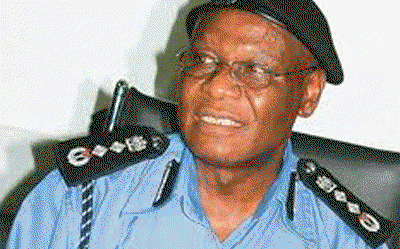
•Former IGP Ehindero
Borno, Kaduna, Yobe, Bauchi, Gombe, Taraba, Adamawa, Katsina, and others have had their own shares of bomb-blast killings. Their targets are institutions like police stations, army barracks and camps, Customs House, beer gardens.
Between January and July this year, the sect has claimed responsibility for more than two hundred deaths with more than three hundred wounded. Prominent Nigerian citizens have been killed by the sect.
These include Senator Mudu Sheriff the brother of the Borno State Governor, and the governorship candidate of the ANPP in Borno State, Alhaji Modu Gubio and many more police and military personnel.
What Has Gone Wrong With The Present Strategy?
There was a failure of intelligence; We Nigerians jumped into conclusion before investigation; Dialogue was not used as a first option; Militarism was adopted not as a last option; the timing and the decision to prosecute police officers for extra-judicial killings appeared ill conceived.
These anomalies are not peculiar to our system alone. They do occur in advance countries.
First, let us consider Jumping into conclusion before Investigation.
During the Oklahoma City Bombings in the United States of America in 1995 where 168 lives were lost, many concluded that Islamic militants were responsible. Clinton was the president.
Eventually investigation revealed that one Timothy McVeigh a US military veteran who hated the Federal Government agencies was responsible for the bombings.
He confessed and was sentenced along with his conspirators. The Louis Edet House Abuja bombing of June 16, 2011, was said to be the handiwork of a multiple agents without investigation. It turned out not to be so.
In the wake of Oklahoma City bombings, Clinton took the following measures:
Increased Counter-Terrorism resources for FBI and CIA and instructed them to work together more closely.
Sent anti-terrorists legislation to Congress asking for:
a) 1000 more law enforcement personnel to fight terrorism
b) A new counter-terrorism centre under the direction of FBI to coordinate the efforts to combat terrorism was established.
c) He got Congress to increased penalties for knowingly providing arms or explosive to terrorists.
d) Markers called tag-gants were placed on all explosives materials with a view to tracing them.
Granted, there is Anti-Terrorist legislation in place in Nigeria, should we not consider some of the above measures especially increasing police capacity to contain acts of terrorism?
Failure of intelligence
One flaw in our intelligence strategy is that security agencies share intelligence vertically and hardly horizontally. Each organization would want to take credit and the accolades of Aso Rock for doing a good job. Those who need the intelligence are not giving such information.
Police, SSS, Military intelligence would rather pass their intelligence to the C-in-C rather than share it with one another. The media report of interception of 700 bombs in Abuja by the military without cross checking with the police before reporting is but an example. The media report was false as no bomb was intercepted.
However, intelligence failure is not in the domain of the developing countries alone. Before the incidence of the 9/11, the CIA had been worried about al Qaeda.
Intelligence pointed out before 9/11 that Al Qaeda would attack overseas. No body expected it to happen in the US. That was why security had been beefed up at Embassies abroad and early warnings about possible hijacking on International flights had been issued.
There was no clear intelligence warning of Al Qaeda attacking the US. However, it did happen. The incidence of the 9/11 could be attributed to intelligence failure.
President Bush and the management of events after 9/11
When the incident of 9/11 happened, what did President Bush do? He deployed the full resources of the US national power to gathering intelligence.
When intelligence indicated that on 9/14 more Al Qaeda operatives in the US were planning to attack America with biological weapons, President Bush set a new mission of preventing further attacks in the US. However, before setting his mission, he sought for intelligence details from FBI.
The latter had identified most of the terrorists and determined when they had entered the US, where they stayed and how they intended to execute the plot. With these, President Bush took the following actions:
a) National Guard Forces were deployed to the airports.
b) Procedure was tightened for granting VISA and screening passengers.
c) Increased security was placed at seaports, bridges, and valuable infrastructures.
d) The Department of Homeland Security was established in 2002
e) He established the USA PATRIOT Act that allowed law enforcement and intelligence personnel to share information. This Act also gave investigators access to tools like roving wiretaps that allowed investigators to track suspects who changed cell phone numbers.
The consequence is that after 9/11 no major attacks had taken place in the US. Do we have some of these measures in place? Do we have a National Crime Commission in Nigeria? Do we have the Police Forensic Science Laboratory including DNA to investigate serious crimes?
THE PATRIOT ACT
Bush alleged that THE PATRIOT Act helped the US break up potential terror cells in the US. To him, the lesson of 9/11 was simple. In his book, DECISION POINTS he said:
“I don’t take chances. When our law enforcement and intelligence professionals found people with ties to terrorist networks inside the United States, I would rather be criticized for taking them into custody too early than waiting until it was too late.”
Have our intelligence community been able to identify kingpins and sponsors of Boko Haram and pick them?
Need For Dialogue:
When in 1981 the Trans World Airlines Flight 847 on route Athens to Rome with 104 Americans onboard was hijacked by Islamic Jihad demanding USD10m and the release of 700 prisoners in Israel, President Reagan’s reaction was “we do not make concessions to terrorists and we do not encourage others to make concessions”.
Even though Reagan did not negotiate directly with Berri the commander of the Shiite militia, he did indirectly through President Assad of Syria who negotiated with the terrorists before the release.
Why should we not use opinion leaders, Elder Statesmen and other stakeholders to dialogue with Boko Haram? This is desirable more so when there is an element of mala or miss-education or ignorance in the objectives of Boko Haram.
How can an organization reject western education that has brought them modernity, aircraft, electricity, motor vehicles, okada, and even the arms they use? The state governments need to do more on enlightenment and alleviation of poverty in their domains.
Militarism without More?
In combating Boko Haram, the old strategic concept of massive military response is ill conceived. Rather a more comprehensive joint community effort with less coercive content is required.
The strategy of deploying the military for purely internal security matters rather than strengthening the capacity of police to accomplish these tasks ought to be jettisoned. There is the need to build within the police force the offensive or defensive capabilities to combat an enemy adept at finding the opportunities to attack innocent persons.
A completely new framework aimed at keeping Boko Haran or the likes from striking again should be formulated. Assisting the affected areas of bomb blasts to recover should be one of our goals.
Police capacity and capability to contain threats to internal security should be enhanced. Too much military visibility in a civilian dispensation is counter productive and anti-democratic.
The Customs, Police and the Immigration Services should be reinforced at our borders for border patrols to prevent illegal immigrants and aliens from entering the country. There should be increased security at our seaports, bridges and other vulnerable infrastructure.
Prosecution of Police Officers for Extra-judicial Killings
No sane person would condone extra judicial killings. International law and our domestic laws forbade extra-judicial killings. However, these laws are full of contradictions far beyond the translucent language.
The killing of Osama bin Laden by the US Marine was not tagged extra-judicial killings. Neither was the police reprobated for killing Yusuf at the time the lives of the public were seriously threatened by Boko Haram’s incursions.
In fact, the public was accessory before the fact in the manner they instigated police to deal with Boko Haram. Soon after the danger had been averted, reprobation of police actions took the stage.
It is unethical to approbate and reprobate at the same time. No empathy was expressed by the public for those gallant police officers who were killed in the fight against Boko Haram. The numbers of police men killed abound in quantum. In advanced society the death of a policeman portrays calamity; not so in our society.
How many Boko Haram’s suspects had been prosecuted? Using police officers as scape-goats in situation of inadequate training and man-power development appears to be morally objectionable.
I cry to high heavens even if I do so alone that the decision to prosecute these police officers does not appear to be justified at this moment in time.
Mr. Ehindero, a lawyer, is former Inspector General of police.
Disclaimer
Comments expressed here do not reflect the opinions of Vanguard newspapers or any employee thereof.