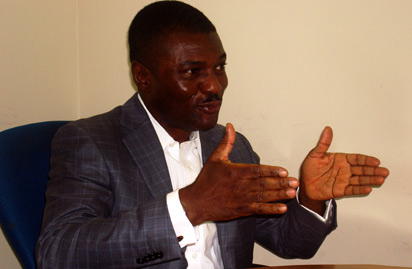
DG/CEO, NESG, Frank Nweke Jr.
* ‘Boko Haram, militancy, kidnapping are products of unemployment’
Those who know him well enough would have observed that virtually everybody he comes across is referred to jovially as BROS.For this multi-lingual Igbo man who speaks the Yoruba language with some deliberately twisted fluency, Frank Nweke Jnr. came to national limelight when he served as former President Olusegun Obasanjo’s Information Minister between 2003 and 2007. Quick-witted and sharp-minded, Nweke Jnr. is today Director-General of the Nigeria Economic Summit Group, NESG.
In the wake of the warning strike being proposed by the Nigeria Labour Congress, NLC, Sunday Vanguard went after Nweke Jnr. to assist in shedding light on why the economy is being said not to be able to support the N18,000 minimum wage.
More importantly, Sunday Vanguard wanted to find out what role NESG has played and is playing with a view to providing a veritable road-map for the revamping of the Nigerian economy. In this interview, Nweke Jnr. proffers suggestions on the way forward. For instance, on the issue of minimum wage and subsidy removal, Nweke Jnr. insists that Nigeria may not escape the woods if its leaders do not embrace contemporary economic modules of growth. “I want to say with every sense of modesty that in the first eight years since after Nigeria returned to civil rule between1999 and 2007, some significant efforts went into stabilizing the economy and laying the foundation for future growth. I also want to say that in the subsequent four years post 2007, it won’t be out of place for me to say that the country experienced some significant inertia, leading to the loss of considerable momentum, on account of that inertia, such that today, we’re almost back to where we were in 1999 and that is where the quality of leadership and people in cabinet come in, that is where the issue of the management of resources comes in and that is where the people of the country also come in.”
EXCERPTS:
By Jide Ajani, Deputy Editor & Anthonia Onwuka
At a time when the Nigerian economy is the way it is, what would you say is the significance of the Nigeria Economic Summit Group, NESG?
I have often made this point that NESG is a private sector-led economic think-tank and advocacy group. It is a platform for public private dialogue between Nigeria’s private sector and government. And one of the most important achievements of the NESG is that it has succeeded in creating that platform of exchange of ideas between the private and public sectors.

*Nweke (Jnr)
You would agree with me that during our military past, it was common place for the military to issue decrees but we had to say ‘yes, we agree that as leaders they had the political power but we were the ones in the private sector managing the economy in a way; that we believe it is necessary for us to interface; that it would be nice to seek and get input before they issue their decrees just so at the end of the day, the output and outcome would be the desired thing’.
And, in a civilian administration, that need is even re-enforced because if you are my representative either in the legislature or the executive, and having got my mandate, it makes sense for you to interface with me regarding the expectations of the people
Therefore, NESG has made significant contributions to the public governance and economic administration of this country and its progress.
Let me make this point clear, we are not an implementing agency neither are we a government agency. We receive no funds from government; our interest is the good governance of the country. And when we say good governance of the country, we are not talking about good governance for the elite alone, it is the good governance of Nigeria and Nigeria include the masses, the economic elite and the political elite.
I can relate with all that you have said but the man in the street who hears the high sounding and seemingly value-laden name would be hard put to make sense out of it within the context of how NESG has affected him or her positively? The conclusion would be that that interface is not yielding results?
That something is not working does not mean that NESG is of no value. In fact, that is why we seek partnership with even the media. NESG doesn’t have all the answers to Nigeria’s problems; NESG is not the only platform for advocacy on good governance and the contribution of ideas is the responsibility of all stakeholders in the Nigerian space and not just that of NESG. And, you see when you think of some of the things we have achieved in the past and you ask who the beneficiaries are, they are Nigerians, across the Nigerian political and business space.
Which achievements? Can you be specific?
Yes! Not a lot of people would remember since the first summit in 1993 where a strong case was made for the creation of the business school. I make bold to say that the idea of the Lagos Business School that we have today can find its root on the platform of NESG – this was a clear concept on the platform of NESG.
The idea of visioning for the country, the pension reform, the establishment of regulatory agencies, the privatisation programme, the fact that government offloaded some of its shares from banks, the privatisations of the ports, electoral reforms, security reforms, these were all recommendations of the NESG and they do not just benefit one segment of the society. And that is why one of the things I’m interested in achieving here is to improve the communication system of NESG activities and achievements and improve communications on the type of issues you’ve raised.
Having said all these, let’s pick the issue of unemployment which has led to militancy, kidnapping, armed robbery and brigandage in the land because the devil, as they say, finds job for an idle hand. What do you think government can do or should have done to handle this?
Factly, in most countries in the world, employment, the bulk of it is generated by the private sector. But that role of the private sector in any economy is contingent on the cliché ‘conducive environment’. Today, however, Nigeria’s private sector is constrained on several levels, particularly the issue of infrastructure.
Take the textile industry, for instance. Anywhere in the world, that industry is a major employer of labour but in Nigeria today, we have lost more than two-thirds of textile operations in Nigeria due to infrastructural challenges, particularly underscored by the non-availability of electric power. There is also the issue of very unfavourable economic policies that it is cheaper for people to smuggle in textile materials than to produce them locally; and these cheap materials come from China, where the operating environment is much better.
Transportation infrastructure is also a major issue when you look at how much it costs to transport goods across the nation. The state of the roads is another problem, not to talk about the complete absence of rail transportation. Most of what people take for granted in most developing and developed world remain our major challenges here and the linkage is the fact of the quality of our human capital. Though we have a large population, which should be an advantage, the quality of our workforce remains largely ill-educated and unskilled and unprepared for certain kinds of employment so much so that even when people are ready to employ, getting the right quality of people to employ is a problem.

* Nweke (Jnr)
You were in government for four years as Information Minister. As one with the responsibility of passing across government messages to the public, what is that thing in government that makes otherwise sensible, responsive and intelligent people do a 180 degree reversal and end up becoming insensible, insensitive and unintelligent, such that all the good policies and ideas they profess before going into government disappear?
What you’ve raised is very important but I want you to look at it from the point of view that each minister, however brilliant is operating within the context of a federal cabinet. You might have great ideas for science and technology but if the finance minister says there’s no money, there’s very little you can do; or that you are in transport – and we all know the important role this sector plays but if the finance minister says there is not enough funds there’s nothing the minister of transport can do. That’s an impediment.
So, for me, what then comes to the fore is this: The leadership issue. Who is in charge? What is the priority of the person in charge, side by side the national development imperatives because today Nigeria is still bugged down by very basic things – law and order, education, health, infrastructure, things that people take for granted in other climes are what are bugging us down here. Okay, the world economic downturn affected everybody but even in America, they are not talking about power, education, but they’re talking about whether men should marry men or women should get married to each other. They are no more challenged by basic human needs.
So, it’s not simply a matter of people losing their way – although some people do – but the issue is not as straight forward as you see it from outside.
I agree that what you see from the outside may not be what is going on inside but how does one interface the issue of lack of funds with wastages in government? For instance, since 1999 till date, power generation level in this country has not gone beyond 4000 megawatts; no new refinery has been built and we still import petroleum products. What is that thing?
That’s why I said leadership is critical. The issue of continuity and consistency in policy is critical.
I want to say with every sense of modesty that in the first eight years since after Nigeria returned to civil rule between 1999 and 2007, some significant efforts went into stabilizing the economy and laying the foundation for future growth. I also want to say that in the subsequent four years post-2007, it won’t be out of place for me to say that the country experienced some significant inertia, leading to the loss of considerable momentum, on account of that inertia, such that today, we’re almost back to where we were in 1999 and that is where the quality of leadership and people in cabinet come in, that is where the issue of the management of resources comes in and that is where the people of the country also come in.
I don’t feel convinced with your response but let’s look at it this way: Your former boss, Olusegun Obasanjo was in power for eight years and part of the things people look up to in a good leader is that ability to have a good successor – this relates to mentoring. So, the inertia you talked about, in which context were you referring to?
It was a PDP government that was succeeded by another PDP government but you would agree with me that strictly speaking, an opposition party may have even been kinder to the Obasanjo administration, especially looking at the way the transition came about. You would agree with me that there were a lot of policy reversals, there were a lot of policies that were thrown out such that two years after those policies were brought back on stream. That is the type of inertia I’m talking about; although people are free to come out to talk about why certain things happened in certain ways, that would be neither here nor there but that does not change the fact that the national power project was halted, only for us to go back to the same policy some years after at greater cost having wasted so much time. The refineries’ privatization was reversed and we continue to import petroleum products, for a country that is the sixth largest producer of crude oil in the world.
It is about policy makers and the person who took over immediately from Obasanjo. How does that concern the average Nigerian?
Are you telling me that if the refineries’ privatization had not been reversed, that if the private sector had taken over the refineries that they would be operating at a loss? I don’t think so. Or that they will not provide security for the pipelines that move the products up North! They will. I want to believe that it is about economic interests.
It is the interests of some people that are being serviced with the continued importation of petroleum products; it is the interests of some people that are being serviced with the seeming endless Turn Around Maintenance, TAM, of the refineries which appear not to be working. This is common knowledge and some people continue to benefit from the subsidy that government pays that does not get to the people in the first place – you know it. That’s what I mean by inertia, policy inconsistency, policy summersault and so on but we can not continue like that in this country, we can not.
Look at what is happening now: The issue of minimum wage has now been linked with revenue formula and the removal of subsidy but do these things really mix?
For me, any economy or country that will not consciously seek to embrace clear vision and a disciplined approach to public governance cannot make progress. If we continue to perpetuate inequities, if we continually seek to mismanage our economy and our country, we can only have ourselves to blame and we cannot make progress.
I believed very strongly that government must take its hands off some of these public companies and public assets and allow the private sector to manage these assets in a clear and well regulated way – let there be regulatory agencies that are allowed to function independently.
Talking about the minimum wage, it is not a lot of money but because of the structure of our economy, it is a huge burden and that it’s going to be a Herculean task for governments around the nation to continue to pay that money. Nigerian workers even need to be paid more but you and I know that keeping up with that expenditure is going to create and cause a lot of problems in the future.
If you remove the petroleum subsidy and you allow the structure of the economy to continue, if you do not diversify the economy and if you continue to depend on oil and gas as major sources of this economy, we are going to be back to square one and so for me the key is not just removal of petroleum subsidy but a conscious diversification of the Nigerian economy – investment in information and communication technology, investment in critical infrastructure, an environment to make business thrive and the investment in the value chain of agricultural produce are all that we need.
The answer you have provided does not address the question I asked in specific terms. If you give the workers N18,000 and you remove the subsidy, what have you done?
I said what I said mindful of the fact that you cannot make an omelette without breaking egg. Something must give.
It’s either you focus on the well being of a generality of Nigerians through proper provision of social services or you focus on the well-being of just a few people who play in the oil and gas sector and who benefit from the subsidy. I believe that a fully deregulated petroleum sector would bring fresh players to the stage and ensure competition – people would have choices, like the GSM thing. Initially there might be inconveniences. And, the same thing would happen in the power sector because you cannot continue to fix prices and expect people to operate at a loss. There would always be a balance at some point. There must be some pain. There would be initial pains. This is a difficult decision and we must make a choice to either go through the initial pains now and enjoy bountifully later or allow everything to collapse.

It is convenient to say that people would benefit in the long run but in the short run, what safety measures would you advise government to put in place because government is talking about removal of the subsidy and not wholesale deregulation?
The Petroleum Industry Bill is with me and I know what I’m saying because the removal of subsidy should not happen in isolation. The holistic approach of the bill is in the interest of Nigeria because as it is now, government has to make provision for the Joint Venture Cash Calls, government has to provide these subsidies, government has to fund the operations of NNPC, government has to fund the operations of all the subsidiaries of NNPC and you and I know that there is a lot of opaqueness in all of these.
Government has to fund the implementation of the national gas master plan and the exploration activities of the green fields and what these means is that government invests funds that would be otherwise available for the provision of social amenities and services and the PI bill is saying let these things be run in a professional way. So, for NNPC for instance, if it decides to go and borrow money to run its operations, that is its business so long as there would be value for service. Once that happens, the refineries would have to be privatised fully for this to happen in the long-term interest of Nigerians.
There is going to be some pain but I don’t see much room for manoeuvre for government because if you don’t do it now, it would amount to postponing the evil day.
In fact, if that PI Bill is not passed quickly enough, it’s going to constrain, in our view, the power sector road map, the implementation of the gas master plan and it might even undermine the amnesty programme if care is not taken; and the refineries would continue to be under the control of Federal Government; we are going to keep wasting money on TAM.
On the Boko Haram issue, government is talking about carrot and stick approach. With your world view, what steps do you think government should take on the matter?
Let me tell you this, what we see today, whether it is the now relatively stable situation in the Niger Delta, the upsurge of kidnapping in the South-East, or the new issue of Boko Haram, all these are indicative of a systemic challenge.
I believe, for instance, that there is no person, well educated, in any region of this country that would put his life on the line under any guise so long as the person is gainfully employed. What is manifesting are indicative of our past failures and our inability to take due care to ensure the well- being of the people.
In the short term, it is very important for us to embrace a preventative approach through intelligence gathering, identify these people, seek them out and enforce law and order.
In the medium to long term, improve investment in the welfare of the people by ensuring that another generation of Nigerians or the country is spared the anger of another generation.
It’s a very difficult situation and having been in government, I know that some pieces of information that come your way are not the type you would need to share with the people so even in making suggestions, one may be constrained because government’s action is based on the information available at any point in time.
But I would say we must focus on intelligence gathering, without prejudice to law and order when you have apprehended people who have broken the law.
When is the next summit of the NESG?
We are looking at September and plans are on for a successful programme.
Disclaimer
Comments expressed here do not reflect the opinions of Vanguard newspapers or any employee thereof.