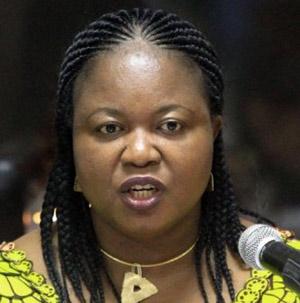
Joy Ezeilo
By Chioma Gabriel
Dr. Joy Ngozi Ezeilo , OON , is a human rights lawyer, scholar and activist. She is a Law Professor and Head of department, Public and Private Law, Faculty of Law, University of Nigeria. She has also served in various governmental capacities, including as Honourable Commissioner for Ministry of Women Affairs and Social Development in Enugu State.
She has consulted for various international organizations and is the founding director of Women Aid Collective (WACOL) working on women’s rights and democratic governance. She has published extensively on a variety of topics in the field of law, gender, democracy, peace and conflict.
Dr. Ezeilo is a recipient of several prestigious national and international awards including chieftaincy titles and a national honour (Officer of the Order of Nigeria, OON) in 2006 in recognition of her outstanding contributions to nation building in the area of legal scholarship, advocacy, civil society movement and community service.

Joy Ezeilo
Dr. Joy Ngozi Ezeilo is currently the United Nations Special Rapporteur on trafficking in persons, especially women and children.
How bad is the problem of Human Trafficking?
Human Trafficking is growing and with the problem of global financial crisis, inequality of women and social exclusion, it has grown in bounds. Although the issue of statistics is lacking, we know from available sources that every year, about two million women and children are trafficked around the world in various forms. Trafficking could be for labour exploitation, or for sexual exploitation. Majority of women and children are affected and Nigeria is involved in a high measure.
There is international trafficking involving Nigeria and even within Nigeria, there is trafficking in women and children. Nigeria is a source country from where women and children are taken away to other countries and it is also a destination country and that really makes the situation bad in Nigeria. I can tell you in my capacity as UN Special Rapporteur that in most counties I have traveled to, Nigerians are highly involved in Human Trafficking. They are involved internationally and locally.
Internally, thousands of Nigerians are being traded in every year. Although the situation is bad, I’m also aware that the Nigerian government is working very hard to curtail that and that was why NAPTIP was established and NAPTIP also access the situation in other countries. The establishment is doing well but I know it can do better. I think the law enforcement agencies should do more to increase public awareness on this and using technology to tackle this problem.
The government should also do more because the factors that contribute to this problem is lack of jobs, growing unemployment, gender inequality, gender discrimination and violence against women but the issue of growing poverty is the major cause.
When people are insecure and have no means of livelihood, without a decent income, they feel insecure and could do anything to earn a living. In the state of their insecurity in search of basic necessities of life, they could do anything and some turn to traffickers of women and children. And many don’t see it as a crime.
In major cities within Nigeria, teenage girls as young as twelve or thirteen are seen around brothels and they have people they report to and account to, yet, nothing is seen to be done about them…
These are the people who are exploiting their sexuality, they are the people exploiting their labour and their prostitution. Those are also the people the security agencies need to go after.
You’ve been in government before?
I was Commissioner for Women Affairs in Enugu State. I have also served in other capacities in government. I chaired the committee that drafted the bill on elimination of violence for the Federal Ministry of Justice which was later forwarded to the National Assembly. I have served in various capacities on issues of Human Rights and I have an NGO, Women Aid Collective (WACOL), founded in 1997 for women and children who are visited by circumstances beyond them. I have taken service to humanity beyond the shores of this country.
Primarily, I’m involved in advocacy for gender equality and human rights for all, especially as regards implementation of laws to conform with international standards as it relates to gender equality and human rights, political issues and otherwise. Women are jeopardised and they suffer discrimination and their rights are violated especially as it relates to gender-based violence; violence against women and on how to get women better protected. I have handled more than 2,000 cases on violation against women across the country. I built the first shelter for women in this country in 1998.
We have offices in Enugu, Port-Harcourt and Abuja, in Abia and Anambra. We built an ultra-modern shelter for women in 1998 and the shelter is in Enugu. There is another shelter by Project Alert on Violence Against Women in Lagos. So, we are two organisations that provide shelter services in Nigeria.
Can you share some of the peculiar experiences you’ve had in the course of this job?
They were many. Some of them dealt on legal works involving women, especially widows who were being deprived of their rights after the death of their husbands as it involves property sharing. There was a woman whose source of livelihood was taken away after the death of her husband. We followed her case conclusively and ensured the restoration of the source of her livelihood.
There was a woman who was detained unlawfully by the family of her husband because they suspected she had a hand in his death whereas, the man died of natural causes. There was also the issue of a woman who had an acid attack by her husband. I was with her before she died and she was bathed with acid from head to toe. She couldn’t lie on the bed and she told me she had even resolved the problem with her husband before the attack and was three months pregnant. She told me the acid attack was unprecedented.
The man was arrested overtime but this case would not be prosecuted because there was this sentiment of who would take care of the couple’s other children in the marriage if the man is condemned to death. There are many women who are living under threats, whose lives are in danger under the guise of marriage and due to society values, they suffer and want to die in silence.
They will not seek help until it is too late. There was also a case of a 70-7ear-old widow who was to be thrown out by her step-son over the property of her late husband and she was the lawfully-wedded wife. There are many peculiar cases, some of which are so incredible . I remember when we tried to review a case in the Niger Delta and when I got there and started doing the documentation of the violations of rights of women, I met a lot of women who were raped by the soldiers and this was heart-rending.
There was a case of an elderly woman, a grand-mother who was so raped that she couldn’t walk. When I saw this woman, we cried together and these people who did it and got away with it. These are some of the things that rend my heart. In 1997, there was this woman who lost her husband and she was detained for eleven days. The in-laws detained her and maltreated her because they believed there was an amount of money her husband kept which was not disclosed by the woman.
There was a case of a girl whose boyfriend forced a bottle into her private part and another case of a 2-year-old girl whose vagina was torn after being raped by a man; there are over 2,000 cases. I have handled on the issue of violation of human rights as it involves women My NGO, WAHOL is 15 years now and I can tell you, it’s been fifteen years of tackling violation and de-humanisation of women in the society on a regular basis; women who have been deprived of their economic rights, who lost their husbands and were subjected to all types of incredible treatments.
There was a particular one whose husband was in the mortuary for 15 months because the family was trying to wrestle all the man’s property from the woman. They tried all they could to deprive her of everything owned by her husband which she would use to train their children but they failed because the woman was educated and went for her right and during her husband’s burial, they laid a siege for her but unfortunately for them, she surrounded herself with water-tight security.
If not, she wouldn’t have gotten anything from that family. There were cases of women whose husbands died of HIV and because the women too were HIV positive, the families of their dead husbands took the children and left the women to die. There were also other cases of acid baths on women by their husband but unfortunately, the women didn’t die. Some were violated by their in-laws.
There was a woman that was sanctioned by the community of her husband because they claimed she violated the community law. She was not allowed to buy food from the market or fetch water from the stream. She and her children were banished into the forest and when we saw them in the forest, they were below human beings. We brought their story to the world and inviited the police to their community. So, everyday in this job is like one being in the battle field.
The injustice meted out to women on daily basis is incredible but our job is to help poor people who on their own, could not access justice. We give counseling and we try to create awareness on elimination of all forms of violation of the rights of women.
Would you say that in terms of recent ministerial appointments made in Nigeria, that women got the 35% appointive position as promised.
The result is there for everybody to see. In terms of elective positions, the result is not something the women should be proud of. But in terms of appointive positions, what is happening at the federal level is more responsive to the agitation of women on 35%. I want to appreciate the First Lady who has been very passionate about the issue.
I think that was a very good campaign that was led by the First Lady. We need advocates right at the corridors of power especially within the first family and I think that is why we are succeeding. Now, it is 30% clearly and with one more appointment, it will become 35% and then, we can really celebrate.
But remember, Nigeria is a federation. We have states and local governments and the question is, at states and local governments, are we making the same progress? The answer here is no. The states are not appointing women and I think this is the time for them to look up at the federal level and toe the line of President Goodluck Jonathan. There is a national gender policy which every state should follow.
There are many qualified women in diverse fields who have the capacity to be in appointive positions. So, I believe the women will make it if given the opportunity. The current Minister of Women Affairs Hajiya Zainab Maina is a round peg in a round hole and having been past President of NCWS and given her antecedent, she will achieve full 35% in appointive position by working in concert with the First Lady and women’s group in Nigeria.
Disclaimer
Comments expressed here do not reflect the opinions of Vanguard newspapers or any employee thereof.