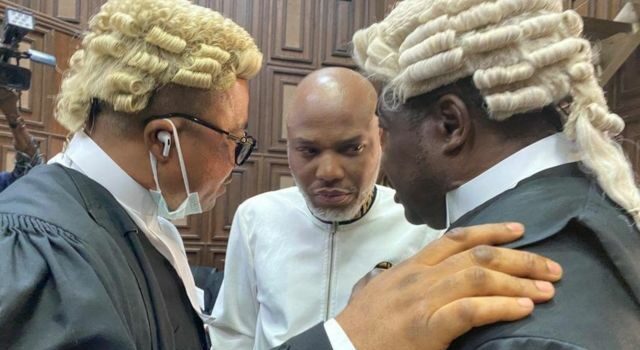
File image of Nnamdi Kanu in court.
.
By Ikechukwu Nnochiri, Abuja
Justice Binta Nyako of the Federal High Court, on Friday, barred journalists from covering the ongoing trial of the detained leader of the Indigenous People of Biafra, IPOB, Nnamdi Kanu.
The court is billed to rule on an application Kanu filed to quash the 15-count treasonable felony charge the Federal Government preferred against him.
Security operatives from the Department of State Service, DSS, and the Nigeria Police Force, had blocked all access routes to the high court premises.
Though accredited journalists were allowed to enter the press centre situated in the court’s basement, they were however denied entry into the courtroom.
A security operative who pleaded anonymity told Vanguard that the order for journalists not to be allowed into the courtroom came from the trial judge, whom he said based her decision on the new practice directions the court issued on Thursday.
“As you can see, we have the list of all the journalists here. We did not block anyone on the list from entering the court premises”.
Efforts by the Chief Information Officer of the court, Dr Catherine Oby Christopher, to help select journalists to enter the courtroom around 12pm, proved abortive, as DSS operatives insisted that the judge was already sitting.
The court had in the new practice direction, maintained that proceedings in terrorism cases, would henceforth, be held in camera or as may be ordered by the trial judge.
“Proceedings of offences of terrorism, subject to the provisions of section 232 of the Administration of Criminal Justice Act, 2015 and section 34 of the Terrorism (Prevention) Act, 2011 (as amended), shall be held in camera or as may be ordered by the Court.
Also Read:
Breaking: Court bars journalists from covering Nnamdi Kanu’s trial
“The names, addresses, telephone numbers and identity of the victims of such offences or witnesses in the proceedings shall not be disclosed in any record or report of the proceedings and it shall be sufficient to designate the names of the victims or witnesses with a combination of alphabets.
“In any proceedings where the Court deems it necessary to ensure the safety and/or protect the identity of the victim or a witness, it may take any or all of the following protective measures:
“Hold its proceedings at any place to be designated by the Chief Judge and in the case of the Abuja Judicial Division, the venue, for the time being, shall be the premises of the Code of Conduct Tribunal;
“Receive evidence by video link; Permit the witness to be screened or masked; Receive written depositions of expert witnesses; Direct that all or any part of the proceedings of the Court shall not be published in any manner;
“Exclude from the proceedings any person other than the parties and their legal representatives;
“Make order as to any electronic devices that would be allowed during the proceeding
“Make an order on any other measure that the Court considers appropriate in the circumstances”.
On the coverage of proceedings in terrorism cases, it read: “The coverage of proceedings under these Practice Directions is strictly prohibited, save as may be directed by the Court.
“A person who contravenes an order or direction made under these Practice Directions shall be deemed to have committed an offence contrary to section 34(5) of the Terrorism (Prevention) Act, 2011 (as amended)”.
Kanu, in the application he filed through his team of lawyers led by Chief Mike Ozekhome, SAN, maintained that the charge against him was legally defective.
He argued that the court lacked the jurisdiction to try him on the strength of an incompetent charge.
Ozekhome, told the court that his client was “unlawfully, brutally and extraordinarily renditioned from Kenya without his consent”.
He argued that since some of the allegations FG levelled against Kanu, were purportedly committed outside the country, the high court, therefore, lack the jurisdiction to entertain the charge.
“The charges appear to give this court a global jurisdiction over offences that were allegedly committed by the Defendant, without specifying the location or date the said offences were committed”.
He argued that under the Federal High Court Act, such a charge must disclose the specific location where the offence was committed.
More so, Ozekhome contended that Kanu could not be charged with belonging to an unlawful organization since the action of FG, in proscribing the IPOB, is still subject to legal dispute at the Court of Appeal and therefore subjudice.
Consequently, Ozekhome urged the court to dismiss the charge, as well as to discharge and acquit the Defendant of the entire 15-count charge pending against him.
“This case is hollow, there is nothing in it. It is dead on arrival. Elements constituting the offence must occur within the jurisdiction of this court”, he argued.
However, FG’s lawyer, Mr Shuaibu Labaran, prayed the court to strike out Kanu’s application and order the Prosecution to open its defence.
He argued that the application would touch the substance of the case that is yet to be heard.
“The position as of now is that the IPOB is a proscribed organization which was duly proscribed through the due process of law”.
He argued that Section 32 of the Terrorism Prevention Act imbued the court with the requisite jurisdiction to handle the trial.
“We urged my lord to refuse the application to pave way for the commencement of the trial in Ernest.
“This is a matter that has been pending for over five years now”, the Prosecution counsel added.
Disclaimer
Comments expressed here do not reflect the opinions of Vanguard newspapers or any employee thereof.