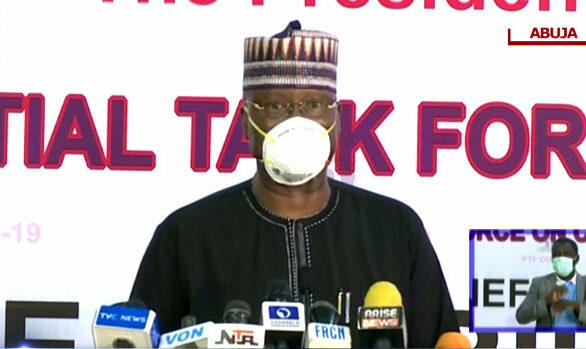
PTF on COVID-19 Chairman, Boss Mustapha.
…gives details of actions so far taken
…seeks amendment of Quarantine Act
By Levinus Nwabughiogu
Chairman of the Presidential Task Force on Covid-19, Boss Mustapha has said that their greatest challenge in tackling the outbreaks of the disease in Kano State was lack of adequate manpower to expedite contact tracing of the suspected carriers.
Mustapha made the revelation yesterday while addressing members of the House of Representatives who had summoned him and his team to brief them on the situation in Kano State.
The PTF Chair who is also the Secretary to the Government of the Federation, SGF said that the state was fast becoming the epicentre of Covid-19 in the northern part, not the country.
Also read: NCDC declares end to 2020 emergency Lassa fever outbreak over
It will be recalled Kano had witnessed many deaths linked to the coronavirus in the recent time with an alarming rate of new cases after Lagos State.
Kano emerging Covid-19 epicentre of the North
He said: “Kano is fast emerging as the epicentre of the COVID-19 pandemic in the North, which necessitated Mr President’s specific directives in his broadcast of Monday, 27th April 2020.
“The PTF has been working closely with the Kano State Government and key stakeholders to identify the issues and seek immediate solutions. We have deployed a technical team of 41 staff from NCDC supported by 17 staff from WHO to provide technical assistance to the State Emergency Operations Centre (SEOC). A team of clinicians and public health experts under the auspices of the Federal Ministry of Health is also in Kano to provide training on case management and strengthen the capacity of the State to handle emergencies.
“A key weakness of the Kano COVID-19 response is the lack of adequate manpower for surveillance and contact tracing.”
Actions so far were taken to stop the spread
Mustapha, however, gave a detailed list of actions so far taken to curtail the spread of the epidemic.
These, according to him, included securing additional logistics, partnering with the state government to establish more testing centres amongst others.
“The PTF has mobilised resources from across the health sector including multilateral, bilateral, MDAs and the private sector to push through an accelerated expansion of the rapid response teams (RRTs) from 21 to 50. This required the provision of 30 additional vehicles from INEC and 15 ambulances from the PTF and private sector. A further 10 Hilux vehicles and 10 ambulances have also been pledged by the private sector.
“Working with partners, we are establishing at least one sample collection centre and two facilitators per LGA. In addition to a 7-day motorised campaign across major urban areas in Kano. We have mobilised about 3300 informants through the WHO/polio programme for house-to-house search and reporting of suspected cases. The Federal government will in due course announce significant additional material and technical resources to complement the State government’s efforts in combating the COVID-19 pandemic in Kano.
“Based on our assessment, the following specific additional measures have been taken in Kano: Lockdown of Kano for two weeks; Sent a team of experts to review the response structure and assess the situation; Been working closely with the political and professional authorities”, he said.
There was also the “deployment of equipment to the medical facilities; training of the Kano state teams of health workers; deployment of some service ambulances from the FRSC; and the Armed Forces Hospital in Kano is also being retooled to provide additional infrastructure”.
The PTF Chair added that they had “deployed 100 out of planned 200 trucks of assorted grains for relief”, improved testing capacity by 400 per day; handed over a new Diagnosis Lab by 54Gene, supported by Dangote Foundation on Sunday 3rd May 2020.
Others included “Preparing to get another lab supported by the eHealth Africa for introduction into service and two government labs in AKTH and BUK are also working.”
Mustapha stated that “by end of this week, Kano will have a capacity to test 2000/day.”
The PTF Chair added that his team had inspected the treatment Centres in the State and found two currently functional.
They are Muhammadu Buhari Hospital with 76-bed capacity and Kwanan Dawarki with a 75-bed capacity.
According to him, both treatment centres still were not full yet due to resistance primarily, and logistics.
Added to the treatment centres were two new treatment Centres being prepared by Dangote Foundation.
They were Urology Centre (75 beds); Stadium tent (100 bed); and Sani Abacha (200 beds).
However, as part of the effort in strengthening the Kano State Response Structure, Mustapha said that “The EOC structure and processes have been improved through reorganization; collaboration with Kano state is ongoing; Prevention of spread to neighbouring states is a priority; Medical personnel from states around Kano are currently being trained as part of the national response strategy.”
He said: “Mr Speaker, Honourable Members, these activities carried out by the PTF are applicable nationwide but more emphasis has been placed on the epicentres where community spread has commenced with a threat to family transmission on the increase.
“I wish to state that the PTF is working in collaboration with other structures set up by the President to ensure that there is a well-rounded national response. These include the Economic Team headed by the Hon. Minister of Finance to examine the impact of COVID 19 on the economy; and Economic Sustainability Committee headed by His Excellency, the Vice President.
“The Task Force on the free movement of farm produce headed by the Hon. Minister of Agriculture and Rural Development.
“As part of the PTF’s mandate, we are working towards strengthening the country’s public health emergency preparedness through system building and infrastructure development. The COVID-19 pandemic has exposed the fragile status of our health system and the near absence of the structures or building blocks necessary for the public health protection of our communities.
“In this regard, we plan to establish state-of-the-art intensive care units and isolation/treatment centres in each of the 36 States plus FCT. We will also upgrade molecular laboratory facilities across the country and ensure that a COVID-19 testing centre is available in every state through the utilization of existing GeneXpert machines. This scale-up of infrastructure will also require additional staff training and a review of existing manpower needs for the country. There’s no doubt that a strengthened and well-resourced health system will not only place the country in a better position to deal with future emerging infections such as Lassa fever but will also provide a solid foundation for medical research and development.”
Preparation for Post-COVID-19/Amendment to Quarantine Act
The PTF Chair also asked Nigerians to prepare to get acclimatized to the emerging new life which will be seemingly occasioned by the COVID-19 pandemic.
He said: “The post-COVID-19 era is going to be a challenging one. As a country, we need to prepare for what will be major changes to our long-term social interactions, events, personal contacts and economic prospects.
“Just as important is the need to provide a strengthened legislative framework for dealing with future public health emergencies in a changing world. The current Quarantine Act needs to be updated due to the unique nature of emerging infections such as COVID-19, the dramatic impact this has on sectors beyond just health and the urgency required to deal with such pandemic.
“The President exercised his powers under sections 3 and 4 of the Quarantine Act LFN 2004 to restrict the movement of persons and goods in Lagos, Ogun and FCT. Although this intervention generated heated debate in the legal circles, with insinuations that it may be in direct conflict with section 44(1) of the constitution and Article 14 of the African Charter on Human and People’s Rights (ratification and enforcement) Act, the legal basis of the intervention is not debatable. However, the Act needs to be adaptable to the changing nature of human behaviour and interaction.
“Mr Speaker, as I mentioned when the combined leadership of the National Assembly was briefed on 9th April 2020, our nation is at war against a very dangerous, unseen and ubiquitous enemy and all hands must be on deck to successfully prosecute the war. In addition to providing the kind of leadership already demonstrated, the National Assembly finds itself in the unique position to do the following, though not exhaustive: Develop a legislative framework to prepare Nigeria for any future pandemic; Develop a legislative framework for reforming and transforming our healthcare systems; Strengthen the legislative framework for economic growth through domestic manufacturing; Deepen the legislative oversight during this pandemic and beyond; Pass legislation that will further ease the ability of the executive to cushion the impact of the economic decline; Be part of community mobilization and enlightenment efforts.”
Disclaimer
Comments expressed here do not reflect the opinions of Vanguard newspapers or any employee thereof.