By Victor Ahiuma-Young
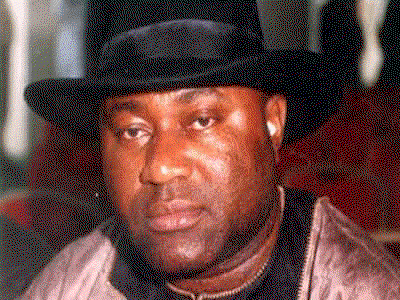
Chairman of Maritime Workers Union of Nigeria, MWUN, Advisory Board, Tony Emmanuel Nted, who is also the immediate past President-General of MWUN, gave insight into how his leadership addressed issues of pilfering and restored industrial peace in the sector.
Nted who marks his birthday on Monday, speaks on the leadership and ‘reformed members of the union.
Excerpts
MY father was a fisher-man and when we got to a certain age, he took all of us to Delta State where we started the fishing business. He later took us to Warri, where we started our primary education. After our primary education, we went to the Institute of Continuing Education in Warri. From there, things became very difficult and I started working at a very tender age. It was difficult as I tried to cater for myself. My father didn’t want us to further our education, but to join him in the fishing business.
But my brother and I refused and decided to struggle to further our education. I joined the Maritime Workers Union from the Dockworkers Branch. We did not have what is now known as Maritime Workers Union of Nigeria then. It was the Trade Union amendment Act of 1996 that brought about the merger.
Heritage Bank partners NPA to support improved ports infrastructure
This led to the formation of Maritime Workers Union that we have today. I was working with the Dockworkers Union where workers and others saw me as a productive man and wanted me to be the head of the Ven Moore workers representative at that time. I started from there and as I was doing that, I was at the same time going to school.
From there, l was elected the District Chairman of the Delta Port of Warri Dockworkers Branch. Some years later, I was elected Zonal Vice- President in Warri. From there, I was elected President of the Dockworkers Branch. After I served my two terms, at the union’s national delegates’ conference in Benin City, Edo State in 2009, I was elected President- General, Maritime, in March.
Leadership by example
Working as a dockworker gave me the opportunity to pass through the hardship in the dock. It is like a labourer’s work. When I got to the leadership position from lower level to highest level in the union, because I experienced almost every challenge from the shop floor to highest level of the union, I was better placed to appreciate the problems facing the workers in the industry. From such vantage position, I was able to serve the workers to the best of my ability. At the end, people believe my administration was one of the best. I can tell you that as a dockworker, I carried rice, fertilisers and so on, on my head. I know the hardships the workers go through. So, when I became a leader, I tried to make the industry a better place. I introduced so many things. For instance, knowing that fatigue and sickness are some of the things affecting the workers in the Maritime industry because of the nature of the job, I made sure that these were addressed no matter how little.
In Warri, I set up what we called Emergency Chemist or Labour Hall. When workers fell sick, they would go there for medical attention. I did a lot of things to help the dockworkers in particular and the maritime workers in general. That is why today, they appreciate me because I did my best to improve their living conditions.
Reforming the workers
I was also a victim of circumstances because in the Dock, we fight, we settle, but I never got myself involved in anything that could stain my father’s name. I know if we did not do what we did, the industry would not be a better place. So in those situations, we put God first and started doing what we called Dockers Restoration weekly. In some weeks, you would find 1,000 or more persons; we preached to them and taught them moral values because some parents brought up their children without the right moral values.
That was what we did on a weekly basis. As we preached, we made them to understand that stealing is not acceptable by God and that anybody that breaks into container or steals in the port will be suspended from the industry. And if you fight on duty, you will also be suspended. We also taught them that insubordination to superiors was wrong and would also attract severe sanction. We impressed on them that if you insult any supervisor or superior, you will be sent out of the industry to serve as deterrent to others.
There was a day I was preaching in the port and was talking about love; I advised that all those who wore charms or fetish-related things should go and remove them otherwise their lives would become miserable. Some of them started removing their charms and fetish objects they wore and threw them away. They said truly God was talking through me. That was how some of them came to know God.
The Dockworkers, the Nigerian Ports Authority, the shipping members of the Maritime Workers Union, are very decent people. When you commit an offence, we discipline you irrespective of who you are. I will give you an example of what happened in Warri. People were going to the ports to vandalise and steal.
We cautioned them, telling them that it is wrong to break into or vandalise containers. We told them that those that do such things, bad things would happen to them. Some stopped but others did not. When caught, we brought some of them to the Labour Hall, called their wives and children to witness as we flogged them. It forced many of them to be reformed which eventually led to the reduction of vandalism of containers and theft in the ports.
Collective bargaining
Even in my days as a dockworker, the condition of service was nothing to write home about. But when we came on board, there were several disparities in the industry in terms of payment. Some terminal operators would pay N10,000 while some would pay N5,000. We decided to see how we could work out a minimum standard or conditions of service for the dockworkers and others that did not have.
Few months after I came on board, we were able to arrive at a certain level and tried to improve on it year after year to get a better condition of service for dockworkers till some of the operators started paying up to N250,000 per month depending on position of the worker. In fact, if not for the global recession, we would have been talking about N300,000 to N400,000 per month.
Training, retraining
I believe training and retraining are very important parts of education. I remember when we took about 60 persons to Dubai, about two persons laid down at the airport and were crying and praying , saying God keep on blessing Tony that has brought us here. One of them said I have not gone to Abuja before by flight, but I have flown an international flight. It was amazing. We kept begging him to stop and let us go. But he kept on crying. At all the training, I told them that we were doing was just training them, but that they must go back to train other and add value to the system. This was one of the ways we brought peace and sanity to the sector.
Through training and retraining, work ethics, improved, vandalism, fighting and all other negative behaviours changed. Besides, the training and retraining also helped to build their capacities. Today if you go to the dockyard and talk to the dockworkers you will the difference that training and retraining has brought into the system. We trained over 6000 workers.
We also brought the culture of saving for the raining days into the system. And part of the training was what we called “Life after Service”. This made the Dockworkers to have a rethink about life. Some of them started buying buses, some built houses, while some did other things. I made them to understand that if you do not have a place to call your own, when you retire from service you will never live a normal life. So, the best thing to do is for you to secure your future. It became a healthy competition for workers to talk about what they have achieved and saved to the extent that everybody wanted to keep something for the future when they leave the industry.
Achievements
Well firstly, I will say we brought industrial peace into the system. We were able to sanitize the maritime industry. The NPA, and other stakeholders, can testify to that. Secondly, we brought quality management to the workers. We also introduced additional gratuity for workers. For example, when they sacked a lot of workers in the industry as a result of the global recession, some of them were paid additional N1.5 million each which was not negotiated for. It was part of our efforts to make workers go home happily. We took more than 1000 workers to different countries such as Dubai, South Africa, London and so on, for training. Like I said earlier, we trained over 6000 workers both locally and outside the country. I do not know how to blow my trumpet. If you go to the ports, from Lagos, Warri, Calabar to Port Harcourt, people will tell you about our achievements.
Disclaimer
Comments expressed here do not reflect the opinions of Vanguard newspapers or any employee thereof.