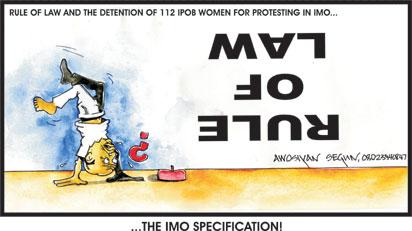
Rule of law
Continues from yesterday
Since the security of the gov-ernment in power is always equated with national security, the police and security agencies have concentrated their attention on monitoring the activities of human rights activists and opposition figures in the country. In the circumstance, the police and security agencies have been unable to foil illegal take-over of government, through coup de tat and rigging of elections, kidnapping, hostage-taking, religious riots and civil disturbances which have continued to threaten national security.

Femi Falana
Following the dissolution of the National Security Organisation, NSO in 1986, three national security agencies were established i.e the State Security Service, the Defence Intelligence Agency and the National Intelligence Agency pursuant to the National Security Agencies Act. Section 2 thereof provides that the Defence Intelligence Agency shall be charged with the responsibility for the prevention and detection of crime of military nature against the security of Nigeria while the National Intelligence Agency is concerned with the general maintenance of the security of Nigeria outside Nigeria concerning matters that are not related to military issues.
The duty of the State Security Service is the prevention and detection within Nigeria of any crime against the internal security of Nigeria. Other agencies of the State in charge of the maintenance of law and order include the Police, Armed Forces, Customs, Immigration and Prisons. Realising that the law enforcement agencies are ill-equipped to fight certain criminal activities in the society, a number of specialised agencies have also been established by the State. They include the Nigeria Drug Law Enforcement Agency, NDLEA, the Federal Road Safety Commission, FRSC, the Independent Corrupt Practices and Other Related Offences Commission, ICPC, the Economic and Financial Crimes Commission, EFCC and the National Agency for Food, Drug Administration and Control, NAFDAC etc.
Additional responsibilities
It is pertinent to note that each of these agencies may be conferred with additional responsibilities affecting national security as the President may deem necessary. On many occasions, the illegal directives of chief executives of the federal or state government have been religiously enforced by the Police and security agencies to the detriment of national security. Some of the security agencies have suo motu abused the human rights of citizens under the pretext of defending state security. I have just confirmed that Mr. Musa Daura, the immediate past Director-General of the Department of State Services, DSS, engaged in the reckless subversion of national security by detaining hundreds of people without any legal justification. Just two weeks ago, my law firm secured the liberty of a Nigerian journalist, Mr Jones Abiri who was held incommunicado for two years. In fact, at the height of his uncontrolled impunity, the fellow dispatched masked security operatives to take over the National Assembly.
Social Security
Although it shall be the duty of every organ of the Government to conform to, observe and apply the Fundamental Objectives and Directive Principles of State Policy, their violations by the government and its officials. But the Appropriation Laws which require the government to create jobs, reduce poverty and provide infrastructural facilities for the society are violated as budgets are partially implemented while public funds are diverted and cornered by many unpatriotic public officers. Those who engage in such crimes against the people are treated like sacred cows by law enforcement agencies. A few of them who are charged with the criminal diversion of public funds are shielded from prosecution by some senior lawyers. Meanwhile, the poor who are driven to criminality by an unjust socio-economic system are convicted and sentenced to long years of imprisonment or executed for armed robbery.
The maximum welfare, freedom
With respect to the economic wellbeing of the people, the Constitution has imposed a duty on the State to guarantee “the maximum welfare, freedom and happiness of every citizen on the basis of social justice, and equality of status and opportunity” . To this effect, the State shall direct its policies towards ensuring that “the material resources of the nation are harnessed and distributed as best as possible to serve the common good” and that “the economic system is not operated in such manner as to permit the concentration of wealth or the means of production and exchange in the hands of few individuals or of a group” . In order to ensure good governance and public accountability, the State is under an obligation to abolish “all corrupt practices and abuse of power” .
Apart from the duty imposed on all citizens to “render assistance to appropriate and lawful agencies in the maintenance of law and order” , it is the obligation of the mass media to “uphold the responsibility and accountability of the Government to the people” . To eradicate illiteracy and ignorance, Government shall, as and when practicable, provide “(a) free compulsory and universal primary education; (b) free secondary education; (c) free university education and (d) free adult literacy programme” . It is also the duty of the State to protect children, young persons and – the aged against any form of exploitation whatsoever and against moral or material neglect
Mr. Bill Gates, the co-chair of Bill and Melinda Gates Foundation was a guest of the Federal Government at the recently concluded expanded meeting of the National Economic Council in Abuja. In his well-publicised address at the forum, Mr. Gates criticised the neo-liberal foundation of the economic programme of the Government of Nigeria. While reeling out facts and figures on the state of underdevelopment of the nation, the special guest made a strong case for increased investment in the welfare of the Nigerian people by all the chief executives of the federal and state governments. In particular, he urged the governments to make the people the cornerstone of its economic programme by investing in education, health and other social services. Not a few people, including some former public officers, have commended Mr. Gates for speaking truth to power! But far from it, the speech was a friendly admonition to the members of the ruling class in Nigeria. Having invested $1.6 billion in promoting the health of the most vulnerable segment of the population since 2006, the locus standi of Mr. Gates to challenge the economic programme of the Government cannot be questioned. Gates has put his money where his mouth is, as they say.
His solidarity message was a critical commentary on the economic programmes of the previous and current governments which have abandoned the welfare policies enshrined in the Fundamental Objectives and Directive Principles of State Policy embodied in Chapter II of the Constitution of the Republic. Therefore, Mr. Gates’ criticism of the economic programme of the Buhari administration is valid for all the economic programmes of the previous governments, which have handed over the national economy to market forces at least in the last 35 years. It is, therefore, the lack of proper appreciation of the ideological thrust of the message that has led some commentators to conclude that Mr. Gates has merely criticised the EPRG of the current administration. But contrary to such reductionist distortion, Mr. Gates’ speech is a summary of the struggle, which has been relentlessly waged by progressive forces against the anti-people’s policies of successive governments in Nigeria since the Structural Adjustment Programme, SAP, was imposed on the nation by the Ibrahim Babangida military junta. Even the World Bank and the International Monetary Fund, IMF, who didn’t emphasise the social costs of adjustment in the 1980s, are now subtly drawing the attention of government burgeoning poverty, which is a consequence of their socially ruinous policies.
It is unfortunate that some of those involved in economic management are still enamoured with neo-liberalism, which callously discounts human welfare policy mix. But when IMF and World Bank caution against poverty, our market forces fundamentalists in policy chambers should at least be worried about their policies which do (not) make education and healthcare as priorities. It was on account of the struggle of the Nigerian people that the Federal Government has been compelled to enact some welfare laws for the actualisation of the socio-economic rights of the Nigerian people. Some of the laws include the People’s Bank Act, Nigerian Education Bank Act, Pension Reform Act, Free, Compulsory Universal Basic Education Act, Child’s Rights Act, National Health Insurance Act, National Health Act, and Immunisation Act etc. But, sadly, the Federal Government has consistently breached the provisions of these welfare laws. As if that is not enough, the several court judgments delivered in cases filed by human rights activists which have directed the Federal Government to implement the provisions of such laws have been treated with disdain. Indeed, the crisis of underdevelopment of the country has been compounded by the anti-welfarist policies of majority of the state governments. For instance, the Child’s Rights Act, which provides for compulsory and free education for every child from primary to junior secondary school, has been adopted by all the 17 states in the South and only eight out of the 19 states in the North.
Denied access to basic education
It is not surprising that terrorists and other armed bandits have continued to recruit from the large army of children who have been denied access to basic education in several states in the country. Instead of providing fund for public schools, the governments have continued to encourage the establishment of private schools for the education of the children of the elite. Whereas 2 per cent of the consolidated revenue fund of
the Federal Government is contributed to the Universal Basic Education, UBE, Fund annually in line with Section 2 of the Free, Compulsory Basic Education Act, majority of the state governments have refused to contribute counterpart fund to enable them to assess the UBE Fund. Hence, billions of Naira is lying waste in the UBE account in the Central Bank while millions of children are roaming the streets. According to the UNICEF report of 2012, Nigeria had 10.5 million children who were out of school. That was the highest figure in the world at the material time. The figure has since increased geometrically.
Yet, all the governments have refused to comply with the judgments of the ECOWAS court and the Federal High Court, which have mandated them to provide every child with basic education. Our appeal to the Police Authorities to arrest and prosecute parents and guardians, who refuse to allow their children and wards to acquire basic education, has fallen on deaf ears. The story is the same with respect to the provision of basic healthcare for the people. As public officers and their family members are flown abroad for medical treatment in foreign medical centres, the people are left to die in ill-equipped hospitals in the country. The Federal Government has failed to implement the provisions of the National Health Insurance Scheme Act and the National Health Act. Some highly placed public officers indicted for looting the account of the National Health Insurance Scheme have been given a clean bill of health. Even though the National Health Insurance Scheme Act was enacted in 1999, only four out of the 36 state governments have adopted it. Following the failure of the federal and state governments to implement the Immunisation Act, the Bill Gates Foundation and Dangote Foundation have taken over the duty of ensuring that our children are immunised.
Preventable diseases like polio, meningitis, Lassa fever and others are ravaging the populace without any meaningful intervention from the governments. It is common knowledge that the scourge of HIV/AIDS persists in the country due to the failure of the governments to provide anti-retroviral drugs for the victims. In 2014, the sum of $30 million donated to the Federal Government by some development partners to fight the scourge was stolen by a handful of officials in the Federal Ministry of Health. Since the Federal Government has refused to recover the fund and prosecute the indicted criminal elements, the development agencies have suspended the provision of more fund to acquire drugs to fight the menace of HIV/AIDS in Nigeria.
In its reaction to Mr. Gates’ speech, the Federal Government assured him of the commitment to invest in human capital development. Beyond such assurance, the Federal Government should review the EPRG with a view to providing sufficient fund for education, health and economic empowerment of the people. The authorities of all state and local governments should be involved in the review of the national economic programme. Meanwhile, we are compelled to urge the state governments to adopt and implement all the welfare laws that have been enacted by the Federal Government. Since the Federal Government has undertaken to operate under the Rule of Law, we call for immediate compliance with the judgments of the ECOWAS court and the Federal High Court on the welfare of the Nigerian people. Accordingly, we have, once again, served the certified true copies of the said judgments on the Attorney-General of the Federation.
Disobedience to court orders by democratic governments
Since democratic rule was restored in Nigeria in May 1999, members of the ruling class have continued to treat court orders with contempt due to lack of understanding of the essence of the rule of law in a liberal democratic dispensation. Our courts had cause to condemn the illegal use of the police and other security forces to rig the 2003 and 2007 general elections by the Olusegun Obasanjo administration. Not too long ago, the worst case of contempt of court took place in the history of Nigeria when President Olusegun Obasanjo defied the order of the Supreme Court to release the statutory allocations of the 20 local governments in Lagos State which had been seized following the creation of additional local governments. Vice-President Yemi Osinbajo, who was then the Attorney-General of Lagos State, tried, in vain, to ensure that the order of the Supreme Court was obeyed by the Federal Government.
Disclaimer
Comments expressed here do not reflect the opinions of Vanguard newspapers or any employee thereof.