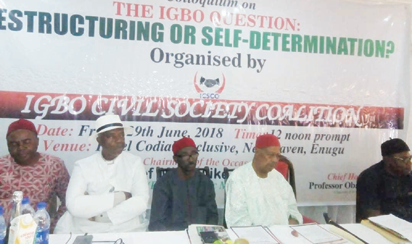
*From left: Dr Jerry Chukwuokolo, Rev. Engr. Echi Nwogu, Prof. Obasi Igwe, Chief Mbazulike Amaechi and Comrade Uchenna Madu at the colloquium.
By Dennis Agbo
ENUGU- THE Igbo Civil Society Coalition, ICSCO, has agreed on pursing self- determination for an independent state of Ndigbo than engaging in Nigeria’s protracted restructuring debate.
The Igbo group said it was of the opinion that achieving a separate country for Ndigbo is a more viable option for the people sequel to their engagements in Nigeria.
The option was the majority opinion at ICSCO Colloquium on The Igbo question: Restructuring or Self-Determination? held in Enugu last weekend.
Among prominent Igbo that spoke at the colloquium included first republic Minister and Zikist, Chief Mbazulike Amaechi; Veteran Biafran soldier and emeritus Professor, Mark Anikpo; Social Science Professor and social critic, Prof. Obasi Igwe, President, National Political Science Association, Prof. Aloysius Okolie; President of Civil Liberties Organisation, Mr. Ibuchukwu Ezike; leader of Movement for Actualisation of Sovereign State of Biafra, MASSOB, Comrade Uchenna Madu who represented a coalition of 24 pro-Biafra groups, among others.
Chairman of the Colloquium and guest lecturer, Prof. Mark Anikpo in his paper concluded that it was better to pursue self-determination straight away than going through roundabout restructuring which he stated would eventually lead to Self-determination.
Anikpo said that self-determination was best for Ndigbo because it will afford them the right to own a republic of theirs, where they could advance their own society.
He said: “Logically speaking, a combination of the two strategies would have made more sense. In other words, restructuring could be a strategy for an ultimate self-determination agenda. While Ohanaeze Ndigbo acts as the political face of the campaign, the MASSOB/IPOB/IBM will function as the military wing of the struggle for self-determination.
“There should really be no conflict between the two groups. It’s only cooperation among all that can achieve the objective of dealing successfully with the Igbo question, a question that can only be finally resolved by the actualisation of an independent state of Biafra.”
On his own account, Octogenarian and first republic Minister, Chief Mbazulike Amaechi regretted that whereas the Igbo led the struggle for Nigeria’s independence, the ethnic group was since then consigned to the back bench of Nigerian polity and tasked Igbo youths to regain the lost position.
Amaechi said: “We should interrogate the present leadership of Nigeria because this is not the type of cabinet we bequeathed on them. The constitution we left behind was a federal constitution but the military subverted it to a unitary one.
“The military institutionalised corruption and Ndigbo cannot stay in society where they play second fiddle.”
The elder statesman pointed out that himself and Alhaji Shehu Shagari were the only surviving members of the First Republic cabinet, stating that he was presently 89 years and would answer any call his attention is required.
The MASSOB leader, Uchenna Madu noted that all the pro-Biafra groups have formed a coalition since they pursue the same goal, noting that they have since realised that working separately will not help actualise their goal faster.
Professor Obasi Igwe in his own paper asked for “lifting of the economic blockade and other Berlin walls against the Igbo if anyone wants them in Nigeria.”
Igwe traced the 1967 Gen. Yakubu Gowon’s blockade of the Ubani/Bonny, Opobo and Igweocha/Port Harcourt ports from their continued use by the Igbo as a calculated economic blockade and plot to reverse Igbo maritime history, render the Igbo non-coastal and deny them continued commercial use of their age-old ports, with the aim of de-industrialising and impoverishing Eastern Nigeria.
“From the de-industrialisation and impoverishment, youth restiveness, unemployment, crime, mutual suspicion, acrimony, hatred and other disasters, have ensued,” Igwe said, adding that the fundamental questions on restricting Nigeria has since been resolved in the Willink’s report of 1958 “and all we need is simply go back to it.”
He called for unity among the Igbo, cooperation with other ethnic groups in Nigeria, stating that justice; equity and fair play were the only foundation for sustainable peace. “If proper restructuring is done in Nigeria, and relative self-determination guaranteed for nationalities, many, including the Igbo, will reconsider arguments favouring absolute self-determination, after all, we’re all Black peoples.”
Disclaimer
Comments expressed here do not reflect the opinions of Vanguard newspapers or any employee thereof.