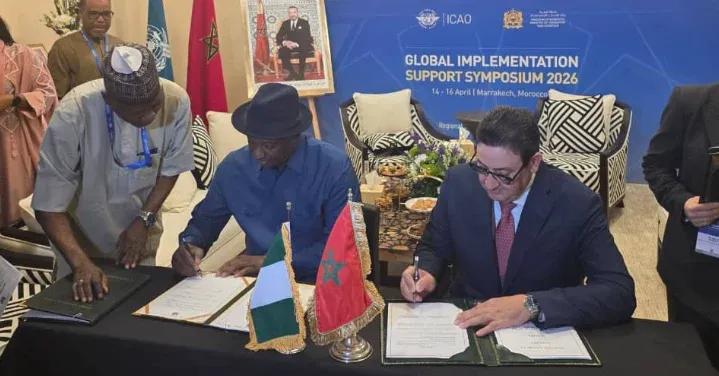
Aviation and Aerospace Development Minister Festus Keyamo joins international aviation leaders at the ICAO Global Implementation Support Symposium in Marrakech, Morocco, in April 2026, where Nigeria received its 20-year Civil Aviation Master Plan covering 2025–2045.
From a 20-year aviation master plan and improved aircraft leasing arrangements to major airport investments and international partnerships, Nigeria is establishing foundations whose economic benefits could extend beyond the present administration. Three years into President Bola Tinubu’s tenure, Aviation Minister Festus Keyamo has advanced reforms addressing longstanding industry challenges. The question now is how to sustain these gains beyond the 2027 political transition.
By Onome Amawhe
In April 2026, Nigeria received a document in Marrakech, Morocco, that could prove more consequential to its aviation future than many of the projects announced in recent years.
It was the Civil Aviation Master Plan, developed with the support of the International Civil Aviation Organisation (ICAO). Covering 2025 to 2045, the blueprint establishes a 20-year framework for aviation infrastructure, safety, air navigation, workforce development, technology and investment.
Festus Keyamo, Minister of Aviation and Aerospace Development, received the document during ICAO’s Global Implementation Support Symposium.
Its importance lies in placing Nigeria’s aviation ambitions within a framework extending beyond the tenure of any president or minister.
For a country where development programmes have often suffered from changing political priorities, contractual disputes and inconsistent implementation, that distinction is significant.
Three years into President Bola Ahmed Tinubu’s administration, Nigeria has recorded progress in aviation regulation, aircraft financing, infrastructure and international connectivity. Yet with another election approaching in 2027, the challenge is ensuring that reforms requiring years to mature are not disrupted by political uncertainty.
Ending the 18-year Bi-Courtney concession dispute
Aviation development depends on predictable policies and enforceable agreements. Nigeria’s history demonstrates the cost of neglecting both.
For nearly two decades, the dispute over the Murtala Muhammed Airport Terminal Two concession complicated airport operations, discouraged investment and generated substantial financial claims.
Successive administrations struggled to resolve the controversy.
On October 20, 2026, the Federal Government and Bi-Courtney Aviation Services Limited finally signed a settlement agreement following negotiations overseen by Keyamo.
The arrangement included the waiver of judgment debt and associated claims reportedly valued at approximately ₦132 billion, alongside provisions clarifying concession rights and airport operations.
Beyond its financial implications, the settlement removed a longstanding source of uncertainty affecting private investment.
It also illustrated why infrastructure development requires stable contractual arrangements capable of surviving changes in political leadership.
Airports take years to finance, construct and operate. Investors therefore need assurance that legitimate agreements will be honoured beyond the administration that approved them.
Restoring Nigeria’s access to international aircraft leasing
Another significant reform concerns Nigeria’s standing under the Cape Town Convention, the international framework governing financial interests in aircraft.
For years, Nigerian airlines struggled to obtain competitive dry-lease arrangements because international financiers were concerned about contract enforcement and aircraft repossession.

Keyamo made resolving these concerns a priority.
Working with judicial and aviation authorities, his ministry advanced a Federal High Court Practice Direction and administrative procedures governing aircraft de-registration and export authorisations.
Nigeria’s compliance rating on the Aviation Working Group’s index subsequently rose from approximately 49 per cent to 75.5 per cent, resulting in its removal from the group’s watchlist of non-compliant jurisdictions.
The commercial significance became evident in November 2025 when Air Peace received a dry-leased Boeing 737-700 from AerCap, marking an important breakthrough in Nigeria’s access to international aircraft leasing.
For domestic operators, greater access to competitive leasing could facilitate fleet expansion, reduce financing constraints and improve international competitiveness.
However, sustaining these benefits requires consistent enforcement of the regulatory commitments that encouraged international financiers to return.
The achievement will have lasting significance only if credible leasing arrangements become a normal feature of Nigeria’s aviation market.
Strengthening Nigeria’s aviation safety oversight
Regulatory continuity is equally important to aviation safety.
In April 2026, Nigeria recorded a preliminary 91.45 per cent Effective Implementation score during ICAO’s Coordinated Validation Mission, its highest reported aviation safety oversight assessment.
The result reflected improvements involving the Nigerian Civil Aviation Authority and other aviation institutions.
For Keyamo, whose five-point agenda placed safety and regulatory compliance first, the assessment represented an important milestone.
It also strengthened Nigeria’s international standing among regulators, aircraft financiers and airline operators.
But safety oversight requires continuous investment in personnel, equipment, training and institutional capacity.
Maintaining international standards must therefore become a permanent responsibility of aviation agencies, regardless of changes in ministerial leadership.
Securing the future of Nigeria’s airport infrastructure
The Tinubu administration has also approved major infrastructure investments whose implementation will extend beyond the current political cycle.
Among them is the ₦712.26 billion rehabilitation and modernisation programme at Murtala Muhammed International Airport, Lagos.
The project involves reconstruction of the ageing international Terminal One and associated improvements intended to strengthen operational efficiency and passenger services.
Other initiatives include the development of a new Nigerian Airspace Management Agency headquarters and centralised Air Traffic Management Centre, the concession of Akanu Ibiam International Airport in Enugu and plans for a Nigerian Aircraft Leasing Company.
International engagements with Boeing, Airbus and aviation financiers have also opened opportunities for aircraft acquisition, technical training and industry development.
These projects and agreements represent substantial commitments, but their eventual benefits will depend on effective implementation.
Airport reconstruction must progress from contracts to completed facilities. Leasing arrangements must become accessible to more operators, while technical partnerships must produce measurable improvements in professional capability.
Continuity should therefore be accompanied by transparent procurement, financial accountability and clear delivery targets.
Tinubu, Keyamo and the question of policy continuity
Keyamo has consistently maintained that President Tinubu’s economic reforms require sufficient time to produce their intended benefits.
His support for the President’s second-term ambition became more formally defined in October 2026 when he was appointed Director of Air Mobilisation for the All Progressives Congress’ 2027 presidential re-election campaign.
His position reflects the wider political debate over the future of the administration’s economic programme.
In aviation, the question has particular relevance because major investments, regulatory agreements and international partnerships operate over several years.
Keyamo’s experience in negotiating aircraft leasing reforms, advancing international aviation partnerships and resolving longstanding disputes forms part of the institutional knowledge accumulated since 2023.
Preserving that experience and documenting the agreements reached could help maintain implementation momentum.
However, the lasting success of the reforms must also depend on strong public institutions capable of operating effectively regardless of political changes.
Ministerial appointments remain the President’s constitutional prerogative, while electoral decisions belong to Nigerian voters.
The national interest is served when viable projects, sound regulations and legitimate contractual commitments are preserved while weaknesses in implementation are corrected.
A 20-year blueprint for Nigerian aviation
Nigeria’s Civil Aviation Master Plan provides an opportunity to move beyond fragmented projects towards coordinated long-term development.
Developed with ICAO support, the 2025–2045 framework identifies priorities covering infrastructure renewal, aviation safety, technical capacity, cargo development, emerging technologies and international competitiveness.
Its significance lies in providing a basis for planning beyond electoral cycles.
But the document will achieve little without implementation.
Government must establish priorities, identify credible financing arrangements and measure progress against defined objectives.
Aviation agencies require the institutional capacity to execute their responsibilities, while investors need confidence in the consistency of commercial arrangements.
The blueprint must also accommodate changes in aircraft technology, environmental standards and global airline business models.
If effectively implemented, it could help position Nigeria as a more competitive African aviation market while reducing the risks associated with abrupt policy changes.
What must survive 2027?
As Nigeria approaches another general election, aviation provides an important illustration of the difference between announcing reforms and making them permanent.
Since 2023, the country has strengthened aircraft leasing compliance, improved safety oversight, expanded international engagement and advanced substantial infrastructure investments.
The administration has also resolved longstanding commercial disputes and created new opportunities for indigenous airlines.
Keyamo has played a prominent role in these developments, particularly through regulatory negotiations and international aviation diplomacy.
But the ultimate measure of success will be whether the gains translate into sustained economic benefits.
For airlines, that means affordable aircraft financing, efficient infrastructure and commercially viable operations.
For passengers, it means safer flights, reliable schedules and improved services.
For investors, it means predictable regulation and confidence that contractual obligations will be honoured.
These outcomes will determine whether the reforms become lasting achievements or another collection of initiatives whose potential remains unrealised.
Nigeria’s aviation industry has never lacked commercial opportunity. Its challenge has been developing institutions capable of converting that opportunity into sustainable growth.
The foundations established under the Tinubu administration have created possibilities for a stronger aviation economy.
The responsibility now is to consolidate them.
Nigeria’s aviation future cannot depend on starting again every four years. The true measure of reform will be whether the progress achieved today continues to deliver value long after the political contests of 2027 have passed.
Disclaimer
Comments expressed here do not reflect the opinions of Vanguard newspapers or any employee thereof.