By Ephraim Oseji
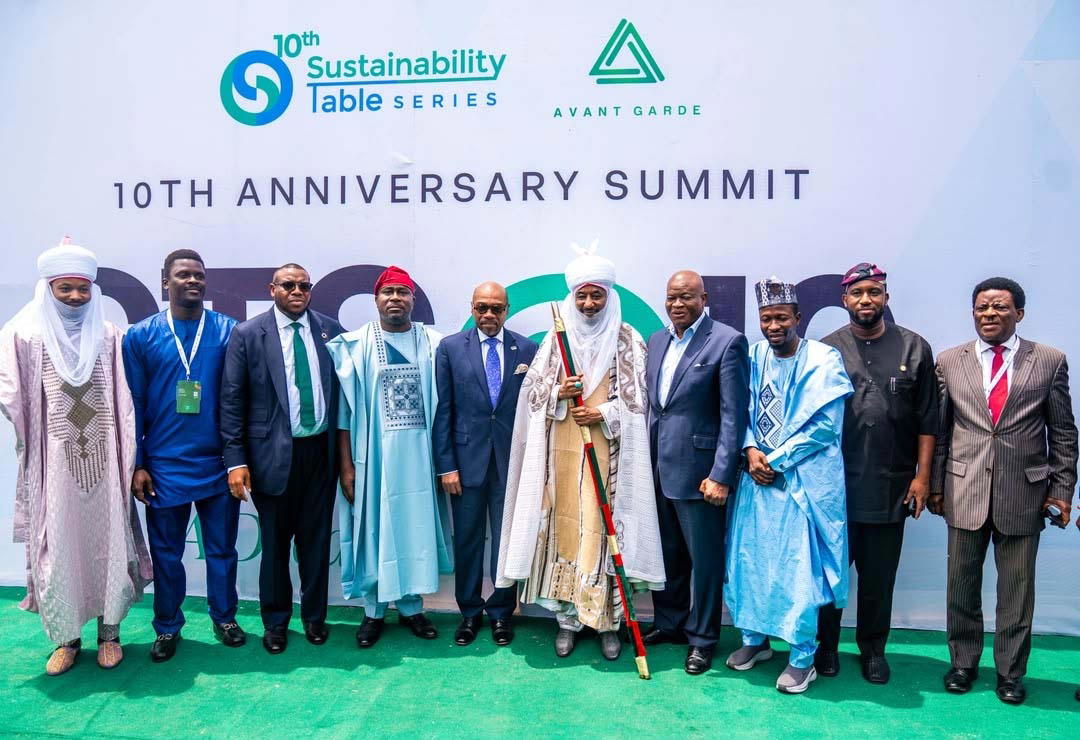
Leaders from government, business and civil society gathered in Lagos for the Sustainable Table series, which has now run for ten years. They left with one instruction: the time for conversation has ended, and the time for delivery has begun.
The event, under the theme “Leading the Sustainable Development Agenda: People, Planet and Development”, brought together regulators, financiers, policymakers and entrepreneurs. Each speaker returned to the same question. What will be built, who will build it, and who will pay for it?
Kayode Olaniyan, Convener, sustainable Table series, said the decade had produced policy and now needed to produce results.
“It is ten years of conversation. It is now ten years of action,” he said.
He said the next stage is to move from knowledge to implementation and to direct capital into businesses that serve the environment, social goals and good governance. He named three priorities: energy, technology and food.
On energy, he pointed to gas, renewables and investment in infrastructure. On technology, he called for data centres and for investment in people who can run them. On food, he urged work on storage, a cut in post-harvest losses and lower food prices, so that every Nigerian can afford to eat.
Four years remain until the 2030 deadline for the Sustainable Development Goals. Olaniyan said that even if every target is not met, the country must make a mark by moving capital and investment towards them.
Oreoluwa Finnih, Special Adviser to the Governor of Lagos State on Sustainable Development Goals, spoke for the state and praised the Avantgarde Sustainability Foundation for keeping the platform alive for a decade.
She said the 2026 Lagos budget stands at ₦4.4 trillion, with ₦2.338 trillion set aside for capital projects. The Lagos Education Access Fund is in use and aims to reach more than 200,000 children within three years.
Finnih said the state is responding to flooding, waste and the pressure of a growing population. The Ministry of Environment and Water Resources maintains drainage channels covering 76 kilometres across 18 routes, together with 178 kilometres of further drains. It has removed 1,544 structures that blocked the flow of water.
On trees, the state had planted 13,401 by 30 June, which is 67 per cent of its target of 20,000. All 57 local governments and local council development areas must now care for those trees for at least 12 months.
She said waste can create work. The EcoSea biodigester plant turns organic waste into electricity, cooking gas and fertiliser. According to the Lagos State Waste Management Authority, recycling companies in the state have grown from three to 78 and have created more than 6,000 jobs. The 2026 budget gives ₦112 billion to energy and power, so that businesses lose less time to outages. In 2025, Lagos attracted about ₦1 trillion in investment.
Finnih asked each group in the room to act. She asked businesses to place sustainability inside their plans, financiers to back projects that can be trusted, and innovators to build solutions that fit the lives of residents.
“What is not measured is not done,” she said.
She added that declarations will not build the future. “It will be built through decisions, investment, institutions and a willingness to work together,” she said.
H.H. Muhammadu Sanusi II, the Emir of Kano, gave the keynote address. He said the central problem for Africa is not a lack of resources, policy or capital. It is the failure to turn plans, spending and investment into productive capacity, institutions that work and prosperity that people share.
“The next decade must be judged by delivery, not by declarations,” he said.
He said a budget shows what a government values. “A budget is more than an accounting document. It is a statement of priorities and a record of choices,” he said. He told the audience that Nigeria now spends more than 100 per cent of its revenue on debt service, and he warned that this leaves little room for schools, clinics, farm support and roads.
Sanusi said infrastructure must be judged by what it does for people, not by how many projects are opened. He told of a visit to Abuja by the then World Bank President, Paul Wolfowitz. A man from Kogi State rose to speak. He said a stream runs beside his village and has no bridge, and he can reach Abuja only in the dry season, when he walks through the water. In Abuja, he said, he saw many bridges and no water.
“For a fraction of the money we spend on flyovers and underpasses, we could link many of those people to markets, to healthcare and to schools,” Sanusi said. “Development is about the people out there whom we do not see.”
He used the Azura power plant to show how systems fail when they are planned in parts. The plant added about 350 megawatts to the grid. Nigeria signed the agreements and secured the guarantee, but in the three years of construction nobody planned how to carry the power or which industries would use it. Because the contract required payment for the power whether or not it was used, the plant almost bankrupted the country in its first years.
“You are going to produce 1,000 megawatts. Where are those electrons going? You need to know from the beginning,” he said.
On food, he said that when the removal of subsidies pushed prices up, the government opened the market to imports, including rice from Thailand. Prices fell, but rice mills closed and loans to farmers turned bad. He said cheap food for the poor is a fair aim, but imports weaken the production that a country needs in the long run.
“We cannot keep importing food from Thailand, India and China. We have to produce food ourselves,” he said.
Sanusi then turned to children. He said more than 50 per cent of children under five in Kano are malnourished, and about 40 per cent of women of childbearing age are anaemic. He said the state counts the damage after it has happened.
“A child whose brain has not formed properly cannot give the country what it needs from its people,” he said. “It begins from conception. We must be there when a woman is pregnant, and we must stay until the baby is born.”
He spoke of education and of artificial intelligence. Sanusi said he is studying law and sits in class at the age of his teachers. He said he first took a 200-level economics course in 1978, took another in Sudan in 1991, and sits in a 200-level class again in 2025, when classmates can ask a machine to write their essays.
“Technology should raise your productivity. It should not replace your ability to think,” he said. He warned that Africa risks buying technology without owning it, and that this is the gap between growth and development.
Innocent Barikor, Director General and Chief Executive Officer of the National Environmental Standards and Regulations Enforcement Agency (NESREA), described the work of the agency. It enforces rules and programmes on the environment and carries out the treaties and conventions that Nigeria has signed.
Barikor said the agency has made rules on noise, plastic and batteries, because standards are needed to measure results. He said he could not score the agency himself, but that it has done what it can.
He named a gap in the rules for solar panels. As more households and businesses generate their own power, panels and related equipment will reach the end of their life. He said NESREA is preparing a regulation, with help from international organisations, to deal with that waste. He said the rule will also open business opportunities for youth.
On plastic, Barikor said the country should favour reusable bottles over disposable ones that end up on roads. He said alternatives must exist before limits begin.
Disclaimer
Comments expressed here do not reflect the opinions of Vanguard newspapers or any employee thereof.