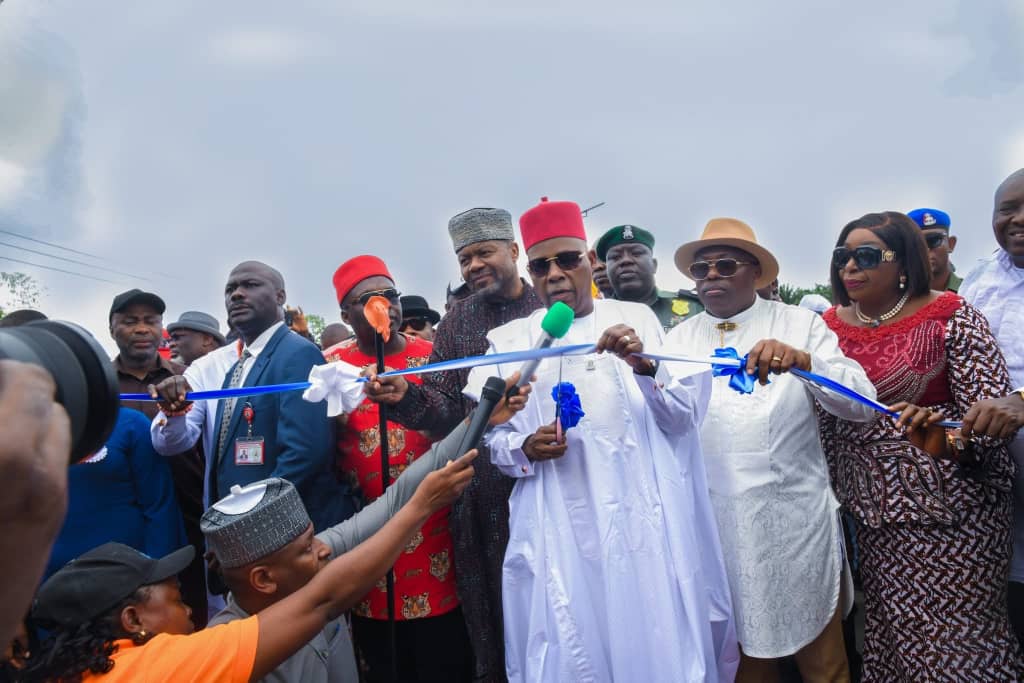
The Vice President, Senator Kashim Shettima and Governor Fubara inaugurate the 33km Elele–Egebeda–Omoku Dual Carriage Road, connecting Ikwerre, Emohua and Ogba/Egbema/Ndoni LGAs.
By Ibisaki Wills
The true measure of government is not the volume of promises it makes, but the value of the results it delivers to the people.
The Nigerian Constitution provides a clear compass for governance when it declares that the security and welfare of the people shall be the primary purpose of government.
Government therefore exists to protect lives and property and to provide the essential services that give citizens dignity and opportunity — quality healthcare, education, housing, roads and other critical infrastructure.
This is the philosophy Governor Siminalayi Fubara has projected since assuming office as Governor of Rivers State. For him, governance should not be reduced to political theatre, propaganda or the accumulation of power.
It should be about putting public resources to work for the public good and ensuring that citizens can feel the impact of government in their communities.
That philosophy came into sharp focus between August 17 and August 28, 2026, when Rivers State witnessed an extraordinary succession of project inaugurations across several local government areas.
For two weeks, roads, bridges, hospitals, schools and strategic security infrastructure became the language of government. Rather than engage critics in endless political exchanges, the Fubara administration allowed completed projects to make the argument.
For years, naysayers had maintained that there was no governance in Rivers State. They criticised the administration and questioned its capacity to deliver amid its political and administrative challenges.
But between August 17 and 28, the response came not through rhetoric, but through concrete, asphalt, bridges, hospitals, classrooms and other infrastructure.
From the riverine communities of Kalabari and Bonny to Obio/Akpor, Etche, Ikwerre, Emohua and Ogba/Egbema/Ndoni, the administration unveiled projects cutting across roads, healthcare, education, aviation and security.
The inauguration of the 19.79-kilometre Buguma-Degema-Abonnema Road was particularly significant. Traversing Asari-Toru, Degema and Akuku-Toru Local Government Areas, the project included the rehabilitation of seven bridges, drainage facilities, culverts, streetlights, walkways and other ancillary infrastructure.
For the Kalabari people, it was more than a road. It represented the fulfilment of a promise. Governor Fubara recalled how the deplorable condition of the road embarrassed him during a visit to the area and prompted his determination to change the narrative.
The completed project has now transformed a once-notorious corridor, where criminal activities reportedly flourished amid bad roads and overgrown vegetation, into a safer and more accessible route.
The Governor has also indicated that the intervention is part of a wider development vision for the riverine axis, including sustained attention to the ambitious Trans-Kalabari Road.
In Etche Local Government Area, the 12.1-kilometre Egwi-Afara-Mba Road tells a similar story. Awarded during one of the most difficult periods of the administration, the project demonstrated the Governor’s insistence that political challenges should not become an excuse for abandoning development.
Its completion has improved connectivity to Okehi, the Etche Local Government headquarters, and strengthened economic and social interaction among communities.
But the administration’s agenda extends beyond roads. Governor Fubara has also assured Etche and neighbouring Omuma Local Government Area of a standard medical hospital before the end of his tenure. It is a reminder that development is a continuous responsibility rather than a collection of isolated projects.
At the Captain Elechi Amadi Polytechnic, Rumuola, the inauguration of the Entrepreneurship Centre, Engineering Faculty Building and Governing Council Building further demonstrated the administration’s investment in human capital.
The message is straightforward: education should produce more than certificate holders. It should equip young people with practical skills, entrepreneurial capacity and the ability to create opportunities for themselves and others.
At a time when technology and automation are rapidly reshaping the global economy, infrastructure that supports innovation and technical education is an investment in Rivers State’s future.
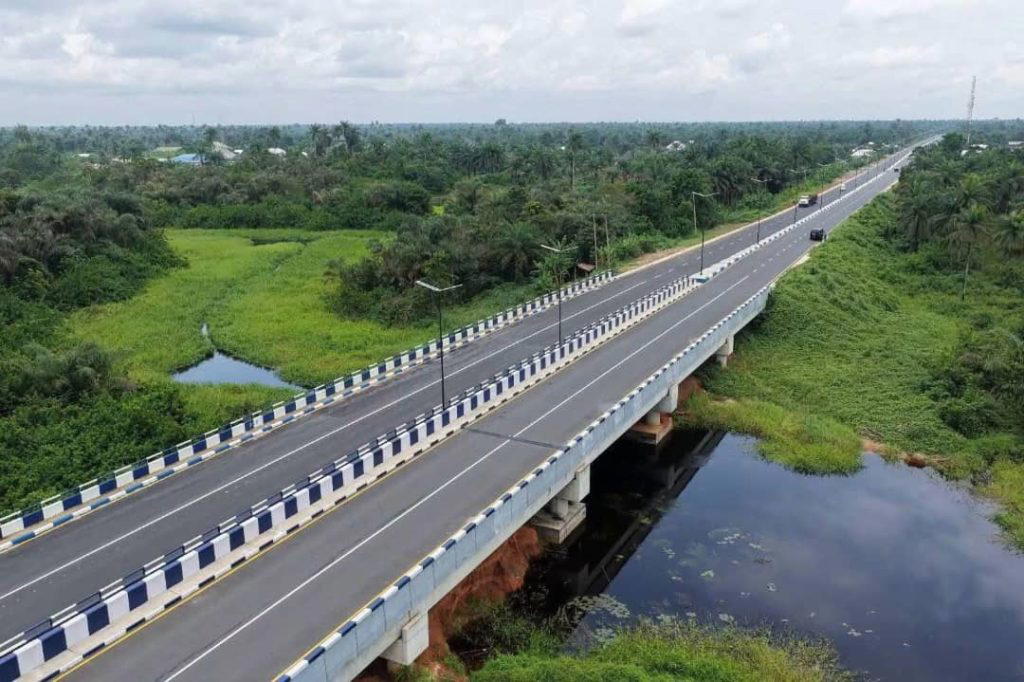
Perhaps one of the strongest responses to the naysayers came with the reconstruction of the 33.5-kilometre Elele-Egbeda-Omoku Dual Carriageway across Ikwerre, Emohua and Ogba/Egbema/Ndoni Local Government Areas.
For years, the corridor had been associated with insecurity, including kidnapping and illegal bunkering. Its poor condition created opportunities for criminals to operate.
The reconstructed dual carriageway, complemented by bridges, drainage facilities and streetlights, is expected to improve mobility, stimulate commerce and strengthen security. It is therefore not simply a road; it is an economic and security corridor.
In the health sector, the inauguration of the 105-bed Zonal Hospital in Omoku represents another significant intervention. Strategically located in the Orashi region and within Rivers State’s oil and gas belt, the facility will improve access to healthcare for residents of Omoku, Egbema, Ndoni and neighbouring communities.
The remodeled Neuro-Psychiatric Hospital and newly constructed General Hospital at Rumuigbo in Obio/Akpor add another dimension to the administration’s healthcare agenda.
The transformation of the facilities is significant not merely because of the buildings and equipment, but because of the opportunity to improve psychiatric care, rehabilitation and secondary healthcare. The project also provides an opportunity to confront the stigma associated with mental health and substance-abuse challenges.
Another striking feature of the two-week inauguration was Governor Fubara’s decision to complete projects inherited from previous administrations.
The 14.5-kilometre Agba-Ndele Road and 240-metre bridge are examples.
The Governor acknowledged that the bridge was initiated by a previous administration but maintained that projects capable of benefiting the people should not be abandoned because of political differences. That position speaks to a broader principle of governance: public projects belong to the people, not to individual administrations.
The completed project now provides a critical link between communities in Emohua and Abua/Odual Local Government Areas, improves access to the East-West Road and reduces travel time. The State Government’s decision to commit additional resources to address damage to the bridge also suggests an interest in sustaining the infrastructure beyond the ceremonial commissioning.
In Omademe, Ikwerre Local Government Area, the inauguration of 8.6 kilometres of internal roads covering 10 roads, supported by extensive drainage infrastructure, brought development closer to residents at the community level.
It reinforced another important principle of governance: every administration has a responsibility to add value to what it inherits.
The Fubara administration also took its infrastructure intervention into the security arena with the reconstruction of the 2,135-metre runway and military aprons at the 115 Special Operations Group of the Nigerian Air Force, Port Harcourt.
For an oil-producing state with enormous economic importance to Nigeria, security is inseparable from development. Improved facilities for aerial operations, surveillance, reconnaissance and rapid response can strengthen efforts against crude oil theft, illegal refining, pipeline vandalism and other forms of organised crime.
Then came Bonny, where the remodeling of Bonny National Grammar School offered perhaps the most symbolic moment of the two-week project inauguration.
Governor Fubara said his administration had broken a longstanding cycle of political promises in the community.
Established in 1965, the historic institution had, according to him, witnessed years of promises from politicians and successive governments.
This time, however, the government returned not to make another promise, but to commission a completed project. That distinction matters. Promises may inspire hope, but completed projects create impact.
The Governor’s additional announcement of full educational support for Rivers students who excelled in the President Bola Ahmed Tinubu Inter-Secondary Schools Debate Championship further demonstrated the administration’s stated commitment to rewarding excellence.
Taken together, these projects provide a counter-narrative to the claim that nothing is happening in Rivers State.
More importantly, they demonstrate that governance can be communicated through results rather than political confrontation.
The significance of the two-week inauguration exercise therefore goes beyond the number of projects commissioned. It reflects an administration seeking to demonstrate that political challenges need not completely paralyse government.
Rather than surrender to distractions, Governor Fubara chose development. Rather than answer every critic with words, he allowed projects to speak. The roads, bridges, hospitals, schools and security infrastructure now scattered across Rivers State provide physical evidence of that choice.
Of course, commissioning projects is not the end of governance. Their durability, maintenance, effective utilisation and measurable impact on citizens will ultimately determine their long-term value. But the completion of infrastructure across diverse sectors and communities provides a basis upon which the administration’s performance can be judged.
The naysayers predicted stagnation; the projects represent movement. They questioned governance; the infrastructure provides something tangible to examine. They expected political distractions to overwhelm development; the administration has attempted to put development at the centre of its response.
Ultimately, leadership is not defined only by the battles fought while in office, but by the footprints left behind.
Across Rivers State, those footprints are increasingly visible — on roads and bridges, in hospitals and schools, and in infrastructure designed to strengthen security and economic activity.
When the history of the Siminalayi Fubara administration is eventually written, the political controversies of its era will certainly form part of the story. But so too will the roads, bridges, hospitals, educational facilities and strategic infrastructure delivered during its tenure.
And perhaps that is the most compelling response to the naysayers: not more arguments, but more evidence.
Ibisaki Wills, Radio Nigeria’s Correspondent covering Rivers State Government House, writes from Port Harcourt.
Disclaimer
Comments expressed here do not reflect the opinions of Vanguard newspapers or any employee thereof.