By Jimitota Onoyume
Chairman of the Niger Delta Development Commission, NDDC, Chiedu Ebie says the commission has adopted a new standard operating procedure (SOP) and governance advisory policies, approved by the Governing Board to smoothen its operations.
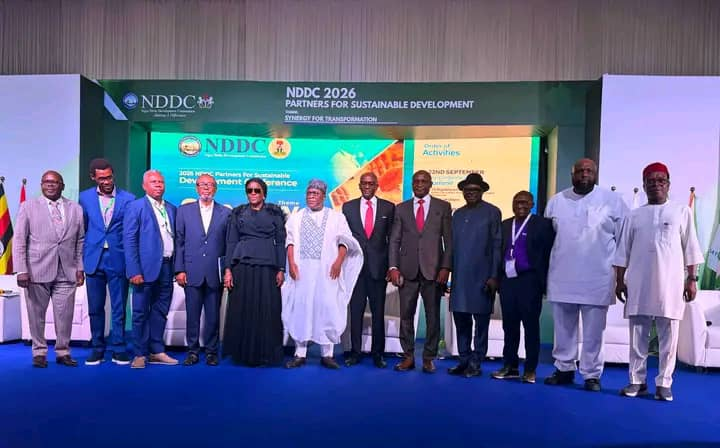
He disclosed this during the NDDC’s Partners for Sustainable Development (PSD) conference in Port Harcourt, Rivers state that brought together a broad spectrum of stakeholders under the theme, “Synergy for Transformation: Aligning Regional Development, Local Governance and Sustainable Partnership in the Niger Delta.”
Media aide to the Chairman of the commission, Jerome Utomi, in a statement titled “NDDC Partnership Drive: Ebie, Ogbuku and the Push for a More Coordinated Niger Delta”, captured several highlights from the conference. It reads
“The development challenges confronting the Niger Delta have never been solely about the availability of resources. They have also been about coordination, institutional relationships, continuity and the ability of different stakeholders to work towards shared objectives.
“It was against this background that the Niger Delta Development Commission (NDDC) convened its 2026 Partners for Sustainable Development (PSD) Conference in Port Harcourt, bringing together a broad spectrum of stakeholders under the theme, “Synergy for Transformation: Aligning Regional Development, Local Governance and Sustainable Partnership in the Niger Delta.
“More than a gathering of government officials and development actors, the conference represented an important conversation about how the region can move from fragmented interventions to a more coordinated development framework.
“At the centre of this conversation were the NDDC Governing Board Chairman, Barrister Chiedu Ebie, and the Commission’s Managing Director, Dr. Samuel Ogbuku, whose contributions reflected two complementary dimensions of institutional development: strengthening the systems within the Commission while building partnerships beyond it.
“For Ebie, the emphasis was on institutional discipline, governance and the establishment of clear operational rules capable of guiding the Commission’s activities. He disclosed that the NDDC had adopted a new Standard Operating Procedure (SOP) and Governance Advisory Policies, approved by the Governing Board.
“According to him, these instruments would constitute the Commission’s “Rule Book” and guide its processes and operations. The significance of this intervention extends beyond administrative procedure. A regional development institution dealing with complex infrastructure, environmental, economic and social challenges requires systems that provide consistency, accountability and institutional continuity.
“By placing emphasis on a defined SOP and governance framework, the Governing Board is seeking to strengthen the institutional architecture through which projects and programmes are conceived, approved and implemented.
“Ebie’s contribution therefore fitted naturally into the central theme of the conference. Sustainable partnership requires trust, and institutional trust is strengthened when stakeholders can see clear processes, responsibilities and standards guiding public institutions.
“The Board Chairman’s position also complements the broader oversight role of the NDDC Governing Board. The conference featured discussions on accountability, transparency and effective project delivery, issues that are essential to maintaining confidence among government institutions, development partners, communities and other stakeholders.
“While Ebie focused significantly on the institutional framework, Ogbuku brought the perspective of implementation and stakeholder engagement to the centre of the discussion.
“The NDDC Managing Director stressed that the Commission could not effectively plan development programmes for the Niger Delta without involving the people and institutions whose interests and responsibilities are directly connected to those programmes.
“His argument was straightforward: development interventions are more meaningful when stakeholders participate in the process from the foundation.
“Ogbuku described stakeholder engagement as one of the important elements of the Federal Government’s development agenda, explaining that engagement helps ensure that government projects and activities are understood by the people and creates room for synergy.
“That philosophy was evident in the structure of the PSD Conference itself. Representatives of state governments, the National Assembly, traditional institutions, development organisations, the private sector and other stakeholders were brought together to discuss the region’s development priorities.
“For the NDDC’S Managing Director, such engagement provides an opportunity not only to explain what the Commission is doing, but also to listen, identify areas of convergence and mobilise collective resources and expertise.
“He stated that the NDDC’s objective was to foster partnerships that would enable stakeholders to leverage their collective strengths, overcome challenges and avoid working at cross-purposes.
“This emphasis on collaboration is particularly relevant to a region where development responsibilities frequently overlap among federal agencies, state governments, local authorities, development commissions, communities and private-sector actors.
“The conference also provided a platform for Ogbuku to highlight major infrastructure ambitions of the Commission. Among them was the 1.2-kilometre Kaa-Ataba Bridge linking Khana and Andoni Local Government Areas of Rivers State, which he announced would be named after President Bola Ahmed Tinubu.
“Such projects illustrate the practical dimension of the partnership agenda: translating institutional planning and stakeholder engagement into infrastructure capable of connecting communities and expanding economic opportunities.
“Ogbuku also pointed to efforts to strengthen the Commission’s internal governance processes, noting that KPMG had reviewed its processes as part of efforts to reinforce corporate governance. He said the Commission had established a structure anchored on accountability and transparency, with measurable Key Performance Indicators to track progress towards its goals.
“The convergence of Ebie’s governance-focused approach and Ogbuku’s partnership-driven management philosophy is significant.
“Institutional reforms provide the framework within which an organisation operates, while stakeholder engagement creates the external relationships required to make development interventions more responsive and sustainable. Neither dimension can easily deliver lasting regional transformation in isolation.
“The message from the 2026 PSD Conference was therefore broader than the need for more projects. It was a call for better coordination of the institutions, resources and people responsible for delivering development across the Niger Delta.
“The Minister of Regional Development, Engr. Abubakar Momoh, reinforced this position by urging regional development commissions to produce master plans that could be harmonised into a broader regional development framework. He commended the NDDC’s master-planning initiative and stressed the importance of coordinated and inclusive development.
“Ultimately, the value of the conference will be measured by what happens after the speeches and deliberations. Partnerships must produce concrete programmes; master plans must guide implementation; governance frameworks must be respected; and projects must deliver measurable benefits to communities.
“The 2026 PSD Conference nevertheless demonstrated a clear institutional direction within the NDDC. Under Ebie’s leadership of the Governing Board and Ogbuku’s management of the Commission, governance, stakeholder engagement and coordinated development were presented not as separate priorities but as interconnected requirements for regional transformation.
“For a Niger Delta seeking sustainable development, that convergence could prove important: stronger institutions providing the discipline, wider partnerships providing the collective strength, and coordinated implementation turning plans into tangible results.”
#
Disclaimer
Comments expressed here do not reflect the opinions of Vanguard newspapers or any employee thereof.