…Ex-Army chief advocates intelligence-led approach to Nigeria’s security challenges
By Ibrahim Hassan-Wuyo
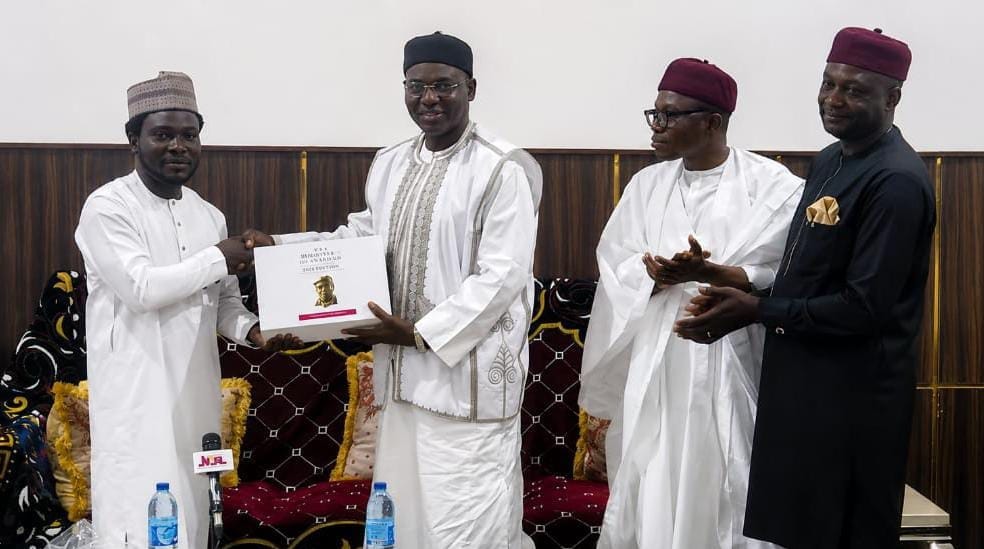
A group of Nigerian academics and security researchers has honoured former Chief of Army Staff (COAS), Lt. Gen. Tukur Yusufu Buratai (retd.), CFR, with a scholarly publication examining the relationship between defence, intelligence and statecraft in Nigeria.
The nine-chapter book, titled “Defence, Intelligence and Statecraft: A Festschrift for Lieutenant General T.Y. Buratai, Rtd, CFR,” was presented to the former Army chief during a courtesy visit on Friday by the scholars, led by Associate Professor Sunday Adejoh and Dr. M.S. Abubakar.
The publication brings together contributions from academics, policy practitioners and senior security professionals on contemporary defence, intelligence and national security governance in Nigeria and beyond.
According to the editors, the book was conceived not only as an academic contribution to security studies but also as a scholarly tribute to Buratai’s military career, strategic leadership, institutional reforms and contributions to Nigeria’s national security architecture.
The contributors examined issues including intelligence foundations, Nigeria’s national security architecture, civil-military relations, strategic decision-making, inter-agency cooperation, defence intelligence and emerging technologies.
Other areas covered include capacity building, professionalism within the intelligence community and the changing global security environment.
Speaking during the presentation, Adejoh said the decision to dedicate the publication to Buratai was informed by his contributions to defence, intelligence and national security.
He said the initiative was intended to document the retired general’s experiences and contributions for present and future generations.
“Your experiences, your contributions, both at the strategic, at the tactical, and at the operational level, cannot really be overemphasized,” Adejoh said.
He noted that Buratai’s military career demonstrated the importance of intelligence to military leadership, resource management and national security decision-making, adding that his subsequent diplomatic service as Nigeria’s ambassador also reflected the statecraft dimension of his career.
Adejoh also cited structural changes undertaken in the Nigerian Army during Buratai’s tenure as COAS, including the establishment of new formations and forward operating bases in response to emerging security threats.
He said scholars from different parts of the country contributed to the volume to ensure diversity of perspectives.
“It is important to honour you while you are still alive. It is important that we honour you and put this down, that it will stand even above and ahead of you. Posterity will live to consult this masterpiece,” he said.
Also speaking, Abubakar said his involvement in the project was influenced by his interactions with Buratai and the knowledge he acquired from the retired general in military studies.
The scholar, who holds a doctorate in military studies, said the book was not intended as an exercise in flattery but as an intellectual effort to document contributions considered worthy of scholarly attention.
He said academics had a responsibility to identify, interrogate and document significant contributions to national development and security for the benefit of future generations.
Buratai Advocates Intelligence-Led Security
Responding, Buratai commended the editors and contributors for the initiative, describing research and intellectual development as important to strengthening national security.
The former Army chief, who said he had yet to read the entire publication but had studied its synopsis, advocated greater reliance on intelligence-driven strategies in tackling Nigeria’s security challenges.
He said the country must move beyond an overwhelmingly kinetic approach to security by strengthening intelligence gathering, analysis and utilisation across the national security architecture.
According to him, intelligence should be effectively integrated into military and civilian security operations at the tactical, operational and strategic levels.
Buratai said adequate investment in intelligence could enable security agencies to detect threats at their formative stages and prevent them from escalating into major security crises.
He further stressed the connection between defence, intelligence and statecraft, describing the three as fundamental to the effective management of people and resources.
The retired general said intelligence involved understanding intentions through careful observation of behaviour, relationships and evolving circumstances, adding that the principle applied from the family and community level to institutions and the state.
Buratai recommended the publication as teaching and reference material for military and security institutions, including the Nigerian Defence Academy, National Defence College and Armed Forces Command and Staff College.
He also said the book could benefit security and intelligence agencies, policymakers, researchers and students of defence and security studies.
The former COAS pledged continued support for scholarly initiatives capable of contributing to the development of Nigeria’s defence, intelligence and national security architecture.
The editors said beyond its commemorative purpose, the publication was designed to contribute to scholarship, policymaking and professional practice at a time Nigeria and other African countries were confronting increasingly complex security threats.
They said the book was expected to serve as a reference for policymakers, military and intelligence professionals, academics, researchers and students seeking deeper understanding of intelligence, defence strategy, national security and statecraft.
Disclaimer
Comments expressed here do not reflect the opinions of Vanguard newspapers or any employee thereof.