By Chioma Obinna
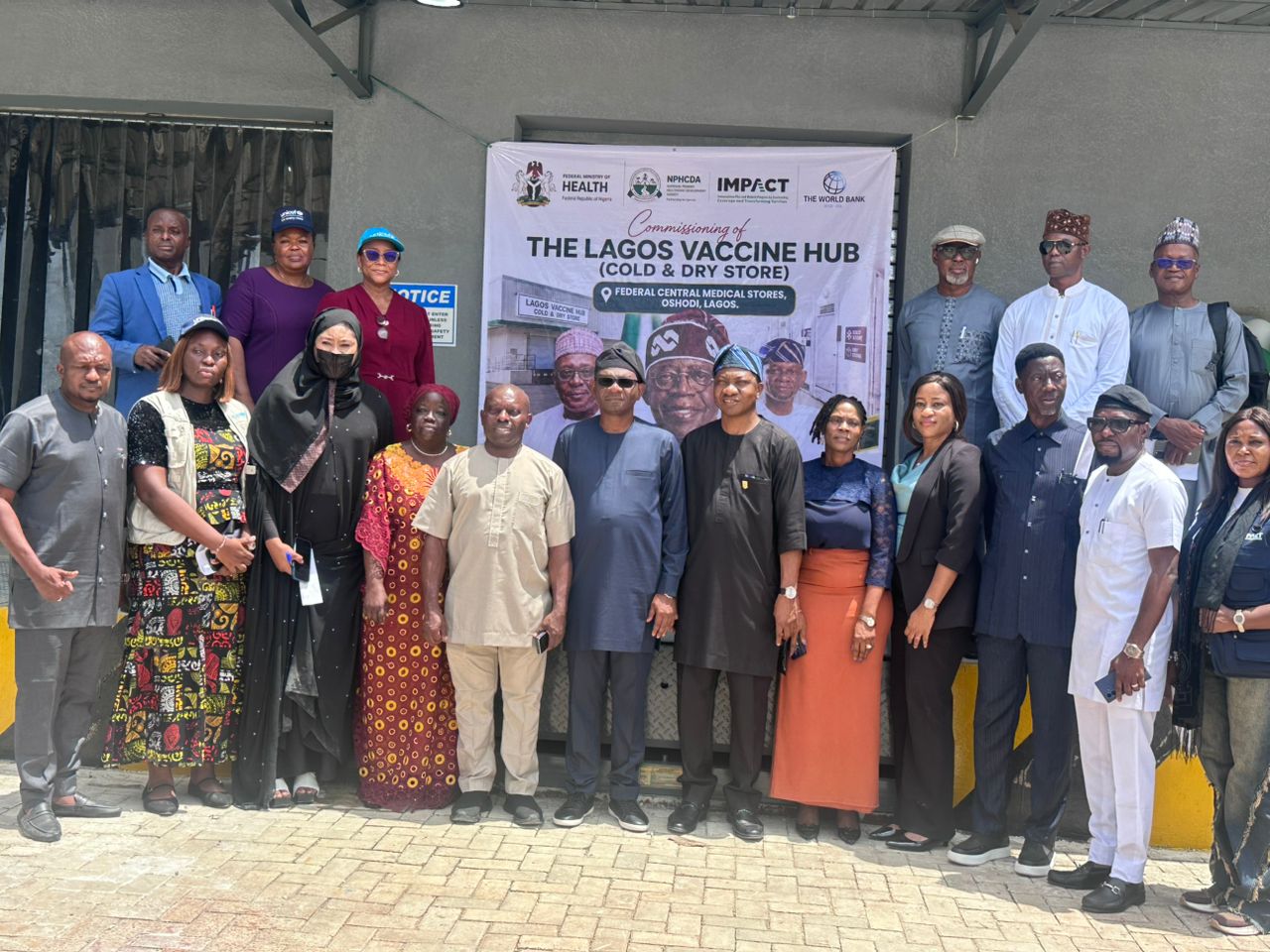
President Bola Ahmed Tinubu on Friday commissioned a massive Lagos Cold and Dry Storage Hub expected to serve more than 90 million Nigerians by 2035, marking a major overhaul of the country’s vaccine distribution system.
The facility, commissioned at the Federal Central Medical Stores, Oshodi, Lagos, and described as the first of three national vaccine megastores, is expected to strengthen immunisation delivery, reduce vaccine stock-outs, improve emergency response capacity, and expand access to potent vaccines across the South-West and South-South regions.
Representing the President, Executive Director, and Chief Executive Officer of the National Primary Health Care Development Agency, Dr. Muyi Aina, described the project as “the Renewed Hope Agenda in action,” saying the facility would strengthen Nigeria’s ability to preserve and distribute life-saving vaccines efficiently.
“What stands at Oshodi today is not simply a warehouse. It is the first permanent proof that Nigeria can build the cold chain infrastructure its population deserves,” Aina said.
“For many years, Nigeria’s vaccine supply chain depended on one National Strategic Cold Store and six zonal stores, a structure that could no longer adequately serve our growing population and expanding immunisation needs.”
He said the Lagos hub, funded through the World Bank-supported IMPACT Project, would function as the primary vaccine storage and distribution centre for 12 states across the South-West and South-South zones.
According to him, the facility is strategically located eight kilometres from the Murtala Muhammed International Airport and 16 kilometres from Apapa Port to fast-track vaccine importation, storage, and nationwide distribution.
Aina disclosed that the project also includes a 10 per cent emergency contingency buffer for supplemental immunisation campaigns and outbreak response operations.
“When completed alongside the Abuja and Kano hubs, Nigeria will have a modern vaccine distribution network built for the future to ensure every Nigerian child, regardless of location, has access to safe and potent vaccines,” he said.
Giving an overview of the project, Dr. Amina Abdul-One Mohammed said the Lagos hub was conceived after the Federal Government identified major weaknesses in Nigeria’s old vaccine supply chain, which had become overstretched by rapid population growth, expanding immunisation demands, and the complexity of reaching communities across the country.
She explained that the government, in partnership with the World Bank under the IMPACT Project, adopted a new Three-Hub Immunisation Supply Chain Model with Lagos, Abuja, and Kano designated as regional megastores to decentralise vaccine storage and improve speed, reliability, and nationwide access to vaccines.
The hub contains 15,312 cubic metres of dry storage capacity and 1,152 cubic metres of cold and freezer storage spread across six specialised temperature-controlled rooms equipped with WHO-compliant technology.
In the welcome address, the Director, of Logistics at the National Primary Health Care Development Agency, Pharm. Hawa Tense, described the facility as a strong statement of Nigeria’s commitment to reaching every child with life-saving vaccines, saying the project, supported by the Federal Government and the World Bank under the IMPACT Project, was designed to serve more than 90 million Nigerians across the South-West and South-South regions up to 2035 while also functioning as a model for the Abuja and Kano hubs expected to follow.
The facility took about five years to complete after construction began in 2021 under the Nigeria Polio Eradication Support Project before transitioning into the broader IMPACT Project.
Speaking at the ceremony, UNICEF Vaccine Cold Chain Logistics Consultant, Emediong Ekere, said the project would strengthen vaccine availability from the national level down to local health facilities.
“This impact will be felt across health centres, LGA cold stores and all health facilities where immunisation services are provided,” Ekere said.
“The warehouse has been equipped with pharma-grade solutions and state-of-the-art warehouse management systems that will optimise vaccine storage and distribution across Nigeria.”
Also speaking, Gavi representative, Mrs. Maureen Ugochukwu, said the project represented more than infrastructure, stressing that it would directly determine whether children receive potent vaccines on time.
“Behind every cold room, every pallet, every door you will see today, there is a child somewhere in Nigeria who will receive a potent vaccine because of the work done here today,” she said.
She noted that the facility would support efforts to tackle Nigeria’s huge burden of zero-dose children, especially in underserved communities.
In his remarks, Permanent Secretary of the Lagos State Primary Health Care Board, Dr. Mustafa Ibrahim, described the project as a major boost to Nigeria’s public health infrastructure but warned that Lagos still carries one of the highest burdens of zero-dose children on the continent.
“Lagos State remains fully committed to supporting initiatives that improve healthcare access and health outcomes for our people,” he said.
“We welcome more investments and stronger collaboration to reduce the number of zero-dose children because Lagos cannot do it alone.”
The Federal Government said construction of the Abuja hub is already ongoing while work on the Kano hub is expected to commence later this year.
Disclaimer
Comments expressed here do not reflect the opinions of Vanguard newspapers or any employee thereof.