By Chukwuma Ajakah
LEGACY announces itself into Lagos like weather breaking after weeks of humidity—charged, inevitable, impossible to ignore. Opening at 1952 Africa Gallery, the exhibition gathers former winners of the Life In My City Art Festival (LIMCAF), the long-running platform that has scouted and nurtured Nigeria’s emerging artistic voices since 2007.
The exhibiting artists – Abiodun Emmanuel, Adebayo Ebenezer Seun, Chibuike Ifedilichukwu, Chichetam Okoronta, Edward Samuel, Ejiofor Samson, Eweje Emmanuel, Eze Mariagoretti Chinenye, Ezichi Nkwocha, Ibrahim Afegbu, Idowu Abayomi, Ijiko Kelvin, Izuchukwu Muoneme, Klaranze Okhide, Lucky Ezah, Mayi Theophilus, Mbaeri Stephen, Motorola John, Ngozi-Omeje Ezema, Nnamdi Udoka, Okechukwu Eze, Olayemi Sunday Opeyemi, Onyinye Ezennia, Oryina Priscilla, Paul Emenike, Popoola Nurudeen, Segun Victor Owolabi, and Shade Fagorusi – stand neither as prodigies nor protégés; they stand as agents, each with a practice honed in the crucible of years between their early prizes and today. Their works carry the residue of that journey: experiments abandoned and reclaimed, failures turned into raw material, moments of silence converted into form.
Consider Ngozi-Omeje Ezema, whose sculptural installations have long unsettled the tidy categories of ceramics. In LEGACY, she arrays her works like constellations: accumulations of clay vessels suspended in precarious balance, neither fixed nor free. Their gravity is palpable, yet so too is their flight. One is reminded not of fragility but of negotiation—the human effort of carrying multiple burdens while remaining upright. Ezema herself once noted that her process is “a way of listening to what clay wants to become.” That sensibility is everywhere here: the humility to yield, the courage to rearrange, the quiet suggestion that endurance is itself a form of invention.
Lucky Ezah operates at the opposite pole, his work hammered into being through metal and industrial residue. The surfaces glint with menace, evoking cities built too quickly and infrastructures corroding before they are even complete. But within these metallic forms is not despair; there is vitality, almost rhythm, as if the welded joints could burst into percussion. He reminds us that Nigeria’s detritus—discarded machines, rusting tools, the language of scrapyards—is not only evidence of collapse but also of adaptation. In Ezah’s hands, ruin does not end the story; it provides the next line.
The exhibition shifts register with Eze Mariagoretti Chinenye, who composes with paper and fabric as if assembling a family archive. Lace cuttings, photographic fragments, hand-tinted cloth all reappear in her works as reminders of lives often swept aside in official accounts. What is striking is her refusal to polish the edges: the seams remain visible, the textures unaligned, the colours slightly at odds. They speak of memory not as a polished heirloom but as something pieced together on kitchen tables, under low bulbs, with whatever scraps survive. If Ezah shouts in metal, Chinenye whispers in patchwork—but both are equally unflinching.
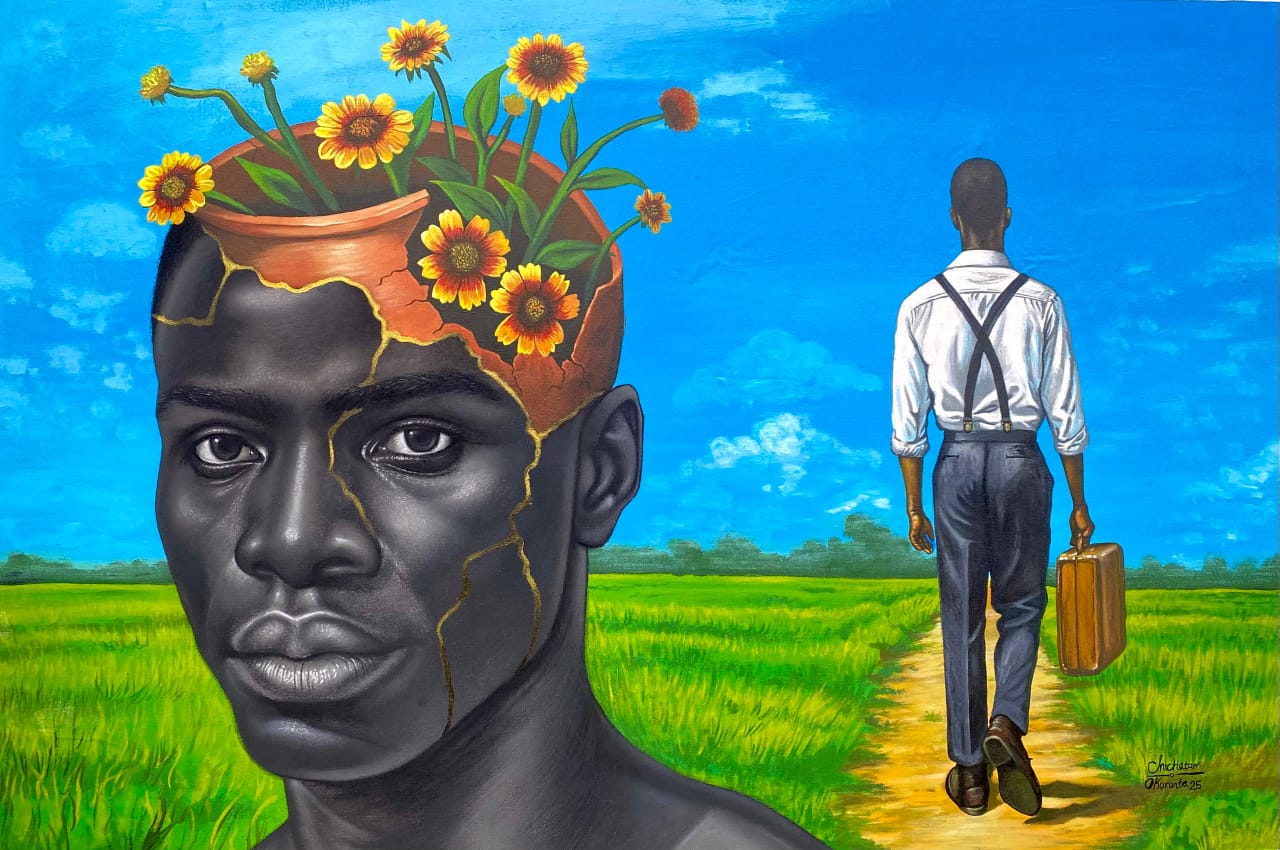
A different cadence runs through the practice of Chichetam Okoronta. His surfaces are dense, tactile, carrying the marks of chisels, stains, and relentless reworking. He has often described his method as “an argument with material,” and one senses that argument here: images emerging, vanishing, resurfacing, never entirely resolved. To view his pieces is to enter an unsettled field where certainty is impossible. That is precisely their force: they refuse finality, insisting instead that art is a place of perpetual unfinishedness.
Finally, Onyinye Ezennia threads her critique through textile, but she does so by manipulating the language of adornment. Bold colours, sinuous forms, and elaborate arrangements initially seduce, only for the viewer to realise that the surfaces cloak discomfort. Beneath their elegance lies an interrogation of expectations—what femininity is meant to display, what bodies are trained to carry, how garments shape identity as much as they decorate it. Ezennia’s practice thrives on this tension between allure and unease, wrapping protest in splendour.
What binds these artists together is not a single aesthetic, nor even a shared trajectory, but an attentiveness to what it means to keep making in Nigeria’s volatile landscape. Their works emerge less as objects than as negotiations: with memory, with ruin, with material scarcity, with cultural burden. LIMCAF gave them an early stage; LEGACY shows how they have learned to build their own stages, sometimes out of clay, sometimes out of rust, sometimes out of cloth.
Walking through the exhibition, one senses not a chorus but a polyphony, each artist stubbornly distinct yet resonant with the others. The gallery becomes a site of encounter rather than display: Ezema’s constellations hovering against Ezah’s metallic heft; Chinenye’s quiet collages conversing with Okoronta’s unsettled surfaces; Ezennia’s textile protests unfolding between them all. The result is less a smooth narrative than a charged field of crossings.
To call this show a “legacy” is therefore to misname it—deliberately so. Legacies are usually thought of as stable, as treasures passed down with a ribbon tied neatly around them. But here, legacy is restive. It is improvised, re-stitched, welded, broken open. It does not settle into inheritance but insists on movement. It demands labour, vigilance, imagination.
In this sense, LEGACY is not about looking backward but about articulating the urgency of now. It is about recognising that the past is never finished, that what was won in earlier festivals must continually be remade. For these artists, history is not a burden to carry but a raw material to be refashioned—sometimes carefully, sometimes violently, always with intent.
And perhaps that is the deeper wager of the exhibition: that legacy is not what one receives but what one dares to construct. It is not the echo of applause but the persistence of a voice that refuses silence. In the works gathered here, that voice does not whisper politely. It hums, clangs, clashes, insists. It asks us not to admire from a distance but to reckon, to respond, to enter the fray.
Disclaimer
Comments expressed here do not reflect the opinions of Vanguard newspapers or any employee thereof.